A warning from the boardroom: OPALCO’s departing board president sounds energy alarm; County Council members call for community engagement
Published 1:30 am Wednesday, April 29, 2026


It was supposed to be a retirement recognition.
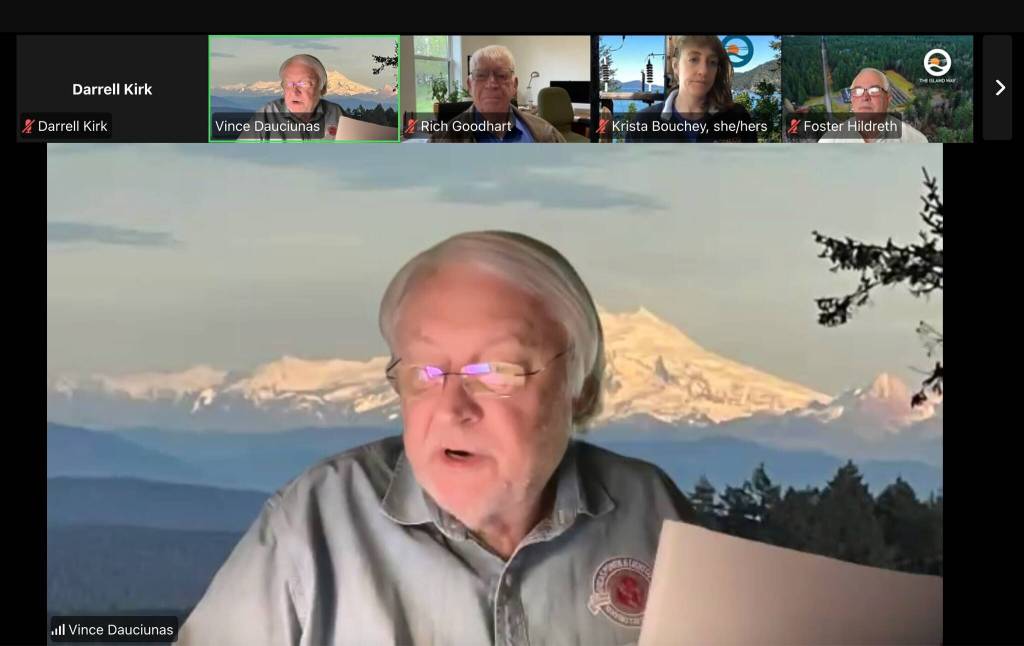
Instead, when outgoing OPALCO Board President Vince Dauciunas stood before the San Juan County Council on Monday, April 20, he delivered an 11-minute warning that the San Juan Islands are sleepwalking toward an electricity crisis of historic proportions.
“The information I’m going to present this morning is not available to you by reading the local times or local social media,” he told Council members. “It’s buried deep in obscure reports and websites and requires persistent digging to get to the nuggets. I’ve accumulated over 2,000 documents and 10 gigabytes of stuff since 2018.
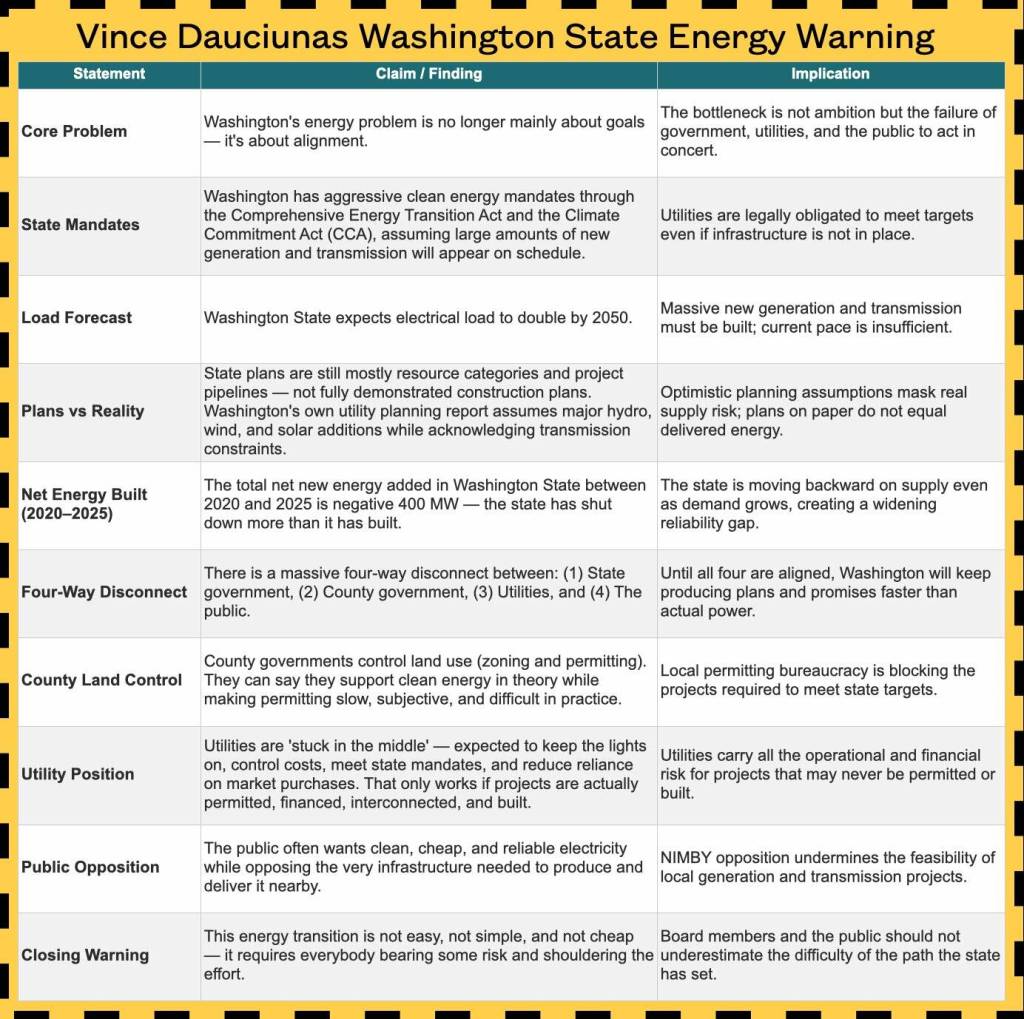
“The state has not created a credible pathway to permit and build what the law requires,” he said. Borrowing from “The Music Man”: “We’ve got trouble right here in River City, and far too many people think the band can tune up later.” His ask to the Council was direct: “Modify the code and policy barriers that block local generation, storage and grid facilities. Work with OPALCO as a planning partner and advocate at the state and federal level for the permitting, transmission and funding necessary to keep the county reliable.”
The Council reacts
Council member Kari McVeigh questioned the setting. “This was billed as a recognition of retirement for Vince, not a professor or a lecture,” she said. “So that’s a little surprising to me to hear that. I’m not sure that this is the right forum — which is not to say I don’t think conversations need to happen. I absolutely do think they need to happen.”
Her sharpest words were aimed squarely at OPALCO: “OPALCO needs to be open to a really strong and strenuous public engagement around these — not just telling them what to do, but actually listening to the fears and figuring out how we can mitigate against those.”
Council member Jane Fuller embraced the warning while calling for a change in approach.
“I’ve deeply appreciated the intellect that you bring to conversation about our future challenges,” she said. “I’ve seen the dissension just grow and grow and grow. We have to lean into meaningful collaborative dialogue in a way we haven’t before — finding solutions to diverging viewpoints and a pathway forward to achieve some meaningful goals.” Fuller said she would “welcome the opportunity to have a conversation with the board once those two new people are brought on board,” and was direct about what must follow: “I think it’s really important that we take stock of how we work differently together in the future, listening to our community.” Council Chair Justin Paulsen drew the starkest lesson: “Goals without policy is just hope. And we can’t continue to base our resiliency on hope.” He closed with a direct appeal to Olympia: “We have a county that is ready and willing and wants to build resiliency. We need the state to give us the ability to do that. We can’t do it on the backs of just the residents here.”
The project behind the warning
The backdrop is a bitterly contested $5.53 million solar expansion on Decatur Island — 4,450 panels, 2,883,091 kWh annually, clearing approximately 8 acres of second-growth forest. The board voted 5-2 on April 21 to proceed while awaiting a Conditional Use Permit ruling, stopping well short of the project cancellation opponents demanded.
The case against this project
Bill Hurley — Decatur Island resident, retired professional engineer and 20-year offshore wind veteran who conducted techno-economic studies for the U.S. Department of Energy — put the financial case plainly: At 16.5 cents per kilowatt-hour, the project costs more than twice what OPALCO pays the Bonneville Power Administration, and “adds only one percent to the county demand — hence does not improve reliability.” Days before the board vote, Hurley and fellow Decatur resident Dawni Cunnington co-presented a formal slide presentation to the board — some of the sharpest criticism the project has faced. “We are not opposed to solar,” Cunnington told the board. “We are opposed to spending co-op money to clear-cut environmentally protected land in order to install solar panels that will be shaded on four sides by tall trees and second-growth forest.” She charged that “management raced to spend co-op funds on a parcel without even a normal feasibility period to determine if the site was suitable for this use,” adding that two recorded environmental deed restrictions “were evident on the title report prior to purchase — who doesn’t read their title report?” Hurley’s call to action: “Significant strategic thinking is still needed before we make a blanket endorsement of utility solar in the San Juan Islands.” His framework — Wrong Site, Wrong Island, Wrong Plan — no fire district, no paved roads, no ferry service, one ramp for all equipment.
Mark Mills, Manhattan Institute senior fellow, author of “The Bottomless Well” and founder of the National Center for Energy Analytics, was interviewed by the Islands’ Sounder. On solar’s suitability here: “From an engineering science perspective, the silliest place to put solar panels is in northern latitudes — each solar panel in Washington State harvests about half as much energy a year as an identical solar panel in New Mexico or Arizona.” His call to action was direct: “I would tell them to hold off and commission an engineering study from an unbiased source — not a climate-focused engineering firm, but an engineering firm that builds power systems for islands around the world.”
Todd Myers, vice president for research at the Washington Policy Center, spoke to the Islands’ Sounder in a separate interview. On the energy awareness gap and conservation: “If you ask somebody what a gallon of gas costs, they can tell you almost to the penny — if you ask them what a kilowatt hour costs, they don’t know. The utility has to be a partner and provide an incentive for people to change the way they use electricity, because if we just simply keep using lots of electricity during peak hours without thinking about it, the result is you’re going to end up having to build lots and lots of solar panels and other energy generation that are very expensive.” On solar panels specifically, Myers was equally direct: Solar generation peaks midday while household demand peaks in the morning and evening — meaning costly batteries are required to make it useful at all.
A community waiting for answers framed in data
Roz Soloman, a Decatur Island resident, put it plainly at a community town hall earlier in the year held at the Karen Lamb school on Decatur, which the Islands’ Sounder attended: “We need to look at everything — what the real cost of another [underwater] cable is, what BPA is really going to do, what the actual growth projections are, and what are the best energy generators for an area west of the Cascades where no one else is building solar.” Debbie Warren, also a Decatur Island resident and OPALCO member, addressed the board directly at the April 16 board meeting: “No business — no private business, no corporate business — would make such fundamental decisions without all the information.”
Dauciunas, in his final words as board president, named the deepest problem of all: “What troubles me most is not just the policy gap — it’s the awareness gap. I do not believe that state government, county governments, or the public have yet more than the vaguest notion of the scale of the problem now bearing down on us.”