County seeks voter approval for levy lid lift
Published 1:30 am Thursday, April 9, 2026
Decades of capped revenue, runaway inflation and a creative labor deal have left the County at a financial crossroads. San Juan County is asking voters to approve a property tax levy lid lift in the April 28 special election — a measure officials say is essential to preserving the public health, safety and community services that island residents depend on every day.
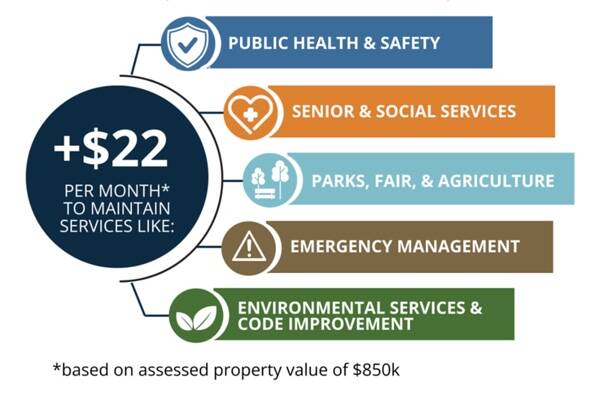
If passed, the levy would reset the county’s general property tax rate to $0.85 per $1,000 of assessed value, the same rate voters approved back in 2019. For the average homeowner in San Juan County — where the median assessed property value sits at $850,000 — that translates to roughly $22 more per month. In return, county officials say, residents would be funding the full range of services that make island life work: the Sheriff’s Office, public health programs, senior services like Meals on Wheels, emergency management, the Islands Oil Spill Association, County parks and Fair operations, 4-H youth programs, victim services and much more.
“Without revenue increases, San Juan County will face service cuts,” the County stated plainly in its levy information materials. Council member Kari McVeigh put it in starker terms at the Feb. 10 Council meeting, where the resolution was passed unanimously.” There is really literally nothing left to cut unless we get rid of almost all of our vital services or the level of services is reduced greatly,” she said. Council member Jane Fuller was equally direct: “We have to get this levy lid across the finish line.”
Current estimates indicate that if the measure fails, approximately $3.7 million in cuts will need to be made for the 2027 budget. If it passes, the levy is expected to generate approximately $4.5 million annually for the County’s general fund. Ballots will be mailed on April 7, and a simple majority — 50% plus one vote — is required to pass.
A law that was never built for this kind of inflation
To understand why San Juan County finds itself in this position, it helps to understand a quirk of Washington state law that Council Chair Justin Paulsen, in an interview with the Sounder, describes as “an experiment that’s still an experiment.”
Under state law, counties are limited to increasing their property tax levy collections by just 1% per year — unless voters approve a higher rate through a levy lid lift. The origins of that cap stretch back to a pair of citizen initiatives led by anti-tax activist Tim Eyman.
Before the cap existed, counties could raise their levies by up to 6% annually — but after years of Eyman-led initiatives, legal challenges and a dramatic one-day legislative special session in 2007, the 1% cap was written into law and has remained there ever since.
The problem, Paulsen says, is a structural mismatch between what governments can collect and what it costs to operate. “What it does is it forces our government entities to consistently go back out every so often and reset the base levy rate,” he said. Since 2019, inflation has risen north of 30% while the County collected just 1% annually. The result is a punishing cycle. “You go from 1% — 1% — 1% — and then it rebases by 50%,” he said. His preferred fix: “Property taxes can be increased by the rate of inflation or 3%, whichever is less.”
A shorter work week, a balanced budget
In what Paulsen recalls as “around 2023,” San Juan County was in contract negotiations with its unionized employees. The existing labor contract had expired, and the union came to the table with a clear ask, according to Paulsen: a 20% wage increase, reflecting the cumulative inflation their paychecks had failed to keep pace with over the life of their previous contract.
“The council was like, holy smokes — if we do that, we’re bankrupt,” Paulsen recalled. With a 1% levy cap limiting revenue growth, the County had no realistic path to meeting that wage demand. So County leadership sought a creative alternative. Rather than a 20% increase in pay, they offered a 20% reduction in hours — bringing the standard work week from 40 hours down to 32, while keeping pay the same, effectively raising the hourly rate by 20%.
“It was very much a financial calculation,” Paulsen said.
The union accepted, seeing it as financially comparable while also offering workers a genuine quality-of-life improvement. And in the two years since the policy took effect, Paulsen noted, productivity has not lagged noticeably, while job satisfaction and employee retention have both improved. Not all County employees are on the 32-hour schedule, however. Some, including those in the courts, the Sheriff’s Office and non-union management, continue to work 40-hour weeks.
Not everyone sees the 32-hour work week as a success. Opponents, writing under the name San Juan County Neighbors for a 40-Hour Work Week, argue that County employees are receiving full pay for 32 hours — an arrangement no other county in Washington has adopted — and that the levy is effectively asking taxpayers to fund it permanently. “The Council could restore a 40-hour work week tomorrow,” they write. “They chose county employees over you.”
The group also challenges the County’s own math: “The County claims the shorter week saved $2 million over two years. Now they want $4.5 million per year, more than double those savings, permanently.”
An islander’s view
For Orcas Island resident Mike Miller, who volunteered on last year’s Orcas Island Health District levy campaign, the stakes are personal. He says the levy debate has forced a hard conversation about who can actually afford to stay on the island.
“I had dozens of conversations with people for whom an extra $100 a year was a difference from being able to stay on the island or not stay on the island,” Miller said. He was quick to note the County’s own data backs that up. “The county lists the median household income as $78,000. So for a significant portion of residents, this really matters.”
Miller supports the services the levy would fund, but he isn’t without concerns about the broader trajectory of island life. Salaries are low, he noted, the cost of living is rising fast, and this levy is far from the only financial pressure residents face.
“I want doctors. I want teachers. I want firefighters,” he said. “But I also want our kids to be able to live here — and other people’s kids.”
Voters will have their say on April 28.