The return of the oystercatchers
Published 3:32 pm Tuesday, May 27, 2014
By RUSSEL BARSH
Special to the Sounder
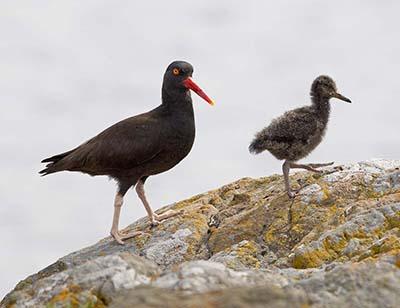
For the fifth year in a row, a pair of Black Oystercatchers has made Indian Island their summer home just a few hundred yards from downtown Eastsound.
Oystercatchers are easily disturbed by humans and dogs, and rarely nest this close to streets and homes. They usually choose isolated sea-swept rocks and rocky headlands, where the only approach is by boat.
Why is Indian Island an exception?
Oystercatchers form lifelong pairs, and once a pair has successfully produced chicks at a particular nest, they tend to return regularly. Since 2010, the Eastsound oystercatchers have fledged five chicks. That number may not seem like a lot, but in the world of Oystercatchers, it’s a very good record.
Oystercatcher numbers have been declining all along the Pacific Coast. There are an estimated 8,000 black oystercatchers total with no more than about 200 nesting pairs in the Salish Sea, including the San Juan Islands. This fact makes it all the more remarkable that even one of those pairs chooses to nest on a busy urban waterfront.

It’s not easy to be an oystercatcher chick. You must follow your parents around for several weeks to learn what’s good to eat and how to pry it off rocks. You can’t fly or swim to escape predators. And although parents are fearless at confronting predatory birds and small mammals, they flee from people and their pets.
Local volunteers of the Indian Island Marine Health Observatory have tried since 2010 to ensure that the pair feels secure enough to stay on the nest, hatch their eggs and successfully guard the chicks against hungry predators such as otters, minks, bald eagles, seagulls and crows.
Chicks only survived to leave the island with their parents in years when human visitors were restricted to the rocky shoreline from May when the first egg appears in the nest until chicks fledge in July, leaving the island’s meadows and cliffs undisturbed for about eight weeks.
Seasonal closure of the upland, and a clearly demarcated trail for visitors at other times of the year have also helped Indian Island’s native wildflowers recover. Visitors in April and early May of this year were delighted to find an unbroken sea of blue camas, pink sea blush, and yellow stonecrop flowers, even where there had been very little green at all last year.
There is much still to be learned about the ecology of these charming shorebirds. For example, do the periodic summer algal blooms in Fishing Bay affect them? Oystercatchers mainly eat mollusks such as mussels that tend to accumulate algal toxins. There was a “day-glow” green bloom of the dinoflagellate Prorocentrum in Fishing Bay just last week. Blooms usually occur in shallow waters, not in the deeper, colder waters surrounding isolated rocks and islets. This condition could pose a threat to Eastsound’s black oystercatcher family and will be monitored by Kwiaht and Indian Island volunteers.
Interested in Oystercatchers and other seabirds? The Indian Island program needs more “godparents” for the summer to help engage visitors and steer human activity away from the nest. Exciting research is also planned this summer, including a clam census, an eelgrass count and twice-monthly checks on bay pipefish, our only Salish Sea seahorse, to see how many males are brooding eggs. Contact exploreindianisland@gmail.com or visit the Indian Island Marine Health Observatory on facebook and at www.kwiaht.org.
Barsh is the director of the Lopez-based laboratory Kwiaht. He studied at Harvard, taught at the University of Washington and worked for years at the United Nations on indigenous peoples and their ecosystems.