

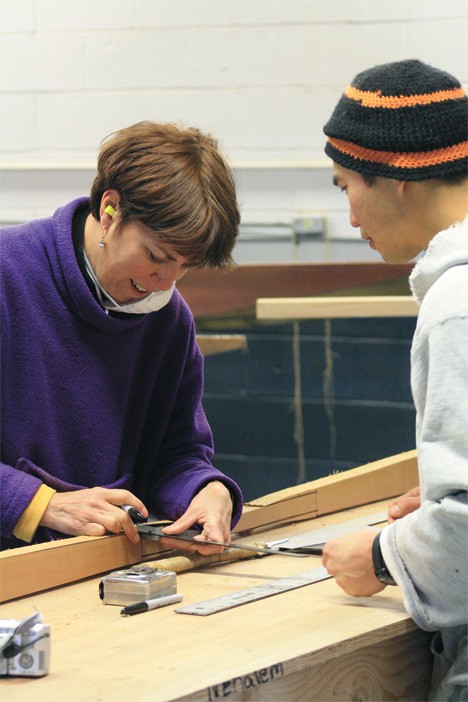
Four Orcas Islanders hand-built traditional skin-on-frame, mid-20th century Greenland kayaks last week, christening them with a launch at Crescent Beach. They sawed, chiseled, carved, lashed, stitched, ground bones and did leatherwork.
“Start with a pile of wooden sticks, twine, bone, and leather and eight days later you are paddling and rolling,” said David Kau, who took part in the boat-building adventure led by kayaker and craftsman Brian Schulz, up from Manzanita, Ore. Kau was joined by Shawna Franklin and Leon Somme, who own the local kayaking school Body Boat Blade, and Wendy Michnay. Lopezian Larry O’Bryant joined in the fun, crafting a unique boat designed by Schulz.
The group worked for 10 hours the first day of the seven-day building process.
“It was really intense; we were working some long days,” Michnay said.
It wasn’t exactly freshly tanned sealskin the students wrapped around their wooden frames, but the waterproof-coated synthetic nylon they used makes a stronger and more durable – not to mention more PETA-friendly – covering.
The boat designs were drawn from antique museum models: Schulz re-created them based on a mid-20th century kayak in the East Greenland National Museum in Nuuk, and a 1931 Disko Bay kayak in the Canadian Museum of Civilization in Ottowa. The boats range from 16 to 18 feet long, are about 20 inches wide and weigh in around 30 lbs.
“For me, it is part cultural history lesson, learning about craft, hydrodynamics and kayaking skills,” Kau said. “Greenland boats are light and lively and easy to roll, and because they are low volume, feel as though they knife through waves. [They’re] different than the traditional Aleutian baidarkas, which are local to this region.” Kau said the boats are very quiet, perfect for sneaking up on seals on day trips.
The hand-carved wooden “stick paddles” are roughly one-third the width of modern sea kayak paddles, fluid lines carved smooth and custom designed to fit each person.
“It’s a beautiful feeling to paddle,” Michnay said.
Schulz, who led the class, is a boat-builder who has kayaked rivers in the Pacific Northwest and sea kayaked in British Columbia, the San Juan Islands, Puget Sound, Kauai, Costa Rica and the north Oregon Coast, where he now dwells.
“People are welcome to call any of us about the kayaks,” Michnay said. “All of us are avid kayakers who also are really interested in the historical and cultural aspects of kayaking.”
The two boats built by Somme and Franklin are on display at the Body Boat Blade shop for those who want to see them. For more information, visit Schultz’ Web site.