Share the shore and don’t touch seal pups, asks Orca Network’s Central Puget Sound Marine Mammal Stranding Network
Published 1:30 am Thursday, July 17, 2025
Submitted by the Orca Network.
With big, dark eyes and a furry, round head, a harbor seal pup is undoubtedly one of the cutest things you might encounter on the beach this summer. But if you do happen to find one, Orca Network’s Central Puget Sound Marine Mammal Stranding Network and NOAA Fisheries ask you to “Share the Shore” and leave seal pups undisturbed. Seal pups are born in our inland waters June through August, and anyone finding a lone pup on the beach should assume its mother will be coming back for it.
“Human intervention is the reason they don’t come back,” explains Garry Heinrich, response coordinator for CPSMMSN. Particularly if a mother sees humans near the area where she left her pup, she will stay away. “For me, that’s their biggest danger.”
“Moms come back to feed the pup when no one is around, so people often think a pup has been abandoned when it hasn’t been,” says Orca Network Executive Director Susan Berta. “That is why people need to leave them alone, so mom will come back.”
It can be easy to assume that a seal pup alone on the beach needs to be taken to a wildlife rehabilitation center, but that is usually not in the pup’s best interest.
“The last thing we want to do is pick up the pup and eliminate the chance of mom coming back,” says Heinrich. ”It’s a difficult decision, if we are uncertain if the mother is coming back, always a tough choice to make.”
Many harbor seal pups are too young to have developed a fear response, so they may not flee when approached while resting and warming up on shore. They may even approach humans and have been known to suck on the hulls of kayaks or vessels at anchor or in marinas.
“If you encounter a seal, stay back 100 yards if possible, and keep your dogs on a leash. If the animal is injured, don’t try to help it by yourself, report it to the local stranding network,” says Berta. “The best thing you can do is to leave the animal alone – its best chance for survival is in the wild.”
Harbor seal pups may haul out in the same place for several days at a time. The beaches are a nursery for these pups. Nursing pups remain with their mothers for four to six weeks and are then weaned to forage and survive on their own. Weaned pups will spend extended hours on shore resting and regulating their body temperature, and disturbance by humans or dogs during this time can be fatal for them.
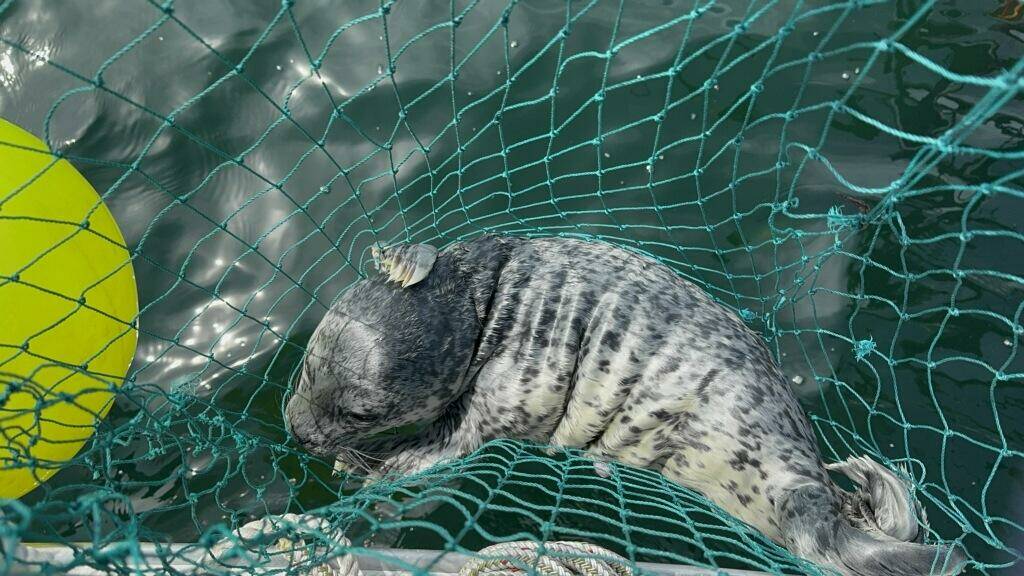
Staying away from seals on the beach can be a safety issue for humans and off-leash dogs as well. Like any mother with her young, the mothers can and will get aggressive when they sense their pup is in danger. On July 4, the CPSMMSN received and responded to a report of an entangled harbor seal pup in netting hanging from a dock. Earlier, passing kayakers had attempted to disentangle the pup but were met by the mother, who bit one of the kayakers in the upper arm. CPSMMSN responders were able to free the pup but had to keep the mother distracted to do so.
“We now have elephant seals in our region who haul out to molt and pup on beaches, and they can be aggressive if disturbed,” says Berta. “We need to give them a lot of space.”
In Island or Skagit counties and in Port Susan, the Central Puget Sound Marine Mammal Stranding Network can be reached at 949-233-2822 or 1-866-ORCANET (866-672-2638 and choose the STRANDING option). For other areas of the Salish Sea, call NOAA Fisheries Regional hotline at 1-866-767-6114.
Harbor seals and all other marine mammals are protected by law under the federal Marine Mammal Protection Act.
The Central Puget Sound Marine Mammal Stranding Network is a program of Orca Network in cooperation with NOAA Fisheries.
For more information about harbor seal pups in Washington state, please read the NOAA Fisheries “Share the Shore with Harbor Seal Pups” fact sheet at https://media.fisheries.noaa.gov/2022-04/share-the-shore-harbor-seals-factsheet-2022.pdf.
For more information on marine mammals and the Central Puget Sound Marine Mammal Stranding Network, go to https://www.orcanetwork.org/stranding-network or visit the Langley Whale Center at 105 Anthes in Langley, Whidbey Island, open Wednesdays through Sundays, 11 a.m. to 5 p.m.