The mystery of Indian Island sea stars
Published 1:30 am Wednesday, August 12, 2026
By Russel Barsh
Kwiaht director
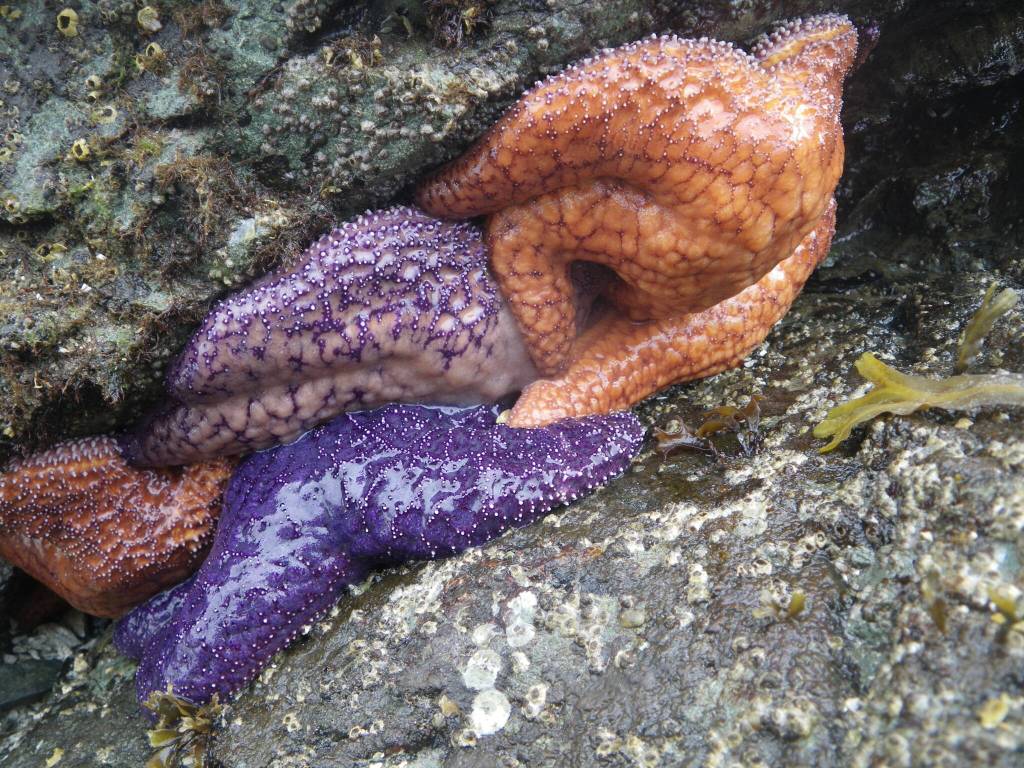
Summer visitors to Indian Island are frequently surprised to discover festoons of orange and purple sea stars in rocky crevices and tide pools. “Didn’t that sea star disease kill them off?”
Seastar Wasting Disease topped the news 12 years ago, provoking dire predictions of the imminent extinction of dozens of species along the Pacific Coast from Alaska to California, and efforts to list the sunflower sea star, Pycnopodia helianthoides, under the Endangered Species Act.
Kwiaht has been protecting and studying sea stars at Indian Island since 2009. Frequent counts of sea stars in the intertidal zone have been made on minus tides every summer since the first signs of wasting were observed in 2014. The results raise questions about our understanding of the 2014 Seastar Wasting outbreak, and marine epidemic disease generally; as well as the way that scientists, environmentalists and journalists report these events.
Prior to the 2014 outbreak, ochre stars, Pisaster ochraceus, were conspicuously common in the Indian Island intertidal zone: not surprisingly, as they are specially adapted to life between the tides. When the tide goes out, ochre stars creep into crevices or beneath rocks where there is moisture and shade. Even if they cannot find shelter, they can dehydrate considerably without lasting harm, although they may appear shriveled or deflated. Their arms lock them down tightly, keeping their delicate tube feet moist.
Most other local sea star species lack these adaptations. If stranded on the beach on low tide, they dehydrate rapidly and lose their mobility, exposing them to gulls and other predators. These are reasons why sunflower stars were most often seen in the past at Indian Island in early summer, when weather was cool and damp.
The wasting outbreak coincided with an intense heat wave in the eastern Pacific Ocean that lasted for three summers (2014-2016). At Indian Island, about 15% of the ochre stars exhibited symptoms and died at the peak of the epidemic. Other Asteroidea species, including sunflower stars, simply disappeared.
By 2017, the ochre star population at Indian Island was rapidly growing, and fewer than 2% showed any wasting symptoms. Average daily ochre star counts rose from 200 to 800 by 2023. Meanwhile, sunflower stars remained absent, although some other species, such as the so-called false ochre stars and imbricate stars (Evasteria troschelii and Dermasterias imbricata), always relatively few at Indian Island, had returned.
One explanation was suggested by the fact that, after the wasting outbreak, most Indian Island seastars had moved from the west side to the south side of the island. Kwiaht researchers noted that the west side is flatter, warmer and drier, and generally has more human foot traffic: a more stressful environment for sea stars. Ochre stars survived and thrived on the cooler, wetter and less disturbed south side. Environmental stress probably made ochre stars less able to fight off an infection.
Meanwhile, sunflower stars were driven down into deeper, colder waters by the marine heat wave. This was consistent with continued sightings of sunflower stars by local commercial crab fishers, who found them on their traps. As their habitat shrank, Sunflower Stars may have experienced greater competition for high-value prey, such as infaunal clams and mud shrimp that had been abundant in the shallow waters around Indian Island. Indeed, visitors to Indian Island often still see pits dug in the sand by sunflower stars to reach a clam or shrimp, but the sea stars were careful to evacuate the beach as the tide ran out!
After a decade of unsuccessful efforts to isolate and identify a microbial cause for Seastar Wasting Disease, it now appears that the culprit is Vibrio pectinicida, a bacterium that had been identified previously in diseased scallops. But as biologist Ian Hewson underscored in a recent article, local environmental factors must also be involved, resulting in significant variation in the impact of the pathogen across habitats on the West Coast — for example, at Indian Island. Since Vibrio pectinicida is widespread in marine ecosystems and genetically diverse, it seems likely that it will continue to create severe, periodic outbreaks in sea stars and other marine invertebrates.
Is it possible that Indian Island ochre stars survived because they possessed or developed some immunity to wasting disease? It is important to study individuals that survive an infectious disease, since they may provide tools for combating the pathogen. Resilient ochre stars like those at Indian Island could be a key to understanding how sea stars adapted historically to severe bacterial infections. Sea stars have been part of Earth’s marine ecosystems for 480 million years, after all!