Orcas Food Co-op embraces shared leadership model as founder moves on | Three longtime managers step into co-general manager roles, embodying cooperative spirit through collaborative leadership
Published 1:30 am Sunday, January 18, 2026
By Darrell Kirk
Staff reporter
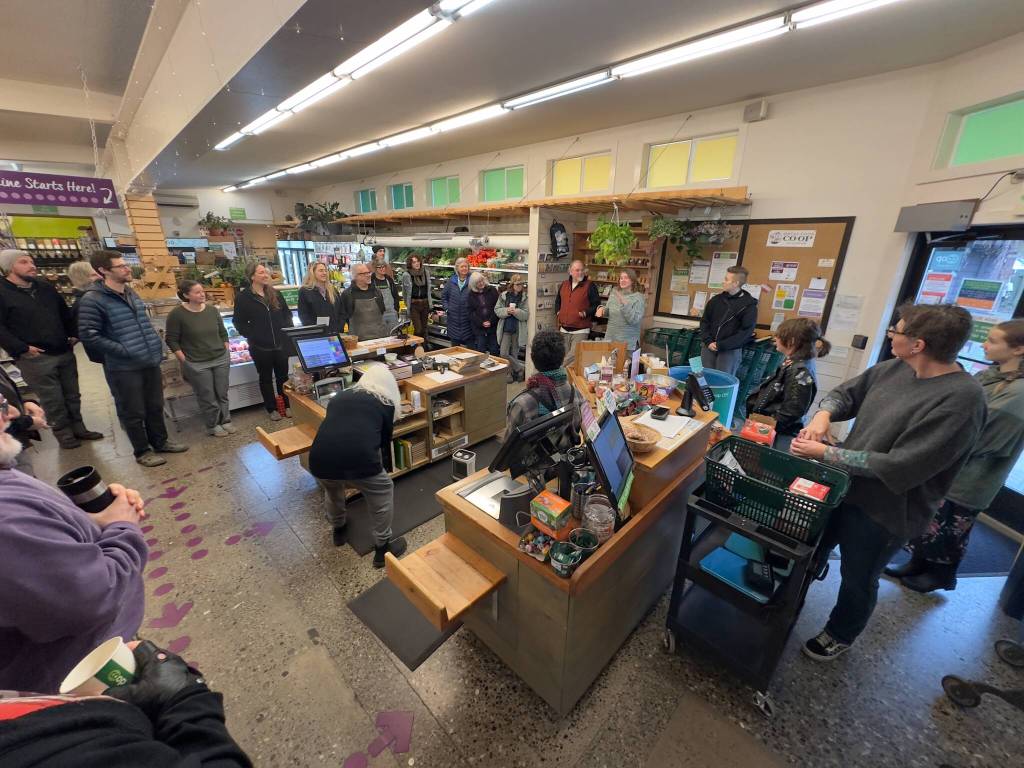
After 11 years at the helm of the Orcas Food Co-op, founder and general manager Learner Limbach is passing the torch — not to a single successor, but to a trio of experienced leaders who will guide the beloved community grocery through its next chapter.
The co-op’s board of directors has made the bold decision to transition from the traditional single-manager model to a co-management structure, selecting Regina Zwilling, Robin Zinthefer and Sara Pelfrey to serve as co-general managers. The three women, who bring a combined 21 years of insight into the day-to-day operations of the co-op, officially stepped into their new roles as Limbach departed at the end of December to become general manager of the Littleton Food Co-op in New Hampshire.
“The board, Limbach, Zwilling, Zinthefer and Pelfrey all support a co-management model that embodies the collaborative spirit of cooperation, and will allow the organization to thrive through collective strength, shared wisdom and balance,” according to an announcement from the board.
Why co-management made sense
When Limbach announced his departure, the board faced the challenge of finding someone who understood both the cooperative model and island life. “Finding somebody who understands the co-op community on Orcas Island — the specifics of living on a small island, the housing and cost of living, and getting somebody to move,” Zinthefer explained. The learning curve for an outsider would have been steep. “We already know the community, and we already each carried a piece of the job.”
The transition created advancement opportunities throughout the organization. “We’re able to offer more financial opportunity, as well as responsibility, for people who already work at the co-op, because I’ve had to give some of my work to somebody else,” Zinthefer noted.
Pelfrey emphasized sustainability: “Those top positions of general manager have high burnout and high turnover, just like in the tech industry or any other industry. As a group of people, we were really committed to not doing that because preventing burnout is deeply embedded in cooperative philosophy.”
Diversity of perspective strengthens leadership, she added: “Having more people with different strengths at the helm serves an institution in a way that just one person sometimes can’t offer.”
Supporting community and farmers
The member-owned co-op keeps profits in the community rather than flowing to distant shareholders, Zwilling noted. “The cooperative model is really reflective of the culture of the islands,” Pelfrey said.
For local farmers like Amy Lum of Lum Farm, the co-op provides essential retail access. “Having a brick and mortar store where you can highlight your products is always helpful for farmers,” Lum said, noting that farm stands and farmers markets have limited hours and weather constraints.
Zachary Leften of Once in a Blue Moon Farm, which sells duck eggs at the co-op, echoed this sentiment. “Farming is already challenging, and getting your product to market takes a lot of time and effort – even just to the farmer’s market,” Leften said. “After we’ve done the farming, I don’t always have time for the farmer’s market because of the requirements of setting up and being there all day. Having a market here that’s open every day of the year and focuses on local products is essential for us to reach consumers.”
The co-op’s ease of operation matters too. “They’re really easy to work with,” Leften noted. “They just let me stock my own eggs there. It’s really low-key and really simple.”
Through partnerships with regional food hubs, the co-op serves as “an aggregation hub for getting our products farther afield, not just on Orcas,” Lum noted, meaning farmers can reach other islands without traveling themselves.
The partnership with local farmers also serves as a critical piece of food security for islanders, according to Zwilling. “If the ferry stopped running, there’s only two to three days worth of food on the island,” Zwilling said. “That’s why supporting local farmers and building food infrastructure here is so critical.”
Challenges and strengths
The three co-managers acknowledge the model has a learning curve, but note that challenges stem from new responsibilities rather than the collaborative structure. “I don’t see any challenges with the model itself,” Zwilling said. “The challenges are just what the challenge would be for anyone stepping into new levels of responsibility and new learning.”
Shared management has “opened some communication” and means “the support can be spread out,” Zinthefer explained.
The model’s strength lies in their established relationship. “I wouldn’t have done it if I didn’t already know Sarah and Robin and how well we work together,” Zwilling said.
Their decision-making relies on communication and mutual respect. “Nobody has a ‘my way or the highway’ attitude, and that’s why this can work,” Zwilling explained. “It’s very collaborative, and everybody brings different perspectives. It’s like, ‘Oh yeah, that’s a really good point. I haven’t thought of that. How do we incorporate it?’”
Lessons for others
For organizations considering a similar model, the co-managers emphasize communication as crucial. “Communication systems are key,” Pelfrey said. “Building communication that comes from you as a person who’s invested in other people is probably the biggest key — learning to develop those relationships surrounded in communication.”
Understanding strengths is essential, Zinthefer noted: “We knew what our job roles were, and we’re in our roles because those were areas of strength for us. We knew our strengths and where we would need to ask for support.”
A strong board relationship has proven vital. The co-managers have “remarkable board members who all have expertise in different things,” Pelfrey said.
The board serves as both supporter and accountability partner, balancing “supporting us while also taking a critical look” to ensure co-management serves the membership, Pelfrey noted.
A model for the future
As the Orcas Food Co-op moves forward, the three leaders remain focused on supporting local food systems, ensuring equitable access to quality food, and strengthening community bonds.
“When we invest in local food networks, you’re building the community bonds that communities need to thrive, even if you don’t know who the farmer is,” Pelfrey said.
As Zwilling reflected on the transition: “It just feels like it was meant to be.”