Meeting of the minds
Published 9:57 am Wednesday, September 17, 2014
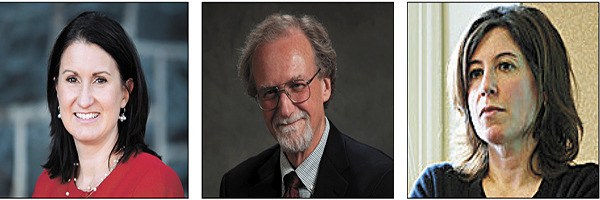
Hair, hemlines and husbands – that’s how we talk about women politicians in the media.
That is according to Dr. Melody Rose, President of Marylhurst University and former Chancellor of the Oregon University System, who will present “Leader of the Free World? The Future of American Women in Politics” on Saturday, Oct. 18, 4 p.m. at Orcas Center as part of the Orcas Crossroads Lecture Series. The series has brought speakers to Orcas Island to share their expertise on timely and important issues for the last five years.
Rose is excited to have a dialogue with an audience during her presentation.
“I hope that people will be more informed about women in politics in the contemporary U.S. and will be thinking differently about news as the next election cycle unfolds,” said Rose about what people will learn during her talk.
Rose will discuss not only women in the news, but get down to specifics like who could be our next president. As far as predictions go, Rose is only willing to predict that Hilary Clinton has a strong chance of winning if she decides to run.
Rose should have a good handle on the topic considering that she co-authored the book “Hillary Clinton’s Race for the White House.”
In the upcoming lecture, she will also discuss other female politicians, what advantages they carry and the fact that there are very few women in the pipeline to presidency of either party.
“There is just a thin bench and if the top candidate sits on the bench that changes things,” said Rose.
Despite the lack of candidates, Rose said there are sectors where women could rise in politics, but it won’t happen in her lifetime.
There is research that points to change happening in the next 100 years, at least in congress, if the rate of change in demographics continues to improve. As far as gubernatorial positions, Rose said, “We are nowhere near to having equality.”
What may be even more depressing to those who would like to see change is that America is lagging behind the rest of the world when it comes to women in government.
From queens in ruling European countries to chief executives in South America, many other nations have found a way to let women lead.
“The paradox is that we view ourselves as world leaders of democracy but how is only 52 percent of the population showing up in elected office,” said Rose.
The way we elect our leaders may be the culprit for the discrepancies.
“We have a unique election system and so it will yield unique results,” she said.
Smoking pot
Prof. Roger Roffman is not shy about talking about smoking marijuana – in fact he thinks it could help others.
“I’m hopeful that my being candid about my personal experiences will help cut through some of the misconception, e.g. that it’s harmless,” said Roffman.
At 24, Roffman took his first hit as an enlisted man in Vietnam. He describes his marijuana use as, “Not the insatiable craving kind of hooked, a blinding drive to stave off withdrawal, but rather the hook that fuels a political junkie.”
He will be discussing not only his personal life, but many other issues in his talk “Cannabis at the Crossroads: Exploring the Roads Ahead” on Sunday, Sept. 21, 4 p.m. at Orcas Center.
Twenty-three states have said marijuana is medicine, two states have said it can be grown and sold for fun, and there seems to be a sea of change happening in our country’s attitudes about pot.
Roffman asserts that we can do a better job when dealing with marijuana risks to health, safety, youth development, racial inequality and crime.
“Criminal prohibition has been greatly disappointing in its effectiveness. Illicit marijuana practices have flourished,” said Roffman. “The violence among competitors has been horrific and the fiscal and social costs of prohibition’s implementation, including the egregious racial inequities in how enforcement has actually been carried out, are undeniable.”
Despite these serious problems, Roffman also acknowledges the other side of the coin, which includes those arguing against legalization by exaggerating the risks of using pot.
“Most occasional users are not harmed,” said Roffman.
At the same time, Roffman is concerned about a potentially major flaw in Initiative-502, which legalized the possession of marijuana for adults age 21 and older in November of 2012. Roffman sees serious problems ahead if 502 does not follow through on its public health promises to provide treatment for young people and research on marijuana and evaluation of the new law’s impact.
In his lecture, Roffman will also touch on why these issues need to be addressed. He will also delve into some of the history behind legalization including factors that led up to more liberal marijuana policies being adopted in this country.
Roffman hopes that after attending his lecture people will be “more informed about marijuana and its effects on health and behavior and the rational that led to the adoption of legalization.”
Will we ever be equals?
The Occupy Wall Street movement sparked conversations across the country about economic equality or, depending on whom you talk to, economic reality sparked the movement.
Leslie McCall, Professor of Sociology and Political Science at Northwestern University, is more of a fan of the latter idea. Her upcoming talk “Economic Inequality: American Attitudes and Political Responses,” will be at Orcas Center, Oct. 5 at 4 p.m. She will discuss recent and historical trends showing how certain aspects of our culture affects this imbalance. She describes the Occupy movement as the aftermath of this situation rather than a catalyst.
“Americans have long desired less inequality and events such as the Occupy Wall Street movement actually reflected these long-held concerns rather than sparked them,” she said.
McCall will also shed some light on the rhetoric and reality of how Americans think about the issues of economic inequality and opportunity and how they think such issues should be addressed?
According to McCall, progress on the inequality front is happening, but people often focus too much on raising taxes on the wealthy instead of expanding employment and educational programs.
Of course, actually eliminating an economic difference among people is not something that interests McCall; she would rather explore a world where less inequality exists. The problem currently with inequality in the U.S. is that economic growth is skipping the middle class and landing right in the laps of the wealthy.
“In order to relieve the economic anxieties of most Americans, the underlying goal of policy ought to be to generate greater and more evenly spread job opportunities, which requires a focus on reducing job and pay inequalities in the labor market rather than reducing after-tax income only,” McCall said.
It is her hope that people walk away from her lecture with an understanding of how Americans think about economic inequality and the part politics play – both in the past and in the present.
“At root, my research shows that there is no opposition between concerns about opportunity and outcomes,” she said. “But rather that Americans become concerned about inequality precisely when they see it as restricting opportunities for regular Americans and stacking the deck in favor of the affluent.”
Tickets are $10 per lecture and can be purchased at Darvill’s Books, at the door and at http://orcascrossroads.org/.