

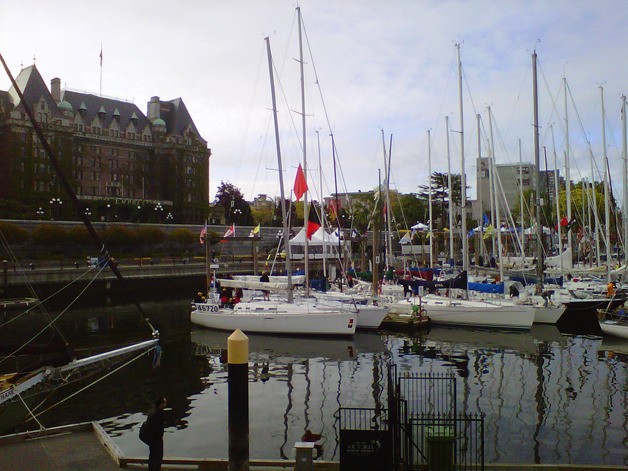
On Memorial Day weekend Orcas sailor Eric Moulton skippered a crew of eight to victory in the Swiftsure International yacht race, hosted by the Royal Victoria Yacht Club.
“Swiftsure is kind of like the first big race that was started in the Pacific Northwest,” said local sailor Betsy Wareham. “They call it ‘the granddaddy of all races’ because it’s been in existence the longest.”
Moulton’s team, aboard his Express 37, ‘Ptolemy,’ placed first in its division and 16th overall in the Cape Flattery race. It took the crew 27 hours, 44 minutes and 19 seconds to complete the grueling overnight race.
“You can’t argue with a race that begins and ends in Victoria,” said Moulton. “It was definitely the best sailors in Canada and Seattle; all the best boats were there.”
The race began in 1930 as a six-boat race from Cadboro Bay around the lightship on Swiftsure Bank at the entrance to the Juan de Fuca Strait; in 1960, 45 boats competed in the annual race. While the lightship was removed from service in 1961, sailors today round a Navy vessel stationed at the same location. The slightly shorter 100-mile Cape Flattery race was introduced in 1988 as one of several options created for boats too small to endure the original 137-mile trek.
“We all kind of reconverge on Victoria at the same time, said Moulton, as the larger boats with longer waterlines speed over the longer courses.
The crew included 2011 Orcas high graduate Taylor Smith, Nate Averna, Kelly Toombs, co-captain Gavin Brackett, who headed up crew selection and provisioning, and from Bellngham: Jim Johanneson, his 15-year-old son Miles, and Miles’ friend Riley Geo.
“It was 28 hours of nonstop racing,” said Smith, whose primary job was jib trim. “It was by far the most enjoyable big boat sailing event I have ever participated in. I’m primarily a small skiff sailor so it was a complete different experience for me to sail through the night.” Smith said he skippered the boat for about five hours of the race.
“I’ve done Swiftsure a lot,” said Moulton. “You can put so much effort into it and it can be a crap shoot because of conditions.” He said their main goal was not to win, but to use the race as an opportunity to teach the boys navigation, watch systems, night sailing and safety.
“At night things can get crazy; you don’t have your eyes to help you as much,” he said. “The shipping lanes were really crowded, so we were doing a lot of radioing at night.”
The crew rounded Neah Bay at midnight, weary and cold. But Ptolemy was in good position, and they had fans back home tracking their progress and urging them by text messages to go for the win.
“It was just about the time you want to send half the crew downstairs,” said Moulton. Instead, just a couple of the crew took a brief rest while Averna drove, Brackett saw to the sail trim and Moulton navigated using the GPS.
As they pulled in to Victoria, Moulton said a 35-mile-per-hour gust stormed in right behind them, pushing Ptolemy across the finish line.