By Darrell Kirk
Sounder contributor
San Juan County Council Chair Kari McVeigh joined Indigenous leaders and elected officials from both sides of the border at a cross-border forum in Sidney, British Columbia, on Oct. 17, focused on strengthening ties across the shared Salish Sea region.
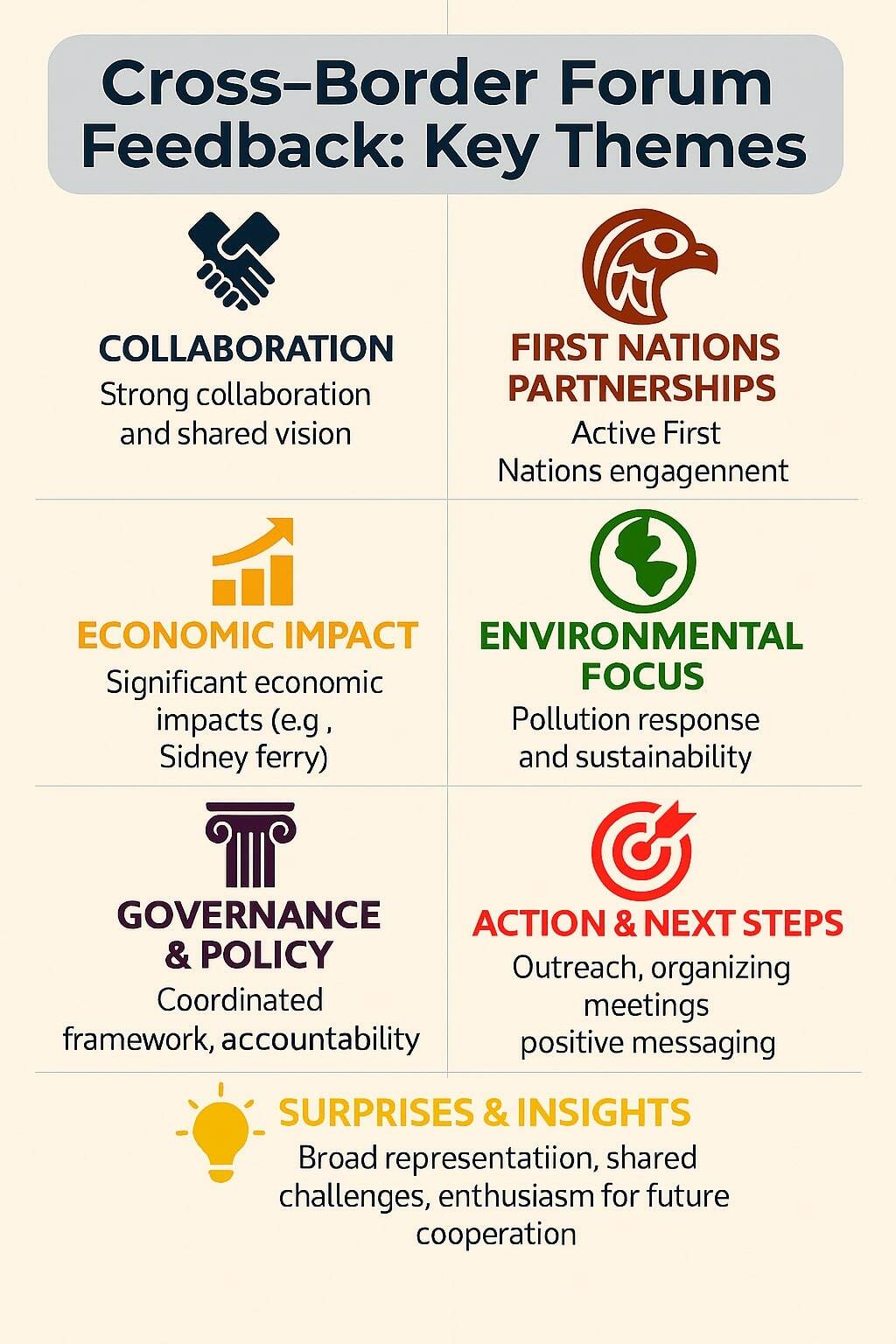
The gathering at Mary Winspear Centre brought together nearly 50 participants from Washington state and British Columbia to address environmental and economic challenges facing island communities. Key participants included Lummi Nation Treaty Protection Director Brandon Morris, Sidney Mayor Cliff McNeil-Smith and officials from Gov. Ferguson’s and Lt. Governor Heck’s offices. Building on a smaller virtual gathering held in March, the event reaffirmed the enduring spirit of cross-border cooperation and emphasized the vital role of local leadership in fostering a sustainable, inclusive and resilient future.
Co-host and member of Parliament for Saanich-Gulf Islands, Elizabeth May noted, “Ironically, the higher levels of tension created by cross-border challenges including tariffs has increased the local and bio-regional commitment to deepen our relationships.”
In an interview with The Sounder, McVeigh stated that she and other leaders were initially concerned about attendance, and all were delighted with the turnout. McVeigh noted, “What that told me is that what binds us is so much stronger than what is separating us now at a national level.”
Washington Rep.Rick Larsen, in a pre-recorded message, emphasized the importance of maintaining cross-border partnerships.
“We share an important boundary along and through the Haro Strait, with deep and long-standing partnerships, across and connecting our island communities,” Larsen stated.
A major focus of the forum was the closure of the Washington State Ferry service to Sidney. McVeigh, who facilitated the economic breakout session, emphasized the devastating impact.
“In the budget line for the state, when they put their budget together, they said it was a $3 million savings. And I know for a fact that it is over a $3 million loss of economic revenue for Canada and the United States, probably three times that,” she said.
The ferry closure has affected more than just economics. For Indigenous peoples on both sides of the border, the loss is deeply personal. As McVeigh explained, tribal entities view the Salish Sea without borders. “There is no border for all of the tribal entities who call the Salish Sea and what touches it their home. They fished all these waters. They landed on all these islands,” she said.
Environmental cooperation emerged as another critical theme. McVeigh highlighted the urgent need for coordinated oil spill response. “If we were to have an oil spill in the Strait of Juan de Fuca or someplace in the Salish Sea or on the Haro Strait with all of those major tanker type ships sailing back and forth, it would be devastating to both countries,” she said, adding that sustainable response capabilities must be maintained on both sides of the border.
The forum emphasized treating environmental protection and economic development as inseparable goals, with salmon serving as a unifying symbol. Breakout sessions on environmental and economic resilience stressed the importance of maintaining strong cross-border ties for the prosperity of island and coastal communities.
To ensure momentum, leaders committed to developing a communications strategy and called for establishing a cross-border secretariat to coordinate efforts, map existing collaborations and identify funding opportunities.
The next cross-border forum is planned for spring.