

In the west, flower arranging is all about color mass.
In Japan, it’s just the opposite.
Ikebana, the Japanese art of arranging flowers, is about simple lines with a focus on one or two elements. It’s an art form where the empty space is just an important as the full space.
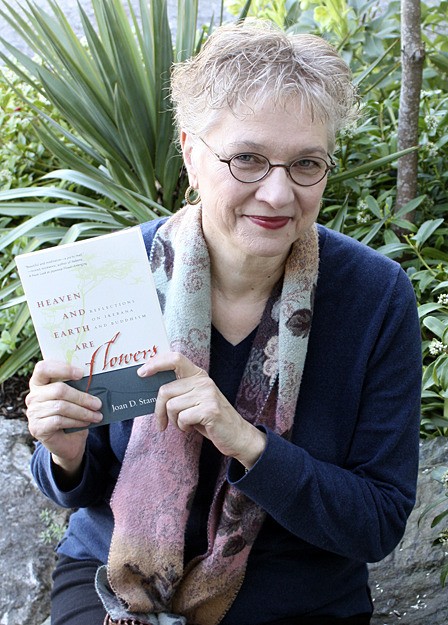
Orcas writer Joan Stamm has studied and practiced Zen and Tibetan Buddhism, and underwent years of ikebana instruction in Seattle. She has written about her experiences in a new book that is part memoir, part Buddhist philosophy, part rumination on the spiritual essence of nature. “Heaven and Earth are Flowers: Reflections on Ikebana and Buddhism” also features color images of her designs, which have been on display at flower shows throughout the northwest.
“Ikebana means ‘living flowers’ or ‘making flowers come alive,’” Stamm said. “The simplicity of design is a main principle. And there is a lot more symbolism involved. There are the three friends of winter: bamboo, pine, and plum. All three symbolize different things. A traditional new year’s arrangement would include all three of those.”
Another arrangement might have a bud and two flowers that are in different stages of dying, representing the past, present, and future. A common theme is the heaven, earth, and human principle.
“The philosophy is that humans are the middle element between heaven and earth,” she said.
Stamm became interested in Buddhism and traditional Japanese arts while living in Japan in the early 1990s. After returning to Seattle, she explored different ways to maintain her connection to the country. She thought about learning the traditional tea ceremony, but opted for ikebana instead.
“I always loved flowers, so it was a natural,” Stamm said.
After 12 years of instruction from Mary Hiroko Shigaya of the Saga School of Ikebana, she received formal authorization to teach. Stamm studied with Shigaya until her death at 82.
“The book is dedicated to Mary and to my mother,” she said. “My mother was an avid gardener. She lived for flowers and gardening. It was her true passion.”
Stamm holds an M.F.A. in writing and literature from Bennington College and a B.A. in art from Evergreen State College. Her new book, being published by Wisdom Publications in Boston, was born out of an essay on ikebana and Buddhism, printed in “Chrysalis Reader and Tricycle: The Buddhist Review.” It was later published by “Utne Reader” and chosen for Best Spiritual Writing in 2001. Her other work has appeared in “Weber: the Contemporary West,” “The San Francisco Examiner,” “Oregonian,” and “Seattle P-I.”
Stamm moved to Orcas two years ago after visiting the island for decades, a regular at Indralaya. Her sister, who is accomplished in the art of Japanese tea ceremony, will be moving to Orcas once her home in Kirkland sells. Stamm, who will be teaching ikebana classes at Emmanuel Parish Hall starting May 8, hopes she – and her sister – can bring more Zen arts to Orcas.
“I’d like to see a Zen arts center here,” she said. “I am also a member of Haiku Northwest, so I am interested in a lot of Japanese arts.”
Stamm finds peace in the art of Japanese flower arranging.
“The most fulfilling part is when an arrangement really comes together in an artistic way and you have that ‘ahh’ feeling,” she said. “You know you’ve got the right balance and the right elements. I feel like I’ve achieved that balance in the arrangement and in myself. When I can let go and work from a more intuitive way, I generally have more success.”
To sign up for classes
Starting May 8, Stamm will teach the art of Japanese flower arranging at Emmanuel Parish Hall. To sign up, email her at jstamm@seanet.com. For more information, visit www.joandstamm.com.