SAFE San Juans launches support group for survivors of intimate partner sexual violence | Eight-week program begins Feb. 3, organization offers free crisis services countywide
Published 1:30 am Sunday, January 25, 2026
By Darrell Kirk
Staff reporter
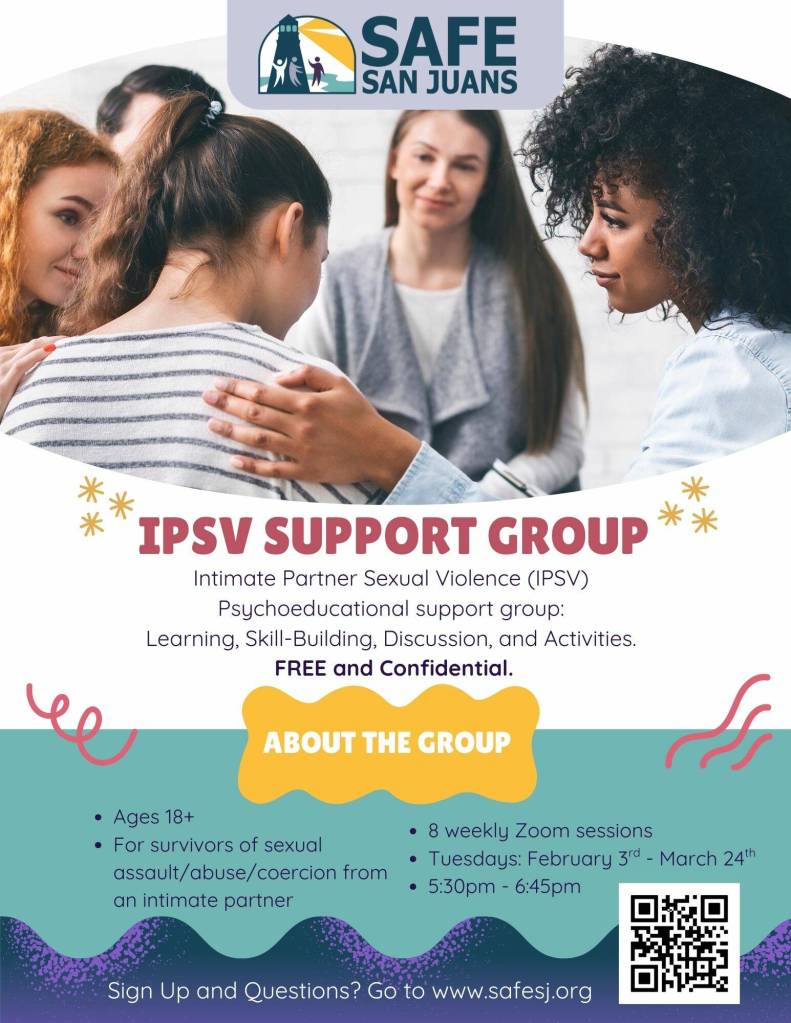
SAFE San Juans, the county’s only community-based domestic violence and sexual assault program, will launch a new support group on Feb. 3 for adults who have experienced intimate partner sexual violence — part of the nonprofit’s ongoing mission to serve survivors and transform community attitudes about abuse.
The eight-week psychoeducational support group, led by therapist Roxanne and advocate Brooke, will provide a confidential space for participants to learn, heal and rebuild. Conducted over Zoom at no cost, the closed group is designed exclusively for adults over 18 who identify as survivors of sexual assault, sexual abuse or sexual coercion from an intimate partner.
“The group includes psychoeducation aspects where we will present information about these types of experiences and often what the impact will look like for people who have gone through it,” Roxanne explained. “There will be reflection on personal strengths and people’s individual needs, as well as guided discussions where the goal is to help people connect with each other over an experience that’s often extremely isolating. Empowerment is our main goal here.”
The program requires commitment to all eight sessions, and interested participants must register before the first meeting. Information is available on the organization’s website at www.safesj.org or by calling the office or emailing info@safesj.org.
Understanding sexual violence
SAFE San Juans uses the state’s definition of sexual assault as occurring “when a person is forced, coerced, or manipulated into any unwanted sexual activity.” But Executive Director Dave emphasizes that many survivors struggle to recognize their own experiences as abuse or to seek help.
“A lot of people feel like it is their fault,” Dave said. “Unfortunately, there are actually a lot of people who have experienced this—being sexually abused—and believe that either it was their fault, have been shamed into it or guilted into believing that somehow this unwanted attention and activity has taken place because it’s their fault, which is just completely untrue.”
This sense of misplaced responsibility keeps many survivors from seeking support, sometimes for decades. The organization’s three licensed mental health counselors regularly work with people addressing trauma from abuse that occurred years or even decades ago, as the psychological, behavioral and emotional effects can persist throughout a lifetime.
Beyond crisis response
While Safe San Juans operates as a 24/7 crisis organization — the only one of its kind in the San Juan Islands — its work extends far beyond immediate emergency response. With offices in Friday Harbor, Eastsound and Lopez Village, the organization provides safety planning, emergency shelter, crisis intervention, legal and medical advocacy, protection order assistance and professional counseling.
The reality of domestic violence situations often contradicts common assumptions, Dave explained. When people observe someone being abused, “they think, well, if it was serious, they would just leave. That’s really not always the case. What many people really want is they just want it to be better. And they don’t want to just lose everything.”
Survivors may have children, shared homes, intertwined finances or deep emotional connections with their abusers. “A lot of the times the abusive person is the one who’s controlled everything in the other person’s life, including the money,” Dave noted. “So for a person to run frequently means to be destitute.”
This is why safety planning becomes crucial — helping survivors think through their concerns and navigate problematic relationships while maintaining as much stability as possible.
The root of abuse: Power and control
When asked what people can do about domestic violence and sexual abuse, Dave traces much of it back to fundamental questions about how people view themselves and others. “I would start by just saying, look in the mirror,” he said. “Think about how you see yourself in respect to other people. Do you see them as less than you? Do you see them as more deserving of you or less deserving of you? Is there something about them that makes you feel superior in some way? Or are we all people, all valuable and equally valuable?”
He recommends examining the Power and Control Wheel — specifically the gender-neutral version, since domestic and sexual violence is not dependent on gender. The wheel illustrates various categories where a person can exercise power to control, extending well beyond physical violence to include emotional manipulation, economic abuse and isolation.
“So much abuse comes from an improper view of the worth of another person in comparison to oneself,” Dave said, adding that abusers may be “trying to control a situation” rather than deliberately targeting a person, though it “frequently happens when someone is trying to control” and “those who are involved wind up being hurt.”
Prevention and community change
SAFE San Juans employs prevention specialists who teach in local schools K-12, focusing on healthy relationships, boundaries and consent, and safe and unsafe touch. Occasionally, students recognize their own experiences through these lessons and seek help.
The organization also mandates reporting child abuse to the Department of Children, Youth and Families when necessary, though Dave notes the state distinguishes between children being directly abused versus witnessing abuse between adults.
Financial support also remains critical as federal and state funding face significant cuts. As a nonprofit prohibited by law from charging fees — to ensure no barrier exists for survivors seeking services — SAFE San Juans relies on community donations to continue its work.
The organization maintains exceptionally strong confidentiality requirements mandated by federal and state law. Anyone seeking services can simply call to schedule an appointment, show up at an office or contact the 24-hour crisis line. More information about warning signs, healthy relationships and available services can be found at www.safesj.org.