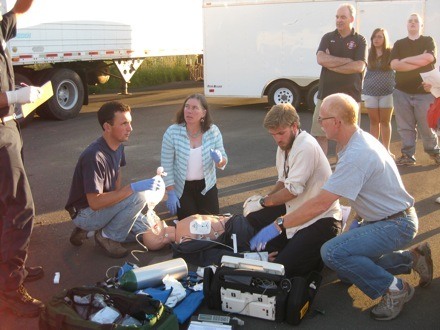
Orcas residents whose hearts stop completely during a heart attack now have a better chance of surviving the incident than people of many other communities in the United States because of a new protocol called hypothermic resuscitation.
Last week, Dr. Michael Sullivan, M.D., San Juan County Medical Control Officer, completed training Orcas Fire and Rescue medical personnel on the new procedure that will cool the body down and improve survival and brain recovery rates.
“It will be possible for a person who has suffered cardiac arrest to walk out of a hospital sooner and with no brain damage,” Sullivan said.
Nationally, survival rates for cardiac arrest and the number of survivors who make a full neurological recovery are low. Annually, 90 percent of the 300,000 people who suffer cardiac arrest in the United States each year die. Cardiac arrest, where the heart loses its rhythm and stops altogether, may follow a heart attack or strike without warning. The heart has to be started quickly so that oxygen can get to the brain within four to six minutes. Even when the heart is restarted brain damage and other secondary injuries can continue to impact brain survival and function for hours. The induced hypothermia protocol will increase the odds of patients recovering completely by extending the window of time that effects brain damage and survival.
“By inducing hypothermia we can protect your brain from the chemicals produced when your heart is not beating,” Sullivan said. “With the new ambulance refrigerator on Orcas, we keep IV Fluids at a certain temperature and they are ready when needed. My goal is to have the highest neurological resuscitation rate in the country right here in San Juan County.”
EMS is a vital link in the treatment process, which starts within minutes of the cardiac incident and continues into the hospital. A combination of ice packs, cooling blankets and injection of a chilled saline solution are used to lower the patient’s core temperature to 32 to 34 degrees Celsius.
Success with cardiac arrest has a chain of survival that includes activation of the emergency medical services once a person’s heart has stopped, bystander CPR, rapid response by the EMS, early defiberation to restart the heart, early access to Advanced Life Support paramedic care and rapid transport to the hospital.
“We have been focused on improving the other elements and have become really good at them,” Sullivan said. “911 operators can tell bystanders how to do CPR over the phone, the Orcas volunteer EMTs carry the automated external defibrillators with them and are located all over the island. Many places are unable to even do this much, though it improves survival significantly.”
Also key, is the transport to a facility that will continue the hypothermia protocol. Sullivan says St. Josephs, which receives most of the heart attack patients from Orcas, has a multi-disciplinary approach to the care of heart attacks. EMS personnel, emergency physicians, intensivists, ICU staff and neurology and cardiology specialists work together for complete heart patient care.
Although Orcas is first in implementing the protocol, Sullivan plans to have paramedics on all the San Juan Islands able to perform it soon. Orcas is first because there is no additional cost to putting the protocol into place. A refrigerator exists on the main ambulance, which is all that is needed to keep the saline at a precise temperature. Other ambulances will need to be retrofitted.
“We will see many more people coming to the fire station after being dead to get their picture taken with the paramedic and EMTs who saved their life,” Sullivan said.