

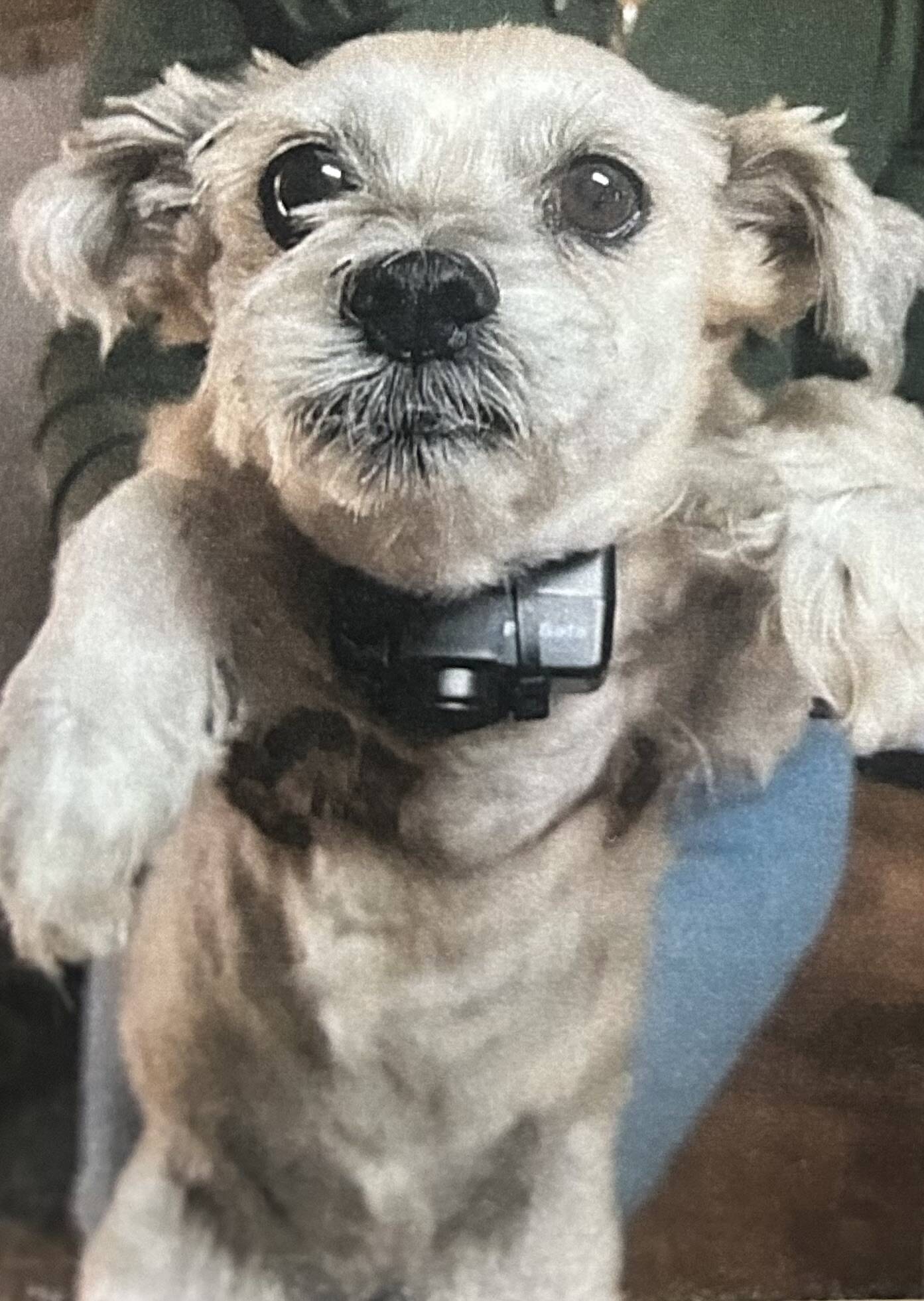
Mayor Raymont Jackson, 59, was found not guilty of animal cruelty on Oct. 24 in San Juan County District Court after three months of legal and public scrutiny over his treatment of 12-year-old terrier mix Sasha. In the two-day trial, prosecutors Amy Vira and Elizabeth Doyle represented the State of Washington, and Robert Bulloch defended the mayor.
Jackson, whose singular term as mayor of Friday Harbor ends in January, was charged with one count of animal cruelty in the second degree after his dog was found with a neck wound from an electronic collar by concerned neighbors in August. He pleaded not guilty.
Civil case
The mayor filed a civil case against the Sheriff’s Office in September, requesting Sasha’s return, but lost due to failure to serve the parties properly and a missed deadline for payment/renewal of the bond, and therefore forfeited ownership.
“Bond-or-forfeit” laws in animal cruelty cases (RCW 16.52.085 in Washington) were created to protect the civil rights of pet owners while also lessening the financial burden of animal caretaking during criminal cases involving animal cruelty. Thirty-day bonds are paid ($25 per day plus medical bills) and renewed by the owner while their animal is in the care of others, a process that maintains ownership and makes the animal ineligible for adoption.
The initial bond was not renewed and lapsed for 72 hours, resulting in forfeited ownership according to District Court Judge Carolyn Jewett-Platts. This means that even after the mayor’s exoneration, he is no longer the owner of Sasha. Once ownership was transferred to the Sheriff’s Office, staff instructed the Friday Harbor Animal Protection Society to find a suitable home for Sasha.
“In the best interest of the community, and to avoid future conflict, an off-island family was chosen for the adoption,” Sheriff Eric Peter told the Sounder. “Ownership was forfeited, and so we found a home for the dog.”
Criminal trial
The state’s criminal case revolved around witnesses and evidence from the initial few days after Sasha was found. Testimony and photos detailed the neck wound as black ooze around a worn, raw area and skin puncture, with thickening and darkening tissue indicating the issue was chronic, as well as an intense foul odor. The collar was said to be extremely tight with a one-inch metal prong on the inside. The collar’s odor was so offensive that the deputy put it in the trunk of his patrol vehicle rather than the cab.
The prosecution argued that the situation could have been prevented and asked the jury to use common sense and experience to interpret the evidence around whether Jackson knew about and ignored the dog’s suffering. “Mr. Jackson should have noticed the injuries developing on Sasha,” Boyle said in her closing argument. “Mr. Jackson failed to provide the necessary medical care and attention to prevent the wound from getting as bad as it did. And Mr. Jackson failed to adjust or change the collar, so that Sasha’s injury would not continue to persist or progress. This failure resulted in unnecessary or unjustifiable pain for Sasha.”
Witnesses for the defense described the Jacksons’ relationship with Sasha as loving, and longtime neighbors and health care providers stated they’d never felt concerned about abuse or mistreatment, asserting that she was known for wandering off and rolling in things. The veterinary expert for the defense, based on viewing photos of Sasha’s wound, disagreed with the assessment that the wound was long-standing and stated she had seen lesions like this appear overnight in the past. The collar was deemed incapable of giving shocks due to there only being one prong, and Jackson stated it was used only as an audible reminder of the invisible fence.
The defense argued that the State hadn’t met its burden of proof because it wasn’t clear exactly what happened to Sasha or who was involved.
“We are in a court of law and the State has to prove beyond a reasonable doubt what happened to that dog and who did it or who inflicted that pain,” Bulloch argued. “There has to be evidence of it.”
The jury found Jackson not guilty.
Aftermath
Vira told the Sounder that the Prosecutor’s Office doesn’t typically comment on the outcome of criminal trials.
“As with all trials, we are grateful for the jurors who took time out of their lives to participate in this vital civic duty,” she said.
Bulloch told the Sounder this was a case of “blatant and disturbing overreach” by law enforcement and the prosecution office.
“There was no credible evidence to even bring the charges against Ray Jackson, let alone a conviction,” Bulloch said. “Yet, they went full speed ahead with the full power and authority of our local officials to go after Ray and remove their family’s 12-year-old dog. I am so grateful we have a jury system that allows the citizenry to have a check on governmental power.”
When asked why Jackson was charged, Jackson said that while his reputation has been “severely impacted”— including being asked to step down from positions he holds — he really just wants Sasha back.
“I won, but I don’t get my dog back, so victory is bittersweet,” Jackson told the Sounder. “It feels like a child has been taken. We didn’t even get to say goodbye to her.”
He says irreparable damage has been done to him and his family, regardless of his exoneration.
“You know what I’m guilty of? I’m guilty of believing that after 15 years, that our neighborhood and our community have enough decency that we would communicate with each other before letting something get this far out of hand,” Jackson said.