

by Darrell Kirk
Sounder contributor
On a sun-soaked Labor Day afternoon, Orcas Island residents gathered on the village green for what organizers called a “National Day of Action” rally, demanding that society prioritize “workers over billionaires” while addressing issues ranging from immigrant rights to climate change to the ongoing conflict in Gaza.
The event, organized by Orcas Rising, brought together speakers from across the progressive spectrum.
“We are aligned around a day of action that is occurring across the nation,” said Pedro Lopez de Victoria, the event’s opening speaker and emcee. “Today, the mantra, the essence of what we’re meeting for is workers over billionaires. So we’re putting our little Orcas Island on the map for this national day of action, organized by labor unions who believe in solidarity.”
While speakers addressed the crowd from the stage, some of the most compelling perspectives came from audience members, like 11-year-old Charlie McCune, an incoming sixth-grader who represents a generation coming of age amid unprecedented political polarization and social upheaval.
In an interview after the rally, Charlie, who identifies as “a very gender-fluid person,” spoke passionately about the rally.
“There are 62 places around the world where it’s illegal to be queer,” they explained when asked about the motivation for attending. “I’m here to help change that and make sure queer and trans youth have safe places to go. Just this past month, the suicide hotline for LGBTQ+ youth was shut down, and there’s been increased danger for trans and queer young people.”
The rally opened with Jaime Beechum and Caitlin Leck providing a land acknowledgment that connected labor organizing to indigenous struggles.
“We are on native land, and we are acknowledging the land’s labor and the land’s intelligence,” Leck said.
Sara Pelfrey and Lydia Dennee-Lee, representing Orcas Pride, highlighted the intersection between labor rights and LGBTQ+ equality, emphasizing the importance of resilience and the power of solidarity.
“When we say queer liberation, we must also say Palestine liberation. The same system that strips trans kids of suicide support lines is the one funding military occupations abroad,” declared Pelfrey, who is also Charlie’s mother. “Please support spaces like the Fun House and the Peach Pit, and consider serving on our school board to help maintain safe spaces where our youth can thrive. We must uplift, protect, and listen to the wisdom of our LGBTQ+ elders to strengthen our community’s foundation.”
Lauren Bigelow, director of the San Juan Agricultural Guild, connected environmental protection to economic justice, highlighting the Trump administration’s environmental rollbacks.
“Since he took office in January, over 45 attacks have hit our environmental policies,” she said, citing withdrawal from climate agreements and expanded offshore drilling. “They are contaminating our air, our food, and our water, making us sick, and then asking us to pay for it. The billionaires profit, industries win, and our communities suffer. When we buy local, and give generously, and choose people over profit, we are pushing back. When we divest in big companies, and reinvest in each other, we shift the paradigm.”
Brooke Budner, representing Jewish Voices for Peace and Islanders for Justice in Palestine, delivered one of the rally’s most emotionally charged presentations, reading a letter from Munira El-Nadar, a Palestinian mother in Gaza.
“To every mother who wakes her children with a kiss and sleeps peacefully to the sound of their laughter, to every mother who packs a school bag or waits by the window for her child’s return, I write to you from a place that no longer resembles life, a place where motherhood is entangled with prayer, where love walks hand in hand with patience, and fear is softened only by hope. We do not ask for peace but for witness. We do not ask for silence but for a voice beside ours so that your children, when they grow up, will know that we had children too,” the letter read.
Eleanor Hoague, a veteran immigrant rights activist, warned about increasing federal immigration enforcement.
“ICE and Customs and Border Patrol are on Orcas, but so far they have kept an extremely low profile, which is a godsend,” she said.
Hoague urged community members to sign up for rapid response notifications at www.orcasinfo.org and emphasized the availability of legal assistance through the Local Immigration Family Treasury.
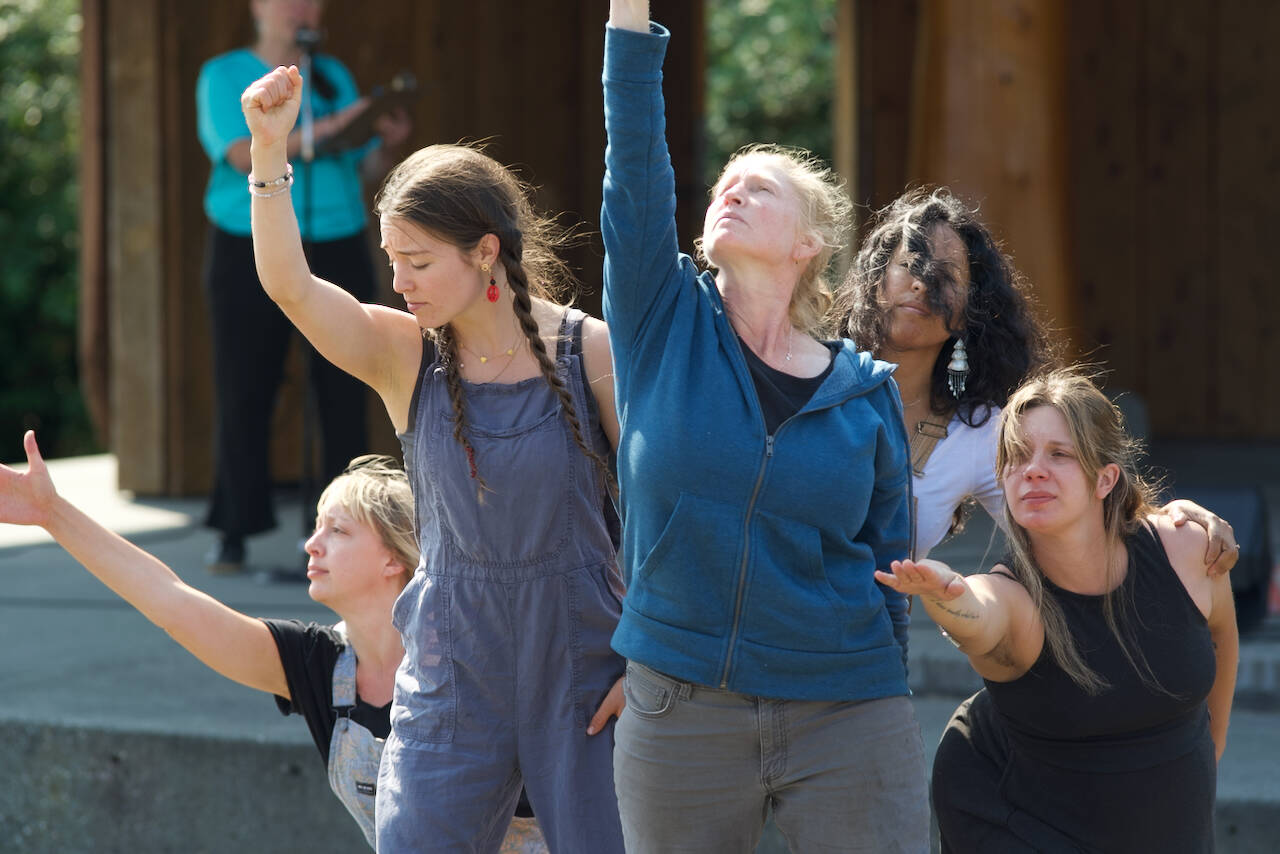
The rally featured performances from the Orcas Dance Collective and musician Clint McCune, who is also the father of Charlie.
Maria Poblet gave a call to action to the people on the Village Green: “We encourage people to self-organize where you have mutual alignment on what you want to do. We need so much leadership in this political moment, in every corner. Our goals for today are to keep strengthening our community and the connections between us so we can show up for each other and for the most marginalized among us.”
Natalie Zohar and Ross Newport from the Orcas Island Yacht Club presented their “Hands Across the Water” project, an effort to build bridges with Canadian communities affected by U.S. trade policies. The Sept. 19-21 event will bring American boats from Orcas Island to Salt Spring Island, British Columbia, Canada, for cultural exchange and is open to the public, both with and without boats.
Amy Venderwarker closed the rally by outlining concrete action steps, from supporting immigrant legal defense funds to pressuring elected representatives on various issues. The demands she articulated reflected the breadth of concerns raised throughout the afternoon: stop billionaire corruption of government, protect social programs, fund schools and health care, stop attacks on marginalized communities and invest in people rather than wars.
For young people like Charlie, the event represented both a source of hope and a call to action. Despite living in what Charlie describes as a small and protected area” on Orcas, they recognize the broader challenges facing this generation.
“I’m really grateful that right now there are no states in America where it’s illegal to be queer,” Charlie reflected when asked about what gives them hope. “Even with all the hardships we face, we can still be ourselves here legally.”
As participants left with concrete action steps and renewed connections, the rally demonstrated that even small island communities can make meaningful contributions to national resistance movements while nurturing the next generation of activists.
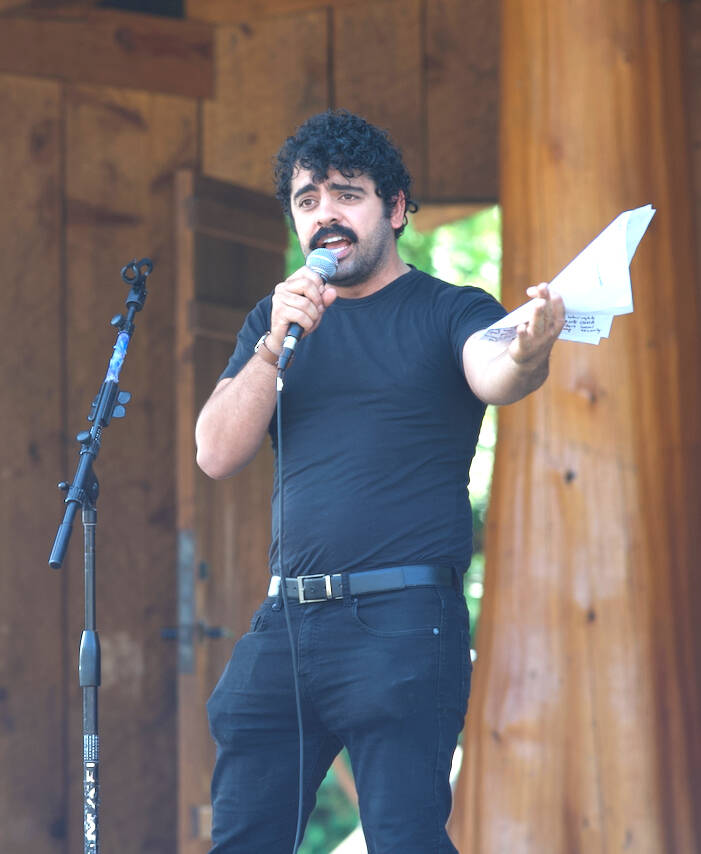
Darrell Kirk photo. Pedro Lopez de Victoria.
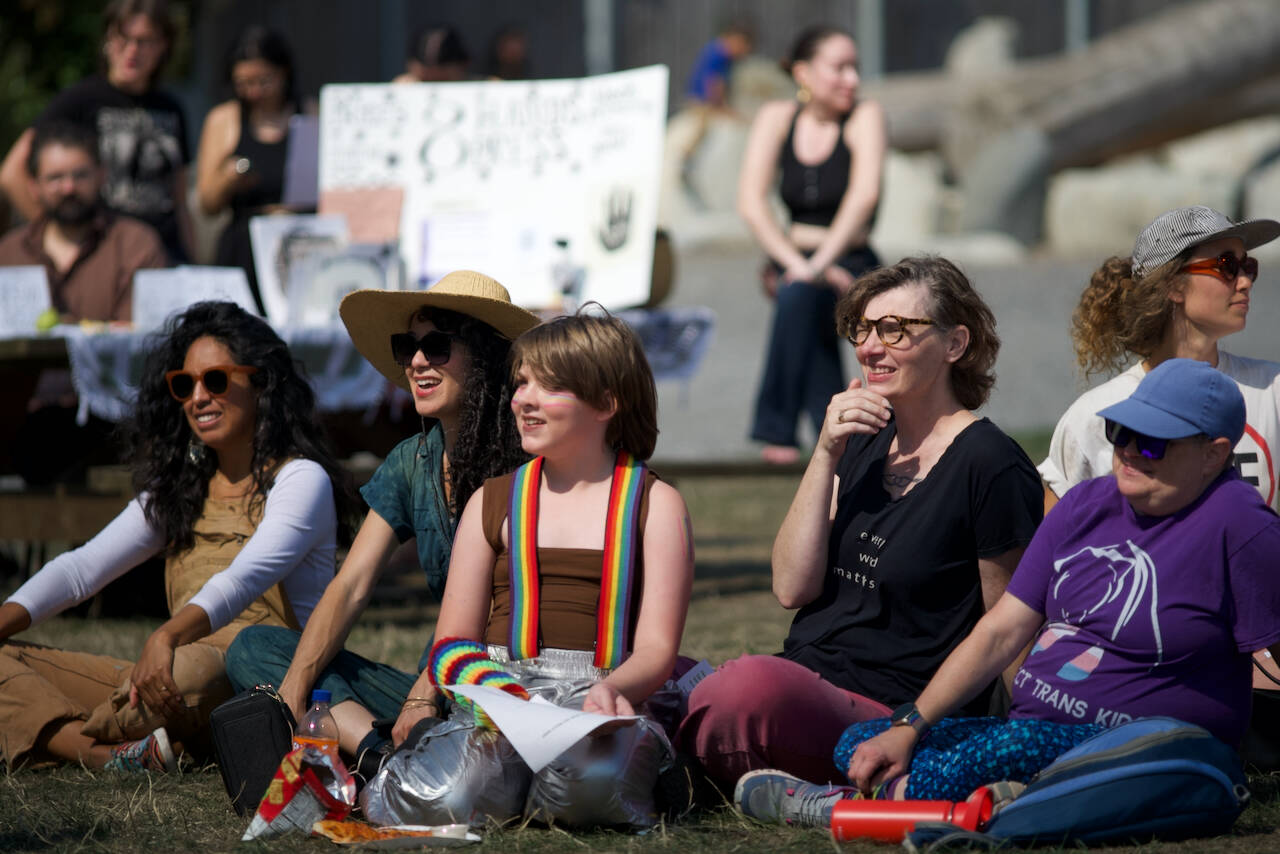
Darrell Kirk photo. Left to right: Bianca Cox, Natalie Menacho, Charlie McCune, Sara Pelfry and Shannon.