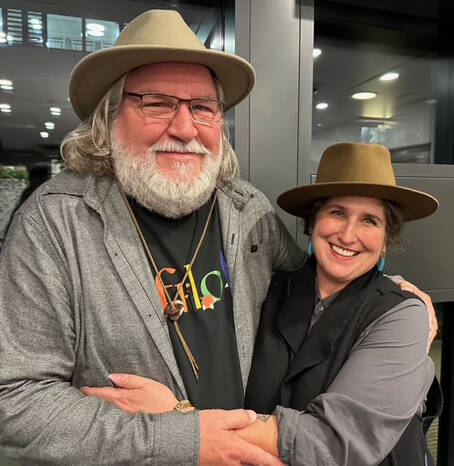
by Darrell Kirk and Colleen Smith Summers
Staff report
When Allen Hartle first got interested in radio as a young man in 1979, working the graveyard shift at a Safeway in South Seattle, he never imagined his journey would lead to creating one of the most innovative community radio stations in the Pacific Northwest.
“Honestly, I always loved electronics. I was very poor, so I didn’t really have access to too much of it, but whenever I’d find another speaker or something, we’d wire them up,” Hartle recalls of his early days. “I was really just a technologist waiting to happen.”
Today, that same spirit drives KIXP 102.3 FM, the new low-power FM radio station that began broadcasting from Eastsound in July this year. The community radio station, located on the corner of North Beach and A Street, marks the culmination of Hartle’s four-decade career in radio engineering and digital media, combining entertainment, community connection, and public safety as envisioned by him and his wife, Liberte Pedicini. In addition to the radio frequency, it can be streamed at https://www.kixp.org/.
‘The genesis of this initiative first started in 2019 when we moved to Orcas Island,” said Pedicini, who is the KIXP community engagement director. “Once we realized that the only emergency alerting is online, it’s not robust enough. Radio waves are this invisible guardrail that protects us. That was the root of it.”
The StayAlert branch of the radio station uses FM radio to deliver text alerts to public places, homes, phones and car radio dashboard displays. In the event of local emergencies, KIXP is offering direct access to on-air signals to Orcas Fire and Rescue, the San Juan County Sheriff and San Juan County Emergency Management. In October 2024, Hartle and Pedicni traveled to Geneva, Switzerland, to present the StayAlert initiative to industry professionals.
The station is also home to locally hosted shows that feature a diverse range of music, from world beats to country and soul. Long-time islander and musician Bruce Harvie donated 7,000 songs recorded in the islands, which play on the station throughout the day.
“A large portion of them he’s recorded, engineered, played on, or produced as part of his Radio Free Olga podcast. Our broadcast day is centered around a historic archive and a mission dedicated to the music of the San Juan Islands,” said Hartle, who is the executive director, general manager and engineer for the radio station.
A radio pioneer
Hartle’s radio career began serendipitously in 1979 via a friend who worked at KZOK Radio in Seattle. Hartle was a night stocker at a Burien Safeway store, where he would dismantle the PA system and install KZOK FM radio on it, allowing music to fill the store.
After meeting the KZOK Program Director at a social gathering, Hartle learned about a job opening that paid $18 a week for screening phone callers during an early morning talk show. This became the foundation for an extraordinary career.
“I quit. I’m in radio,” he declared, leaving his union grocery job for the uncertain world of broadcasting. “I was young enough and single enough and living frugally enough to where I could just be crazy enough to give it up.”
What followed was 13 years at KZOK, where Hartle rose from part-time assistant to chief engineer. In 1992, while still at the radio station, he created what may have been the world’s first real-time digital billboard displaying radio programming information.
“My manager came to me asking if I would build an electronic billboard that would display the ‘Now Playing’ information,” Hartle recalls. “I kind of wanted to say no, but we went ahead and said yes.” The innovative system collected artist and song title data from the radio studio and transmitted it via telephone lines to a massive electronic display on Mercer Street in Seattle. “That was probably the first use of metadata and the term broadcast metadata, very specific data regarding the audio program that I can think of.”
The creation caught national attention when Radio and Records, the broadcasting industry’s leading trade publication, featured it on its front cover in 1992. The success led to an upgraded commercial-quality electronic sign costing $14,000, which Hartle describes as “really expensive” for the time.
For the second time, his work was featured on the front cover of Radio & Records, and stations from across the country called to inquire if the billboard project could be replicated in their markets. A business was born. Hartle took “a few thousand dollars from a 401 (k) and set up an office in the corner of my living room of a very small house with three children running around it and started my first business.”
Operating from increasingly larger spaces, his company, Specialized Communications, sold digital billboard systems internationally. Metadata for Internet streaming media became a real marketplace, as did products like Apple iPod mp3 players. His company licensed his broadcast technology to Apple for three generations of iPod Nano Mp3 players, as well as Microsoft’s Zune MP3 player.
Emergency alert innovation
Perhaps Hartle’s most significant contribution to public safety came through his work with NPR Laboratories and FEMA in 2012. His company was hired to develop an emergency alert system for deaf and hard-of-hearing residents in 26 Gulf of Mexico radio markets.
The system utilized NPR’s satellite network to distribute emergency alerts to the station’s equipment for broadcast, which would ultimately activate bed shakers and strobe lights in subscribers’ homes, enabling deaf individuals to receive critical safety information. Unfortunately, budget cuts at NPR eventually ended the program’s potential.
When Hartle and Pedicini moved to Orcas Island in 2019, he began developing what would become KIXP’s dual mission: community radio and emergency preparedness.
“We started learning about the inter-island cables that feed us our electricity, telephone, and internet. And I thought, ‘What’s going to happen when the inter-island cables are impaired?” he remembers.
Using the 63,000-watt signal from KWPZ 106.5 on Mount Constitution, he developed a system that embeds emergency data within their radio signal, invisible to regular listeners but accessible through special receivers. Data receivers can be combined with electronic signs or kiosks installed in the community. The first public gathering installation will be at Oddfellows Hall.
Due to KWPZ’s redundant facilities on Mt. Constitution, the “StayAlert” system can operate even when the internet and power are down, providing crucial communication during disasters.
Getting involved
KIXP welcomes community participation through multiple channels.
“We have an unusually high number of talented, successful, motivated, artistic and conscientious people. We just have a really rich community,” Hartle said.
Added Pedicini: “KIXP is devoted to amplifying the missions of every single significant nonprofit on the island, and raising up the voices that aren’t being heard, including our Spanish-speaking community.”
You can send voice memos (including birthday and anniversary shout-outs) by email, while more involved participants can use the station’s professional recording equipment. In the near future, islanders will produce long-format interview programs, DJ shows and live performances from the studio. For those interested in participating, visit www.kixp.org to fill out a volunteer sign-up sheet. The radio station is a registered non-profit, and tax-deductible donations may be made at https://givebutter.com/KIXP. They are also looking for board members.
Pedicini gave a special thank you to Brad Brown, whom she calls “our number one volunteer and donor.”
“He has such a steadfast commitment to this project,” she said.
As KIXP continues growing, Hartle envisions expanding both its community programming and emergency preparedness capabilities. With the right financial support, the nonprofit can apply to the FCC to install additional KIXP transmitters at other locations throughout the San Juans.
“I would thank anybody and everybody who sees the positive energy in the project and is willing to contribute in any way, shape or form,” he said. “In an age of corporate radio consolidation and digital streaming, KIXP represents something increasingly rare: a truly local voice that combines cutting-edge technology with grassroots community engagement, all while maintaining a crucial public safety mission. For Orcas Island, it’s not just a radio station — it’s a technological lifeline and community gathering place rolled into one.”