By Darrell Kirk
Staff reporter
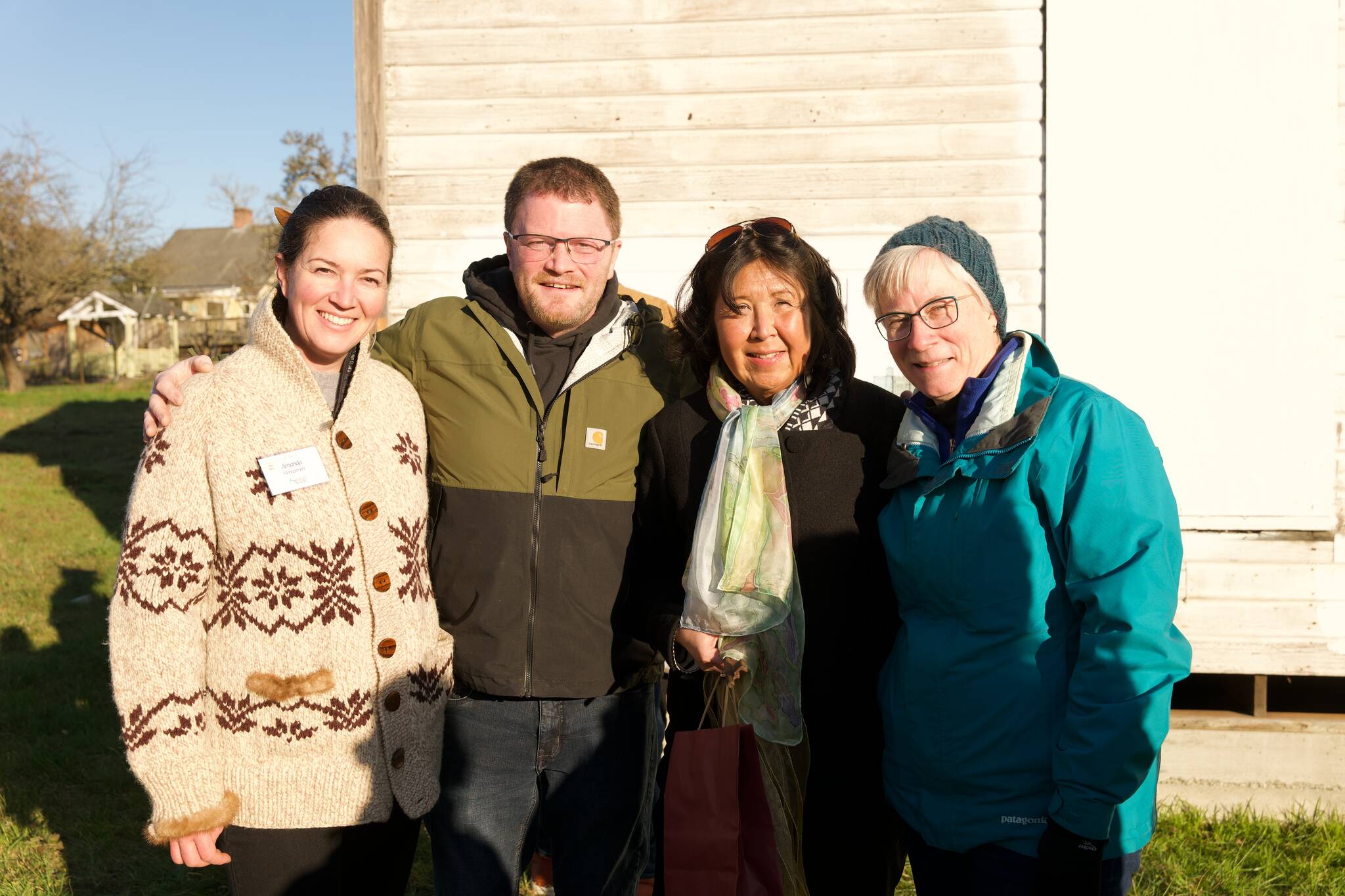
On a sun-drenched Saturday afternoon, hundreds of islanders gathered at 55 Pea Patch Lane to witness what many called a defining moment in Orcas Island history — the ceremonial ground turning for the Pea Patch Community Campus.
The January 25 event drew an unexpectedly large crowd. “When we decided to have this event, I thought there would be a hearty few who support us,” said Suzanne Olson, who has led the project for the past two years. “I did not expect so many wonderful warm faces.”
What made the gathering particularly poignant was the presence of children — students from nearby Salmonberry School, young residents of existing OPAL neighborhoods and the next generation of islanders who will inherit this legacy. As Heather Stansbury, the Food Bank’s capital campaign fundraising director, told the crowd, “Your grandchildren will be on this campus. They will be cooking food and picking apples and walking on the pathways. This is the start of something really big, and you are a part of it.”
A community building community
The $40 million Pea Patch Community Campus represents an unprecedented collaboration between OPAL Community Land Trust and the Orcas Island Food Bank on 11 acres of the historic Lavender Farm property, providing 20 new long-term townhome rentals with supportive services and a permanent Food Bank facility.
“Today we celebrated a milestone,” Lisa Byers, OPAL’s executive director, said just after the event. “We’ve gotten permission from San Juan County to do site work on the property, put in utilities and roadway access. This is the first step towards actually being able to build housing and the food bank.”
Washington state Rep. Debra Lekanoff, who traveled to Orcas for the celebration, said the project embodies rural communities taking care of their own. “The Pea Patch reflects community building like I’ve never seen before. I am moved to tears by the commitment.” Lekanoff has championed the project in Olympia, securing $5 million in state funding for site work in the 2025 legislative session. “For the last two years, this has been my sole capital budget project,” she told attendees.
San Juan County Councilperson Justin Paulsen also addressed the crowd. “Representative Lekanoff and I represent the government and the funding, but it’s other people who do the work,” Paulsen said, acknowledging Ryan Page, the county’s housing coordinator. “There’s a lot going on at the national and world level that we have no control over, but we have control here. We get to do this for ourselves. Let’s keep focusing right here.”
Lives transformed through affordable housing
Amber Paulsen’s story illustrates the project’s transformative potential. In an interview during the “Hands Across the Water Flotilla” in September 2025 in Salt Spring Island, Canada, where OPAL Community Land Trust presented to the community, Amber said: “Without OPAL, my family wouldn’t be contributing to the community 30 years later. OPAL was a stepping stone when I became a single mother. I had grown up on Orcas and wanted to raise my family there, but it didn’t seem possible until I could own a home through OPAL. My three daughters and I moved into Bonnie Bray, welcomed foster children into our home, and eventually built on another piece of land. We’re now in what I believe will be our forever home. I can’t imagine where my entire family would be without that opportunity. All three of my daughters still live on the island and have chosen to live here with their families.”
The Pea Patch townhomes will serve people earning between $21,360 and $40,600 annually, with projected rents from $485 per month for a studio to $1,038 for a two-bedroom unit.
“The people who will live in these townhomes are islanders that you see in the grocery store,” Olson said. “There are lots of very low income people on the island that you see every day and you’re just not aware of their circumstances.”
Meeting basic human needs
The project addresses twin crises of housing and food insecurity. According to the 2025 San Juan County Point-in-Time Count, 69 people were classified as homeless, with 40 on Orcas Island. More than 50% of island households qualify for Food Bank services, while the median home cost has increased 50% over the past decade to $1 million, with median wages around $52,000 per year.
Bob Morris, who serves on both the Food Bank and OPAL boards, explained the rationale for the new building in an interview with Olson. “We’re not building for what we have now. We’re building for the future,” he said. “We’re building for growth we’re already experiencing and growth we anticipate. We’re building for the capacity to handle disruptions. We’re building for a 75-year horizon.”
The Food Bank facility will include a commercial kitchen where surplus donations can be transformed into ready-to-eat meals, cooking classes can be held and community members can learn food preservation. “We want to turn those issues into positive outcomes,” Morris said.
Collaboration at every level
Extensive community engagement shaped the project’s development. In 2024, OPAL held design workshops with neighbors, people with lived experience, Spanish speakers and the community at large. Participants worked with site maps and movable pieces representing different campus elements to envision the best configuration.
The collaboration with Salmonberry School proved particularly meaningful. “The kids at Salmonberry School, I’ve been visiting the classroom on and off for the last couple of months,” Olson said. “They’re designing playgrounds as part of their STEM education, and they’re hopeful that the Pea Patch will consider putting a playground on the campus once they complete their designs.”
Other partnerships enhanced the project: a cost-share agreement with the Funhouse for additional parking, coordination with the Senior Center on access points, and a new sidewalk from North Beach Road, improving safety for children walking to school.
A vision rooted in history
The community land trust model OPAL employs traces its roots to the civil rights movement, when African American farmers in Georgia created the first community land trust to maintain autonomy over their housing and businesses. OPAL, founded in 1989, was one of the first on the West Coast.
The organization now stewards 120 homeownership homes, 102 rental apartments, five office spaces and more than 100 acres — housing between 8% and 9% of Orcas Island’s year-round population.
“OPAL’s mission is to maintain the character, vibrancy, and diversity of the Orcas Island community,” Byers said. “To me, that’s the very fabric of this community.”
Looking forward
As ceremonial shovels turned earth and children planted daffodils on the preserved knoll, the crowd sang a song Stansbury had written 30 years earlier: “We are builders, oh builders, from a long way back. Show me your dream and we’ll build it today.”
With $26 million already raised toward the $40 million goal, site work begins in March or April. Housing construction follows in summer 2026, with completion expected in 2027. The Food Bank building begins construction in 2027, with the entire campus projected for completion in 2028.
“This grew out of a stressful time during the pandemic,” Byers reflected. “We realized we could do better meeting our neighbors’ needs. That’s why we’re here.”
For the children who witnessed Saturday’s ground turning, the Pea Patch Community Campus will be woven into the fabric of their island home. Twenty years from now, they’ll remember the day their community came together to ensure that everyone, regardless of income, would have a place to call home and access to nutritious food.
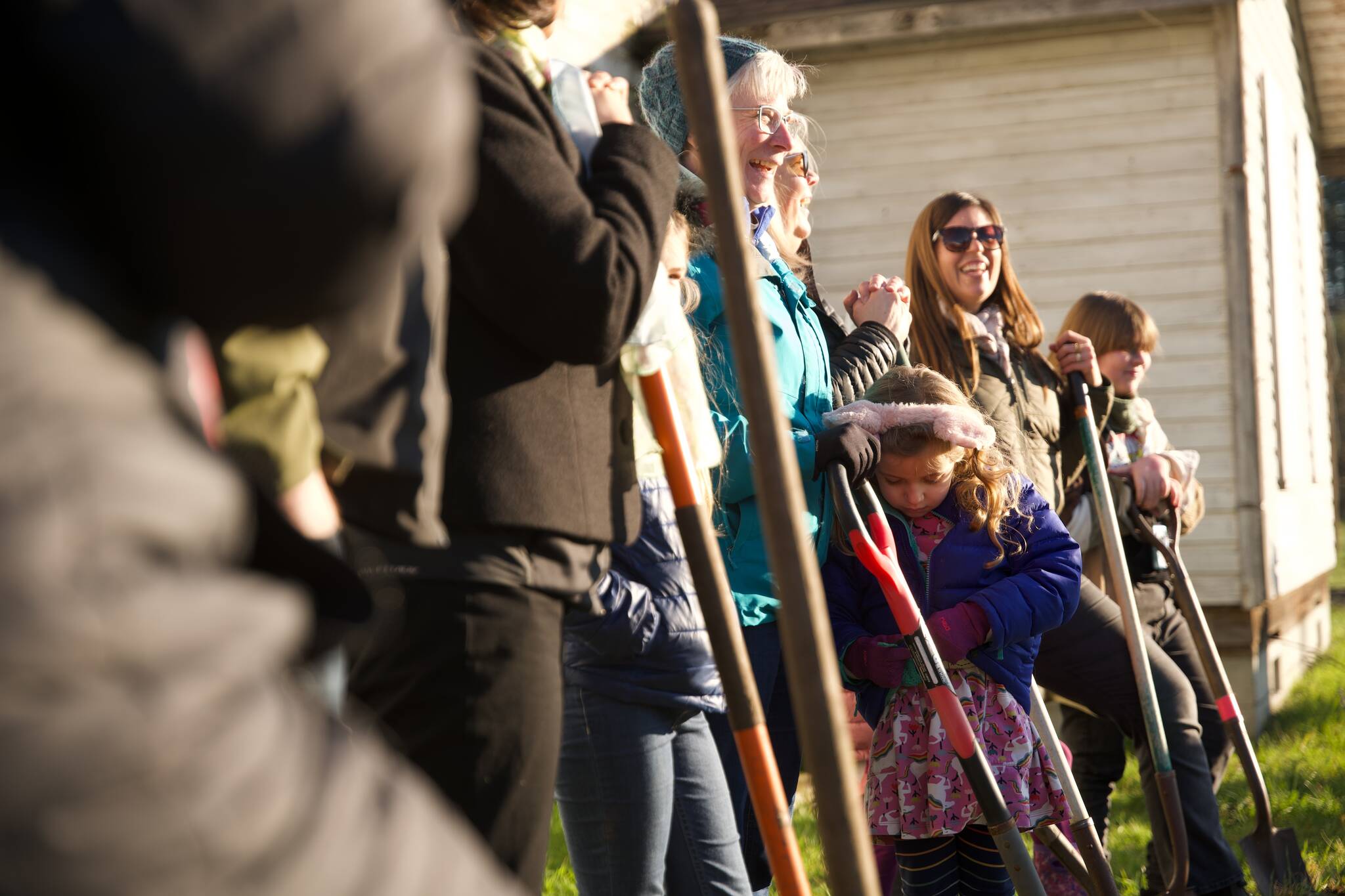
Darrell Kirk photo.