By Darrell Kirk
Contributor
San Juan County residents are confronting a harsh reality: the possible loss of Affordable Care Act subsidies is exposing fundamental flaws in America’s health care system that leave self-employed workers, people with disabilities and families choosing between medical care and basic survival.
“We have somehow decided to use the words insurance and healthcare as interchangeable words,” said Justin Paulsen, San Juan County councilman. “Healthcare and health insurance are two very different concepts, but we have allowed one to get in the way of the other. We have allowed the health insurance system to get in the way of the healthcare system.”
Jim Glozier, former executive director of a Center for Independent Living who now lives in Eastsound, has spent 40 years advocating for disability rights after his son Kyle was born with cerebral palsy in 1985. His transformation from civil engineer to activist was born of necessity.
“To many Americans, people in poverty are invisible. Disabled people are invisible,” Glozier explains. “We were cast almost as second class citizens, because now we had a son with a disability.”
San Juan Island resident Eva Luna describes feeling societal pressure about not having health insurance.
“There’s a lot of stigma, I feel, around people who don’t have health insurance. And I’ve always felt when I tell people I don’t have health insurance that they think there’s something wrong with me,” she said.
While acknowledging that insurance can be important for those who really need it, Luna emphasizes that her priority is being able to afford healthcare itself. When examining insurance plans through the ACA marketplace, she found the coverage promises misleading: “You look at what the insurance is gonna cover, but that’s not really what you’ll get. It’s kind of a bait and switch.”
Arna Robins-DeLappe, a nurse practitioner who owns Ancora Clinics on San Juan Island, faces an impossible situation.
“We looked at our rates through Ambetter, and they’re a little more than double — $2,800 a month is more than our mortgage. And frankly, it’s not affordable. I’m a nurse practitioner. I own my own clinic here on the island and I’m about to have no health insurance,” she said.
For Luna, who is a self-employed house cleaner and artist, the decision was clear.
“I’ve been uninsured the entire time and still am. I pay cash for medical care and put the rest into savings. That’s been a much better gamble than wasting my money on huge insurance premiums with little coverage,” she said.
Sarah Carlson, a 40-year-old pediatric speech language pathologist with a private practice in Friday Harbor, represents another facet of this crisis. Her family’s Regence plan costs around $2,000 per month with a $5,000 deductible per person.
“As a 40-year-old who’s healthy and works out and eats well, there’s nothing aside from an emergency surgery or catastrophic injury that’s going to exhaust my $5,000 deductible. It’s November and I’ve only spent $2,000 and none of that was illness,” she said.
Providers trapped in the system
Health care providers themselves are caught in this dysfunctional system. Carlson faces strict limitations.
“I am unable to bypass a family’s insurance company and take a cash rate — that’s against the contracts that I have with the various insurance companies,” she said.
Last year, Carlson made an agonizing decision to drop Medicaid patients.
“Medicaid over the past 16 years has dropped my reimbursement so much that I was actually losing money per session when I was seeing Medicaid patients. I had 12 families that when I dropped Medicaid were affected. Two families, we had to part ways very amicably,” she said.
Robins-DeLappe sees the fundamental problem: “You’re trying to put for-profit insurance companies to fix a broken health care system. We can’t depend on for-profit insurance companies to fix anything.”
The dysfunction is uniquely American. According to an article from the Peter G. Peterson Foundation titled “How Does the U.S. Healthcare System Compare to Other Countries?”, the United States spends nearly twice as much on health care per capita compared to other wealthy countries, primarily due to higher prices rather than increased service utilization, with administrative costs alone exceeding $1,000 per person. Despite this significantly higher spending, America’s health outcomes are not better than other developed nations and actually perform worse in metrics like life expectancy, infant mortality and maternal safety.
Adding to the crisis, Medicare has stopped covering telehealth services for most medical appointments, forcing elderly island residents to travel off-island for routine care.
“I just learned that Medicare is no longer covering tele-health services for medical appointments other than for very specific things (behavioral health and substance abuse). This affects me personally because I now have to go off-island just to get test results in Sedro Woolley. You know how that goes, as it means a whole day trip plus the ferry fare,” said Ellen Roberts from San Juan Island.
Government response
The San Juan County Council has taken action. Jane Fuller, vice-chair, described meeting with Rep. Rick Larsen on Nov. 10, who wanted to know “what’s happening with regard to the reduction to one health insurance plan carrier for those who are self-insured in this county.”
Fuller offered a measured perspective on the political situation. While the outlook doesn’t “sound very positive that ACA is gonna be saved,” she noted that “those eight Democrats or one independent as well, who voted with the Republicans yesterday, they did accomplish extracting a vote on ACA subsidies explicitly. And what’s important about that is it’s not any longer buried deep in a big bill.”
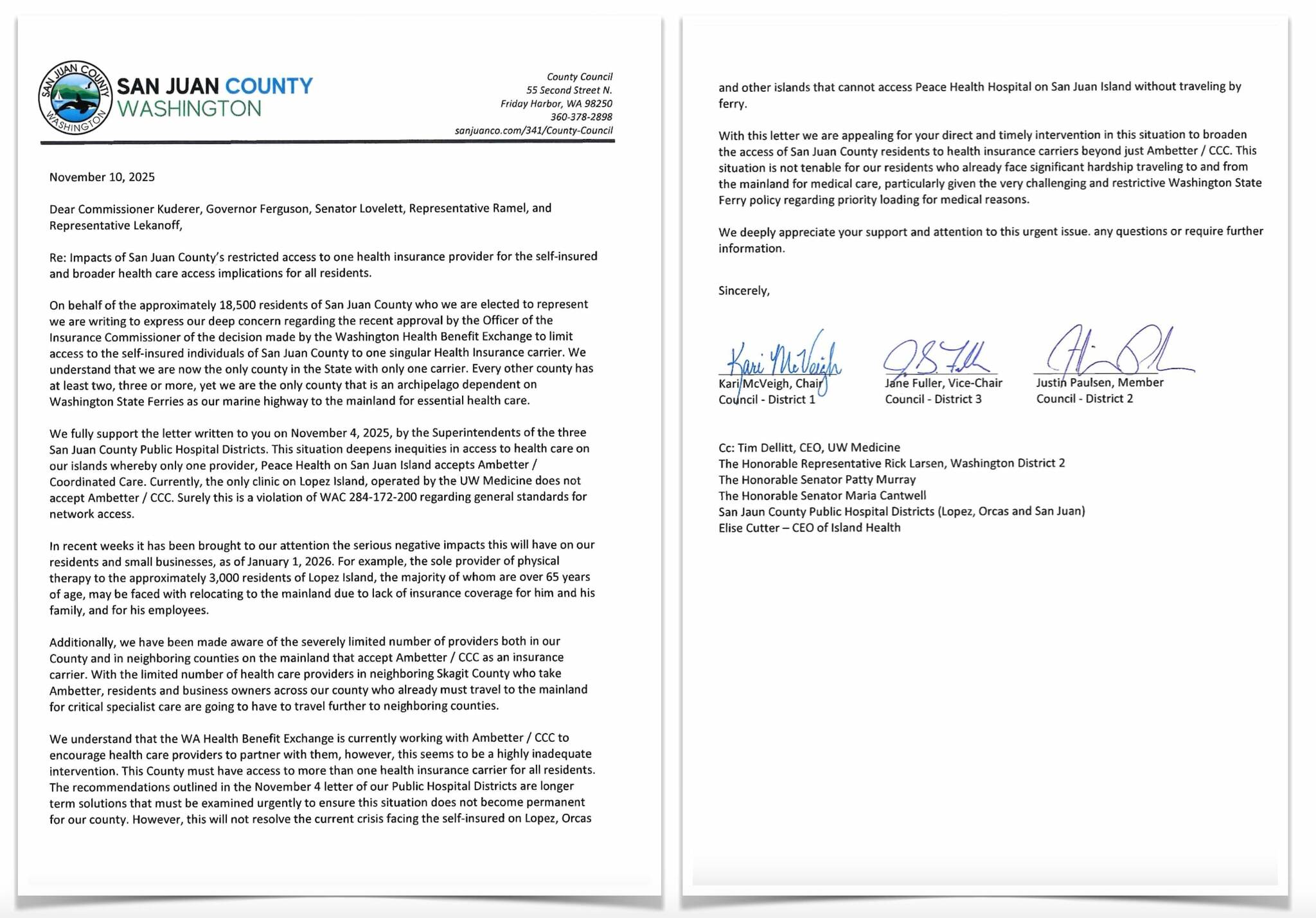
The County Council’s letter to state and federal officials emphasized unique challenges: “We are now the only county in the State with only one carrier. Every other county has at least two, three or more, yet we are the only county that is an archipelago dependent on Washington State Ferries as our marine highway to the mainland for essential health care.”
Hospital district superintendents sent their own urgent letter Nov. 3, noting that “UW Medicine will leave Lopez Island Clinic in June 2026, and a new operator has not been identified. Ambetter does not contract with UW, and it is unknown if a future provider will.”
Alternative solutions emerge
Robins-DeLappe and her business partner at Ancora Clinics are pivoting their model.
“We have looked at establishing something like a direct primary care model and doing a hybrid model practice where people could pay for a monthly subscription and get their medical care that way,” she said.
They’re also adopting a sliding scale for cash-pay patients.
Luna and her husband use Eventide, a membership-based medical practice in Friday Harbor. Luna believes that such membership practices, known as direct primary care, offer better value than paying high insurance premiums. Patients pay a monthly membership fee for access to office visits, basic procedures and consultations. There is a membership-based clinic on Orcas called Salish Sea Medical.
Councilperson Justin Paulsen revealed an unconventional lifeline: Orcas Fire.
“They are likely providing a lot of the service that would otherwise be provided by a health district or a health provider,” he said. “If you get a cut and you go into the firehouse and they bandage you up and send you home, under an ideal medical provision world, you would go to a doctor for that. But we don’t do that. We go to our fire department. The benefit there is they don’t ask you if you have insurance when you walk through the door, they just do it.”
Ben Luna, Public Information Officer for Orcas Island Fire and Rescue, said that every chief he’s worked with has consistently told residents to “call us anytime, day or night, no matter the problem.”
And residents do exactly that. Almost daily, people come directly to the fire station with medical issues.
Luna said the issues range from minor needs like bandages to serious emergencies like heart attacks.
While the fire department can’t officially call itself a clinic, Luna explained, “in some ways we serve in a capacity like an urgent care center might in a city because people just show up at the door.”
Luna described an innovative program that could further expand this role.
His understanding is that the CPS program was never fully established.
Paulsen emphasized the significance: “In our community, we are fortunate to have an EMS provider who is able and willing to provide those services without regard to a person’s insurance status or being on the hook later. Our community has said, we believe this is an important piece of function on our Island. And so we have allowed them the funds to do that work.”