Submitted by the Orca Network.
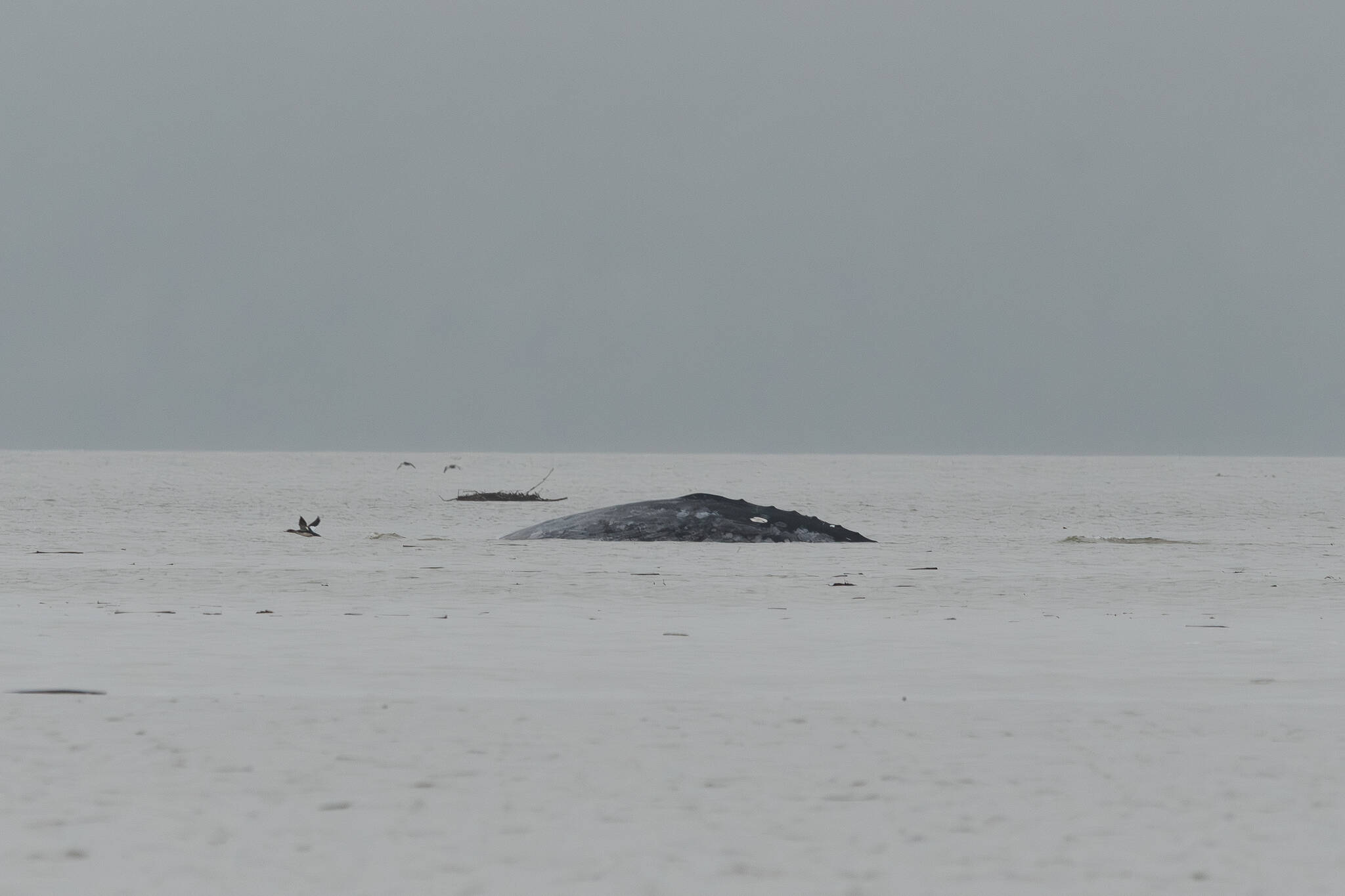
Little Patch, one of the “Sounders” gray whales who return to feed in the Salish Sea each winter and spring, was first spotted in Saratoga Passage on Dec. 11, just as torrential atmospheric river rains began to fall. The disastrous floods that followed damaged roads and levees, inundated homes and businesses and submerged farmland around Puget Sound. While floodwaters bring essential organic sediment that enhances the habitat for the shrimp and other invertebrates that feed gray whales, floodwaters also carry pollution and debris to the shorelines of the Salish Sea, which can be a problem for marine mammals of all kinds and visiting gray whales in particular.
“Gray whales feed on ghost shrimp that live beneath the sand in the intertidal zone,” said Cindy Hansen, education coordinator for Orca Network. “Things that wind up on the beaches after floods can also wind up in gray whales’ stomachs, and that’s a concern for Little Patch, Gretchen, and any other Sounders who might show up in the next couple of weeks.”
For several years now, Little Patch and some of the other Sounders gray whales have been arriving earlier than they used to, showing up in early December and January instead of in February or March. Gretchen is the second Sounder to arrive early this year, confirmed by Orca Network staff on Dec. 22.
The whales’ change in arrival coincided with an Unusual Mortality Event, or UME, in the overall gray whale population. While the UME was declared closed in 2023, the gray whale population continues to struggle with very few new calves born last winter, and many whales stranding or dying from malnutrition and ship strikes along the gray whale migration route. Many migrating grays in recent years were seen in poor body condition, an indication that their summer arctic food supply is dwindling.
The ghost shrimp that live in the sandy shores of Saratoga Passage, Port Susan and the Snohomish River estuary are an important food source for the gray whales that know about it, and throughout the UME newcomer gray whales have discovered that this part of the Salish Sea can help them survive.
“That’s one reason for concern about contaminated floodwaters,” says Hansen. “Floods carry all kinds of pollutants downstream, some of which may be harmful to the ghost shrimp, and some of which may be directly harmful to the whales.”
As floodwaters recede, cleanup efforts can include shorelines, and beachgoers are encouraged to look for and report debris or hazardous items to the proper authorities.
“It’s always helpful to take along a trash bag and gloves when you visit the beach, to pick up litter that might harm wildlife,” says Susan Berta, Orca Network’s director, “but after flooding like we’ve been having it’s important to report hazardous items to the right place rather than try to remove them yourself.”
Hazardous materials in the water or along shorelines can be reported to the Department of Ecology via their website, https://ecology.wa.gov/footer-pages/report-an-environmental-issue. If you find deceased land animals on the shoreline, refer to your county sheriff or local animal control. Stranded marine mammals in Island, Skagit or north Snohomish counties should be reported to 866-672-2638 or strandings@orcanetwork.org. In all other areas of Western Washington, call 1-866-767-6114. Boaters can report hazards to navigation due to flood debris on VHF channel 16.
For more information about Sounders gray whales and other marine mammals of the Salish Sea, visit www.orcanetwork.org.