

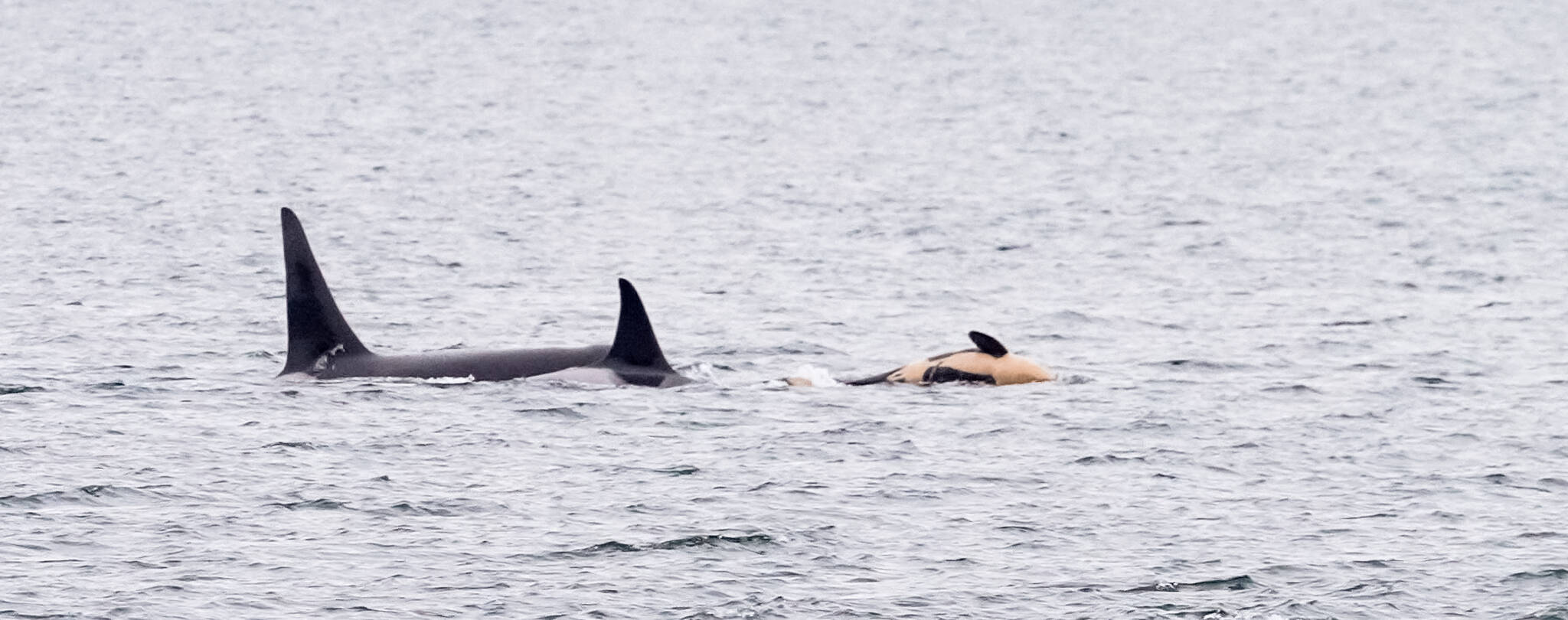
Just before the end of the year, Southern Resident killer whales welcomed a new addition to their struggling population.
An orca calf in K Pod was spotted frolicking in Puget Sound on Dec. 9. It is the first born to this pod since 2022.
There is also a high probability that the baby will not survive to reach adulthood.
“Yes, it’s something to be joyful about, but we also need to prepare for the worst,” said killer whale scientist Dr. Deborah Giles, whose nonprofit Wild Orca has merged with the SeaDoc Society. “K Pod has the worst reproductive success of all three [SRKW] pods. Prior to the birth of this baby, there was an 11-year period of no births. That is crazy. You can’t grow the population. All of the pods have suffered from this, but K Pod has been a flat line population for many years.”
K47, who has yet to be named, was seen swimming near likely mother K36, Yoda. The sex of the calf has not yet been determined.
Southern Resident orcas are divided into three familial groups, known as pods: J, K and L. Orcas were listed as an endangered species in Washington in 2004, and nationally in 2005. At that time, there were 98 whales. Today, there are 88 in total — 15 in K Pod, 27 in J Pod and 33 in L Pod. The population has steadily declined due to food scarcity.
“All three pods are massively impacted by the loss of Chinook salmon from the Fraser River, especially in the summertime,” Giles said. “It’s a conundrum. We have a list of [other] species that are reliant on different runs of salmon species that are also on the endangered list. We believe K Pod is significantly food-deprived. These moms don’t have a problem getting pregnant; they have a problem staying pregnant. They are nutritionally deprived.”
After a female orca becomes pregnant, she either loses the baby in gestation, has a miscarriage or gives birth to a stillborn. The whales are starving to death, and according to Giles, the increase in hatchery production has not included an allocation for orcas.
“Whales are not factored in for fisheries management,” she said. “We are absolutely going the wrong way with recovery. We are seeing six to eight new calves every year, and if one or two survive, we are lucky.”
Michael Weiss, research director with the Center for Whale Research, agreed that more needs to be done in order to help the whales.
“If we want more Southern Resident calves to survive, we need to make sure their mothers have enough to eat,” Weiss told the Sounder in April when J63 was born. “That means improving the abundance, size and health of Chinook salmon. This will require fisheries reforms, the breaching of obsolete, harmful dams like the lower four Snake River dams, and large-scale habitat restoration.”
On March 11, Rep. Dan Newhouse (WA-04) introduced a federal bill to protect the dams and remove funding for studies on their removal. HR 2073, the “Defending Our Dams” Act, which seeks to safeguard dams as a source of hydropower at the expense of the salmon population, has been referred to the Subcommittee on Water Resources and Environment and is cosponsored by three other representatives.
The San Juan Islands are in District 2, represented by Rick Larsen, who has historically been against removing the Snake River Dams. Larsen has secured funds for fisheries reforms, however. Larsen can be contacted at athttps://larsen.house.gov/contact/ regarding constituents’ desires around how he votes on HR 2073.
As a socially connected, intelligent species, the emotional impact of losing babies is significant. Tahlequah (J35) is heartbreakingly famous for carrying her first dead calf for 17 days in 2018. In late 2024/25, she gave birth prematurely to J61. That calf only survived for a few weeks and was carried by Tahlequah for 35 days. A new calf born to Echo (J42) in September 2025 was dead by November. Echo was also seen carrying her dead newborn in what’s believed to be a show of grief.
As the resident orcas are spending more time in local waters during the off-season, Giles is now keeping her research boat active year-round to collect and study scat.
“We’re trying to figure out this mystery,” she said. “The Federal government likes to point out that our whales are inbred, but there are even more inbred whales in other regions, and they are increasing in number.”
For now, whale researchers are watching this exuberant bundle of joy very closely.
“This baby is particularly important. We need those different genetics circulating through the populations,” Giles said. “I am cautiously optimistic.”
Resident killer whale births in 2025
J62: A healthy newborn seen on Jan. 1, 2025, near Seattle.
J63 (Suttle): Born to J40 (whose calf J60 died), this calf was spotted in April 2025 and named for its significance to the local Samish Nation.
J64: A new calf born to J42 (Echo) in September 2025, seen in Puget Sound but later presumed dead by November.
Calves L128 and J61 (born late 2024/early 2025) did not survive past mid-2025, with J61 carried by her mother J35 for days.
K47 (expected name): Seen Dec. 9 swimming near likely mother K36, Yoda.
Tamara Kelley photo. A new calf was spotted with K pod on Dec. 9.