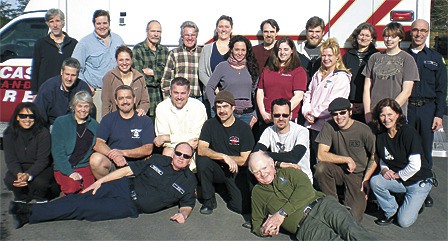
By day, they swing hammers, sit behind a desk, or clean teeth.
But in their off time, a group of 23 islanders are training to become Orcas Fire Department’s newest volunteer EMTs.
By this spring, they will know how to operate a defibrillator, tend to a mother experiencing labor pains, monitor vital signs, and much more.
Division Chief Patrick Shepler, who is teaching the course, says this is the largest class Orcas Fire has ever trained. Of the 23 students, 13 are brand new to the department. The rest are firefighters who are cross-training.
“It’s an eclectic group,” he said. “We have a former submariner and salvage diver, a dentist, and someone who used to work in the state department. The ages range from 18 to 72.”
Dwight Guss, who has been a firefighter for two years, decided to take the EMT class so he can help more people “in their hour of need.” He is also a mercy flight pilot, taking cancer patients to the mainland on a regular basis.
“I’m trying to take care of people who need my help,” he said. “And we’re trying to cross train as many people as we can.”
Guss said it’s a “pretty tough” set of classes, with a lot of studying. He decided now was the right time to buckle down and take the course, as work has been slow with his construction business.
“I’ve been doing a lot of ambulance calls, but now I’ll be more valuable,” he said. “I can be more than just an ambulance driver. A lot of what we’re learning isn’t new to me, but one of the most interesting things I’ve learned is how to deliver a baby.”
Guss says the most difficult part about being a volunteer firefighter is the 2 a.m. emergency calls.
“Being woken up in the middle of the night is hard,” he says. “But I do it. Everybody does.”
Classes began in early January, and students meet on Mondays and Wednesdays from 6 to 10 p.m. and every Saturday from 9 a.m. to 4 p.m. On April 3, they will take a comprehensive practical test with state evaluators. After that, they can take the National Registry Exam for certification.
Once certified, volunteers can respond to a call whenever they are available. EMTs are also asked to sleep over at the station and accompany a paramedic on calls two nights per month. Last year, the department responded to 700 incidents, 80 percent of which were aid calls. The most common cases are cardiac-related issues, strokes, and falls.
“We have four drugs that mainland emergency responders don’t usually have,” Shepler said. “It can take over an hour for a patient to be airlifted to Bellingham, which is the difference between disability and a full recovery. So we do a lot of things that the mainland doesn’t.”
In 2009, the department had a nearly 100 percent survival rate for cardiac emergencies.
“It’s all about being able to get there on time,” Shepler said.
Of the more than 50 department volunteers, only seven are just EMTs. EMTs are not required to cross-train, but firefighters are.
“I’ve been so impressed with how many people respond to calls,” said Shepler, who worked in a high-volume department in Florida before moving to Orcas. “They step up and make it happen.”