

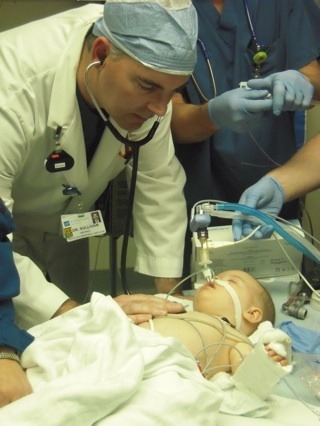
Every hour of the day, every day of the year, being on call to provide medical care to the people of Orcas Island is the job that Dr. Michael Sullivan, M.D. signed on for in 2003 as the island’s Medical Control Physician. Although not required under his contract, for him, that means that even when he’s on vacation from his other jobs, he’s still consulting on medical emergencies when the people of Orcas need him most.
“I tried to turn the job over to someone else when I went on vacation, but it just didn’t work out,” Sullivan said. “There’s such a unique set of information when dealing with emergencies from Orcas, but it’s really because of my relationship with the paramedics. Another doctor wouldn’t have the same relationship of trust that I have with them. I know the system really well.”
Understanding the system includes factoring in weather, alternative transportation, additional testing and his relationship with the island physicians.
As the medical director, he is contacted on every medical call to which Orcas Fire and Rescue responds. He consults on patient treatment and transportation issues until the situation is resolved. His job entails much more than consulting. He also analyzes personnel performance, the needs of the department, leads treatment reviews and group discussions, conducts classes for ongoing continuing education of Orcas Island EMT’s, conducts personnel medical exams, and manages the department’s health and fitness program.
“My role on Orcas, and throughout the San Juan’s, is to ensure that each emergency medical service provides the most value to the citizens and visitors of the islands,” Sullivan said. “I look at the cost and the quality of the service to make sure it equals value. I expect the highest quality available through training, education and medical protocols within the budget of the service.”
In addition to being the Medical Control Physician for Orcas, Sullivan is a fulltime emergency room physician at St. Josephs Hospital, the San Juan County Medical Program Director, and in Whatcom County, he is Medical Director for Cascade Ambulance, a firefighter lieutenant and has served for many years as a fire commissioner.
Sullivan is often doing a medical procedure at the hospital, while a nurse holds a phone so he can consult with a paramedic about an emergency on Orcas.
“I am a master multitasker,” Sullivan said. “When I have 15 people yelling at me, and a number of people asking me what to do, adding one thing is not difficult.”
He says this ability was cemented during his training at Cook County Hospital in inner city Chicago and in his emergency medical residency at the University of Pittsburgh. Due to the high volume of patients seen in the ER, he learned to quickly assess multiple patients with complex medical problems.
Since he was 16 years old and took a high school medical explorer post, Sullivan has known that he wanted to be in emergency medicine.
“I can remember coming out of the classes and thinking this stuff is just incredible,” he says. “I thought, ‘this is a body of knowledge that you could carry around and use it to help someone in the greatest time of need in their life.’ It wasn’t useless like reading the Grapes of Wrath.”
He became an emergency room volunteer at Harborview’s Trauma Center in Seattle, and had his first EMT position before he was 18. He went on to work two jobs simultaneously in the Northwest and Providence hospitals’ emergency rooms while completing his undergraduate education at the University of Washington.
He has served as the Assistant Medical Director for the City of Pittsburgh Bureau of EMS and was responsible for the one of largest medical helicopter services in the country and oversaw the airline disaster in 1994, of USAir Flight 427 that crashed outside of Pittsburgh killing all 131 passengers and flight crew.
He says he averages 60 to 70 hours of work a week, but has never added it up.
“I would probably have to take an antidepressant if I did,” Sullivan said. “I organize my life so that I can do all I need to do. I schedule time for family and friends including my three children; two daughters Caroline and Anna, ages 13 and 14, and my son, Thomas, age 17. I just don’t sleep a lot.”
In an effort to slow down the pace, Sullivan is restoring a 1953 American LaFrance fire engine. He will be driving the fire truck in the July 4th parade.
“I never tire of the emergency calls from Orcas,” Sullivan said. “I like getting them. I don’t have quiet days. At my base, I am an adrenaline junkie for sure. If I stand around with nothing to do, I get into trouble. I will do anything to keep myself busy including doing magic tricks and telling jokes.”
He started doing magic tricks for sick kids and always has one handy. “You never know when the treatment plan may be a magic trick,” Sullivan said. “I am a big believer in giving the right treatment. The other day, I saw a 97 year-old woman who was demented and confused. They brought her in for an evaluation and I wrote on her medical chart that the treatment she needed was soup and crackers.”
Sullivan to bring hypothermic resuscitation protocol to Orcas
As the medical control officer for Orcas, Sullivan makes sure that the emergency medical service has everything it needs to save lives and ensure the highest possible quality of life after an emergency. He arranged for the paramedics to have a clot-busting drug called TNKase, which is not available on any other ambulance in northern Washington. The drug is credited with saving the life of an Orcas resident this past winter.
His newest plan is to implement a procedure for “hypothermic resuscitation”. “If you go into cardiac arrest, we can now induce hypothermia to protect your brain from the chemicals produced when your heart is not beating,” Sullivan said. “With the new ambulance refrigerator, we keep IV Fluids at a certain temperature. My goal is to have the highest neurological resuscitation rate in the country right here in San Juan County.” Currently, brain injury is likely if cardiac arrest is untreated for more than five minutes. The induced hypothermia will extend that time. Reducing brain damage also helps improve overall survival rates from sudden cardiac arrest.
“It will be possible for a person who has suffered cardiac arrest to walk out of a hospital 72 hours later with no brain damage,” Sullivan said.