

by Heather Spaulding
Journal reporter
Ai Weiwei was a year old when his father, poet Ai Qing, was sentenced to hard labor for defending intellectualism against the Cultural Revolution in 1958.
The family was exiled to the far reaches of the Chinas Xianing providence, where they spent the next 16 years struggling to survive. According to the documentary about his life entitled “Never Sorry” by director Alison Klayman, he would not forget those experiences.
Weiwei’s art has been shown in the Tate Modern Museum in London, the Museum and Sculpture Garden in Washington D.C., Taipei Fine Arts Japan, Martin Grapius Berlin, as well as other venues across the globe. His human rights activism helped propelled him into the spotlight. Headlines have called him the most dangerous man in China.
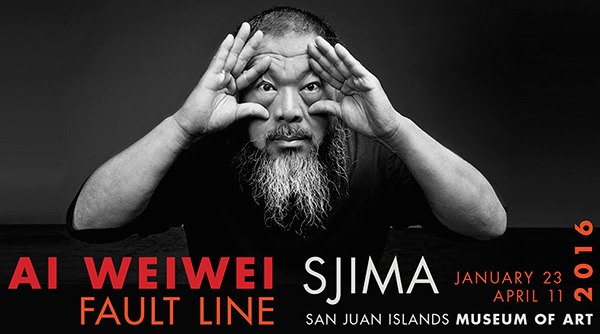
Human rights will be a major focus when the San Juan Islands Museum of Art brings “Ai Weiwei: Fault Line” to its halls Jan 23 through April 11. Fault Line was inspired by the 2008 earthquake in Sichuan, China.
Approximately 70,000 people died in that earthquake, more than 5,000 were children attending school. The exact number of students killed remains unclear, as the Chinese government has refused to publicize that information, “Never Sorry” explains. Undaunted by the lack of documentation, Weiwei made it his mission to find out the name of each child, and calculate the exact number of casualties. He gathered volunteers of all ages for his Investigation of the Sichuan Earthquake.
One year after the quake, Weiwei began work on an intense untitled project in Munich Germany. Across the façade of the Haus der Kunst Museum, he installed a wall of blue backpacks, bright pinks, yellows and other bright colors thrown in the mix, which, when stepping back, says in Chinese, “For seven years she lived happily on earth.”
“The thing about Ai Weiwei is that he is an artist who hasn’t shied away from human rights. That is very rare in the art world,” said Ian Boyden, executive director of SJIMA.
In 2012, Weiwei was awarded the Vaclav Havel prize for Creative Dissent from the Human Rights Foundation in New York. He is currently working on an exhibit in Lethos Greece in an attempt to help refugees.
Weiwei has been very clear, however, it is up to the audience to decide what his work means.
In the case of the Chinese government, the work is threatening.
“Never Sorry” discusses and shows footage of that reaction; officials have posted surveillance outside his studio in Beijing, interrogated him on multiple occasions, detained him for 81 days, beat Weiwei severely enough to cause a cerebral hemorrhage requiring emergency surgery, accused him of tax crimes for which there is no evidence, and shut down his blog.
“People say I am fearless, but I am not. I am fearful. I act more brave because I know the danger is really there. If you don’t act, the danger becomes stronger,” Weiwei says in the documentary.
In fact his childhood taught the essence of survival in the face of that danger. Weiwei spent his youth on the edge of the Gobi desert, where the family found shelter in a cave while his father served out his sentence. Necessities like food and water were a daily struggle. In 1976, Ai Qing, now having lost his eyesight due to poor nutrition, was pardoned, and the family returned to Beijing.
In the 1980s, Weiwei moved to New York City, during the Reagan era and Iran-Contra hearings. He was part of the first generation to be able to study abroad under Chinas new “opening up,” and while art engaged him, Weiwei could often be found watching TV, shocked a government would go through a cleansing process in public. He moved back to Beijing in the early 90s when his father’s health began to fail.
“Freedom is a pretty strange thing. Once you’ve experienced it, it remains in your heart, and no one can take it away. Then, as an individual, you can be more powerful than a whole country,” Weiwei smiles wryly in the film.
For those not familiar with his work, Weiwei uses a combination of materials and mediums.
“He provides you with a set of pieces, and you, the viewer, get the pleasure of putting that together,” Boyden said.
He describes one of the exhibits in Fault Line, which is made up of coffin like boxes. Within each box are pieces of replicated re-bar carved from marble. If the re-bar was made out of iron, there might not be much of an impression, but marble usually has some other associations to it. Some might be reminded of ancient Greek statues, others countertops, others still, may be reminded of tombstones. Further still, the marble was quarried from Sichuan, the very providence the earthquake occurred.
“So there are multiple layers in this piece. Now you, the viewer gets to test yourself. Is this political? Is it about equality? Depending on where you sit, your own experiences, is where you will draw your conclusions,” said Boyden, as his eyes sparkle.