The stories told by an Orcas Island apple
Published 1:30 am Saturday, November 29, 2025
by Russel Barsh
Director of Kwiaht
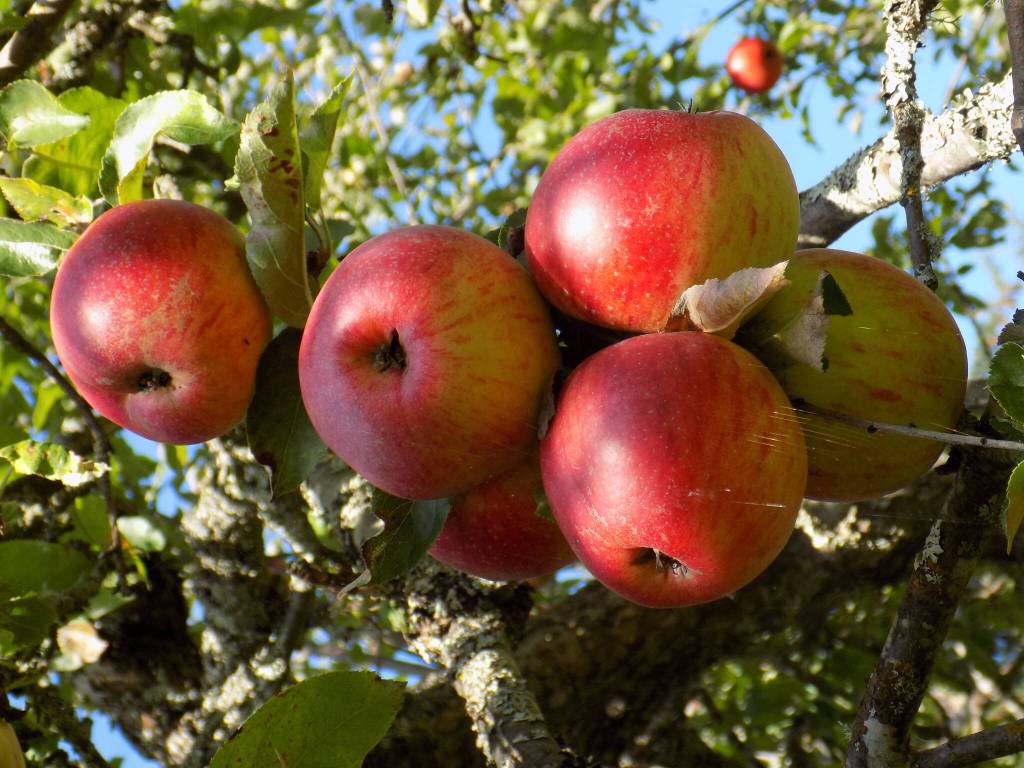
Kwiaht’s botanist Madrona Murphy calls it “Cayou Peach.” It’s an unremarkable apple to look at, but its flavor is unique. It grows on a single tree in Deer Harbor: a seedling hybrid that resulted from a bee carrying pollen from a bloom of Northern Spy to a Smith’s Cider flower nearly a century ago. A bird or raccoon ate the fruit and left its seeds nearby, already fertilized.
Cayou Peach is just one of more than 20 seedling hybrids of heirloom apple varieties that Kwiaht’s team has discovered while mapping and identifying the trees in Orcas Island’s pre-1930s orchards. Some are a century old themselves, very productive, and most importantly, delicious with unusual flavors and aromas that resemble rosehips, pineapples, citrus and other fruits.
Old orchards also have remarkable stories to go with their unique seedling varieties.
The first grafted trees of recognized apple varieties from the East Coast were brought to Oregon Territory in 1847 by Henderson Luelling, who established a pioneer nursery at Albany in the Willamette Valley. In 1852, he made his first shipments of grafted trees to settlers in Puget Sound, including the Crockett brothers, who were planting an extensive orchard near Coupeville. The same year, the Hudson Bay Company broke ground on San Juan Island for its Bellevue Farm. Bellevue was primarily a sheep ranch, but its manager, Charles Griffin, who grew up in Montreal, planted apples, grapes and hops around his home on the bay that now bears his name; and the Haskins orchard at Westcott Bay, already planted and producing by the mid-1850s, was feeding the British marines camped at Garrison Bay.
In 1865, Allen Kittles, a Georgia Cherokee who came to Puget Sound by way of the Trail of Tears and Gold Rush California, married a young Coast Salish woman from Lummi Island and put up an orchard on Sinclair Island with varieties available from the Luelling nursery. His son Robert planted a second orchard on Jones Island about 1885; some of the trees are still bearing fruit but have been severely damaged by campers and picnickers. Robert made his living as a steamship skipper around Orcas Island, and his brother John Taylor lived in Eastsound. They were friends of the Cayou family in Deer Harbor, which, in the days before motorcars, was just around the corner from Jones Island by boat.
There was a Caillou family in St. Louis, Missouri, as early as 1800, when the city was a small French fur-trading post. Hyacinthe Caillou was born in Yamachiche, Quebec; the township’s name is Algonkian, and it lies just west of the traditional territory of Mi’kmaq people, in an area where the Mi’kmaq-led Wabanaki Confederacy and the Haudenosaunee (Six Nations) had clashed three centuries earlier. Like most Acadian French families, the Caillou family had probably intermarried with their indigenous neighbors, who were also Catholic French subjects under treaties made as early as the 1580s. Hyacinthe’s parents had married in 1758, shortly after Great Britain began to expel the Acadians from what is now Atlantic Canada. One escape route available to Acadians at that time was the string of French trading posts and forts on the Mississippi River, like St. Louis.
One of Hyacinthe’s grandchildren was probably Louis Cayou, who reputedly worked for the Hudson Bay Company before he settled down in Deer Harbor. His Coast Salish spouse Mary was identified by her son, Henry Cayou, as a “Mitchell Bay.” These were families from the original cedar plank-house villages at Mitchell Bay and Garrison Bay, who spoke a dialect of Lekwungen, the same language spoken in Saanich, Sooke, Samish and Lummi villages. Like other Coast Salish communities, Mitchell Bay people traditionally managed and harvested thickets of wild Pacific crabapples (Malus fusca), and thus easily adapted to growing European apples. The Cayou family planted two orchards at Deer Harbor, and portions of both of them survive and still bear fruit.
The apples growing in the Cayou and Kittles orchards are a taste of living history, tracing back to New France, the fur trade, the Oregon Trail and multiple indigenous American cultures: Algonkian, Cherokee, Coast Salish.
Kwiaht is raising funds through the Orcas Island Community Foundation’s holiday catalog to continue identifying and propagating unique seedlings in historic orchards, telling their stories and making them available freely to island growers and gardeners through annual apple tastings, grafting workshops and scion exchanges organized in partnership with the Orcas Island Historical Museum. As Kwiaht botanist Madrona Murphy says, “History can be tasty!”