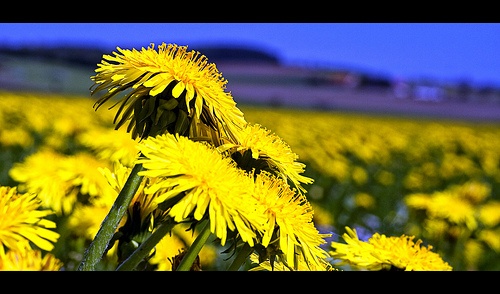
“Do you like butter”, asked my mother when I was a little girl, while holding a golden dandelion under my chin. I never did know if it was the yellow reflection of the petals or the dusting of pollen that provided the answer. There were plenty of dandelions in our big yard, and my sisters and I loved to blow the seeds from the mature heads and watch them float away in the breeze. Dandelions were an accepted part of life here in our island community, though our family did not eat them.
As an adult, living in the city, I learned that homeowners were expected to keep their lawns free of that despised weed, the dandelion. One could take the time to dig them or use weed-killer to eradicate the enemy at the roots.
Highly regarded by early emigrants to North America for their food and medicinal value, dandelion seeds were packed along with other valuables for the ocean voyages to the New World. Once planted, the seeds spread quickly in plowed soil and dandelions are now ubiquitous across the continent.
What was it about dandelions that made them so precious to our forebears? Have we lost that knowledge? Can we regain an appreciation of dandelions that will make them an important plant to us once again?
Dandelion history
The common dandelion (Taraxacum officinale) has long been used in Chinese herbal medicine and its use is documented in Arabic medical literature in the tenth and eleventh centuries. The plant is widely used in Europe as well as in Asia as food and medicine and is popular in the United States among some ethnic groups.
Health benefits
Dandelions are rich in minerals, vitamins and a number of active chemical constituents that may have therapeutic effects on the body. Dandelions are well-known for treating liver ailments and increasing bile flow with positive effects on the entire digestive system from stomach to bowel. Viral, fungal and bacterial infections, chronic inflammation, cancer, hepatitis and diabetes have been known to respond to dandelion usage. Warts may diminish with the application of the white sap which has also been used as an insect repellent.
Culinary uses
The challenge of eating dandelions lies in their potential for bitterness, a flavor that is hardly noticed by some individuals, and not tolerated at all by others. In “Making Dandelions Palatable,” Dr. John Kallas of Wild Food Adventures based in Portland, has several recommendations. Years of testing have revealed that the leaves are less bitter when grown in moist, rich soil in the shade and harvested in cool weather.
Two methods of preparation can reduce bitterness. Bring a pot of water to a boil, drop chopped leaves into the water and cook 3-5 minutes until the bitter flavor is reduced. Drain the water and use the leaves in any recipe that calls for greens. Adding the blanched greens to soups, casseroles, meatloaf or sausage, lasagna, an omelet, or grilled cheese sandwich are excellent ways to incorporate the rich nutrition of dandelions in the diet. Bitterness can also be masked with fats and oils. A combination of both methods is the most effective way to introduce dandelions to taste buds unfamiliar with this wonderful food.
Dr. Peter Gail’s classic book, “The Celebration of the Dandelion,” contains health information and over 70 recipes for dandelion leaves, flowers, crowns and roots, including dandelion wine and beer. Several books on cooking with dandelions and other garden plants are available for a reasonable price from Dr. Gail’s family business at www.dandyblend.com.
My favorite is “dandelion coffee” which is actually a richly-flavored tea made by simmering roasted dandelion root in boiling water. Roasting the chopped root until brown gives it an almost chocolate-like aroma. It’s also an ingredient in dandelion root ice cream! Digging roots, washing them until clean, chopping and roasting is a lot of work. If you develop a liking for this beverage, chopped or powdered dandelion root can be purchased by the pound from herb suppliers.
Garden benefits and pollinator food
According to Rhonda Barbieri of La Campesina Project, plants with long taproots such as dandelions are termed “dynamic accumulators”. The deep roots draw nutrients to the surface making them available to shallow rooted plants around them. Beneficial soil microbes, insects and worms live beneath the leaves and around the roots, leaving behind the fertilizer of their excrement to enrich the soil. “It’s what you leave alone,” says Barbieri, “that may be the most important part of your garden, so give yourself permission not to weed.”
John Steward, owner of Maple Rock Farm, says of dandelions, “They are beautiful and I don’t worry about them. Dandelions are not a big deal compared to pigweed which out-competes with root crops.”
Of course, the brilliant yellow blooms of dandelions attract scores of pollinating insects, vital to our food supply, so it behooves the wise gardener to maintain a healthy lawn and garden without the use of herbicides and pesticides. Even “natural” weed killers such as vinegar and citric acid affect the health of the soil and the creatures that live in it. Barbieri suggests a generous flushing with water following the use of any weed killer.
Growing your own dandelions
“Italian dandelions”, produced for sale by market gardeners, are actually sub-species of chicory (Cichorium intybus). Catalogna, Clio and Red Rib are varieties which produce erect, easy to harvest, clean leaves. The nutritional profile of chicory cultivars is similar to the common dandelion; however, the nutrients in dandelions are more abundant in nearly every category than in chicory (USDA Nutrient Database).
Dandelion or chicory seeds are sown in the fall or early spring in well-tilled, fertilized soil and watered regularly. For young, tender greens, plant seeds every two weeks when the soil is above 45 degrees.
Harvest roots in late winter to early spring. Plants two or three years old will yield larger roots.
A fresh outlook
My journey from childhood delight to adult frustration with dandelions has made a leap forward to an educated and genuine appreciation of the glories of this enduring plant. I now truly enjoy its brilliant yellow flower, knowing that it will lead me to its nutritious, healing qualities.
Betty Densmore is trained in Food and Nutritional Sciences. She enjoys gathering wild edibles on walks through the woods surrounding her home in Olga, and keeping her family and friends healthy with organic bone broths and traditional fermented foods.