

by Darrell Kirk
Sounder contributor
Before Washington’s eastern valleys became synonymous with towering pyramids of Red Delicious apples, another corner of the state held the crown for some of the most delicious apples. Not Yakima, but the San Juan Islands — and particularly Orcas Island — served as the proving ground where Washington’s apple industry, in part, first took root and flourished.
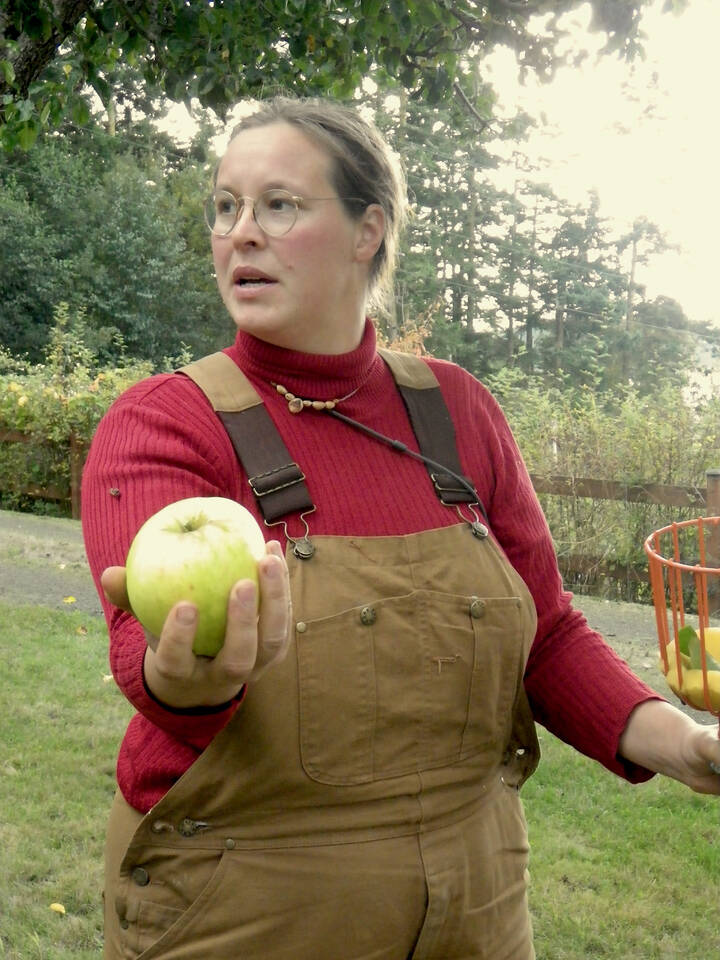
“It was a place where people certainly explored their dream for apples making them rich,” explains Madrona Murphy, a researcher and botanist with Kwiáht, who has spent years documenting the islands’ forgotten apple heritage. Through genetic analysis and historical detective work, she has uncovered a story that challenges the conventional narrative of Washington’s rise to apple supremacy.
Visit the Orcas Island Library on Friday, Sept. 5, at 4 p.m. for the free presentation of “Big Apples, Big Business: How Washington Became the Apple State,” a collaboration between Humanities Washington, Orcas Island Historical Museum and the Orcas Island Library.
Native beginnings and pioneer dreams
The story begins long before European settlers arrived with their grafted varieties.
“We have a native crab apple that was valued very much by the Coast Salish families that lived in the islands,” Murphy notes.
This native species, Malus fusca (qáyexw), provided the foundation for what would become a thriving apple culture.
“Some of the earliest orchards in the San Juans were actually planted by mixed families, typically with Coast Salish matriarchs, as kind of a way of reclaiming some of the land that wild apples grew on,” she said.
These early plantings established a tradition that would soon attract ambitious entrepreneurs seeking their fortunes in fruit. The commercial apple industry in the islands began in earnest in the 1860s to 1880s, reaching its peak around 1910. What made Orcas special wasn’t just its ideal growing conditions — it was the fierce competition and innovation among its apple pioneers. Two men in particular embodied the entrepreneurial spirit.
“There were a couple of nurserymen on Orcas — George Gibbs and George Meyers — who competed with each other to sort of have the best money-making production from their orchards,” Murphy recounts. “George Gibbs is responsible for bringing in the Wagener apple variety to the islands. Some of his trees disappeared, and he accused a nurseryman on San Juan of stealing the trees from him. It made the papers.”
The market demanded flexibility, and Gibbs and Meyers delivered.
“They started with apples and the varieties that they were planting. And then he and George Meyers decided that they would make better money growing prunes,” Murphy said. “There was sort of a prune craze on Orcas, which is how you have the prunes that still grow on Prune Alley. And then they decided that it really wasn’t in prunes. It was in pears, and they cut down their orchards again and replanted them with pears before the prunes even came into production.”
Building an industry
The apples grown on Orcas weren’t random selections. Murphy’s genetic analysis reveals a sophisticated understanding of market demands and shipping requirements.
“Most of the varieties that people were planting on Orcas come from the East Coast. So they’re New York and New Jersey varieties to a great extent,” she explains. “The most important apple, I think, grown in the islands is the King apple, which was from New Jersey, but is far more popular, I think, in the San Juans than it ever was, where it comes from on the East Coast and is found in nearly every island orchard that we’ve looked at. About 25% of the samples we sent from San Juan turned out to be King apples.”
The Baldwin apple from Massachusetts represented another strategic choice.
“One of the varieties that we found a lot of is the Baldwin apple, which comes from Massachusetts. And it’s a lovely apple, but the reason people grew it is that it’s very, very hard. And they can ship it quite a ways, and it arrives in good condition,” Murphy said.
The scale of Orcas Island’s apple operations was impressive.
“The idea was people were planting orchards as industry to ship huge amounts, big boxes of apples quite a distance,” Murphy explains. “There’s still an apple barn right across from the Coffelt Farm at Bill Perry’s place that was designed for storing and packing apples for shipping, and it’s been restored.”
The transformation that would strip Orcas Island of its apple crown began in the 1930s.
“It tends to be associated with the [D]epression, but it’s really associated with the damming and aggregate and irrigation around the Yakima area,” Murphy said. “Suddenly a lot more apple production could happen because the hot conditions are good for producing sweet fruit, but it was too darn dry without artificial irrigation.”
The decline was swift and dramatic. The planting of orchards in the islands peaked in 1910 and declined thereafter.
“So there are aerial photos of the islands from 1932. And a lot of the orchards that were planted around 1910 are still visible in those 32 aerials. And sometime between then and now, a lot of them were cut down, sometimes just neglected, but more often actively removed and replaced with things like pasture,” Murphy said.
The rise of Eastern Washington’s apple industry brought with it a fundamental change in what Americans expected from their apples. The Red Delicious apple, which Murphy describes as Washington’s state apple, exemplifies this shift.
“There was an emphasis on the appearance of apples, and Red Delicious color up beautifully. They’re very, very pretty, and at the time, there weren’t a lot of apples that looked like that,” she said. “Red Delicious totally changed apple culture here in Washington state, where it became the symbol of apples as a beautiful product rather than a really delicious one.”
Today, Murphy sees potential for a renaissance in island apple production, driven by shifting consumer preferences and the growth of the craft cider movement.
“The funding I had initially, before I started working with the Community Foundation to work on orchards, came through WSDA to look at heritage fruit trees as potential cider,” she said. “I love island apples. I think we grow better apples by far than the eastern Washington apples, and I think we have a better choice of varieties. The apples in the islands are going to taste better because they’re not just bags of water. They’re still getting enough sun to produce sugars, but they’re concentrated.”
Perhaps most exciting for the future are the unique varieties that have emerged naturally.
“We’ve been finding unique seedlings, because people planted apples in 1890 or 1910, and they’ve been growing, often neglected ever since, and they start to cross,” Murphy explains. “Apples are obligate outcrossers. They won’t self-fertilize. And so the seeds from every apple make new varieties. We’ve been sending samples from those seedlings to the lab at WSU and finding apples that grow nowhere else on Earth that taste wonderful and are really well adapted to the San Juans.”
One example is the East Sound Rose. It’s a cross of a very early apple, the Yellow Transparent, with a very late apple, the Wagener apple. They smell and taste like roses, ripening in August. The only tree that produces that apple is in Eastsound.
“People don’t know the diversity of apples at all,” Murphy observes. “Even the orchards, even the apples growing in their own yard, they can’t even tell me if the individual trees are very different from each other.”
The solution lies in storytelling and value-added products. She points to successful examples like Audra Lawlor of Girl Meets Dirt, “who definitely sells the heritage aspect of the fruit.”
Murphy says Salt Spring Island has hosted an Apple Festival for the past 20 years — something the San Juans could do. It features a display of over 400 varieties plus farm tours. She remains optimistic about the future, despite the challenges. The key is understanding what made the original industry successful and adapting those lessons.
Through research, education and the promotion of unique varieties and value-added products, Orcas Island could reclaim its place in Washington’s apple story.