

Eastsound’s Indian Island is coming back to life with a little help from scientists, local volunteers and visitors.
The 1.3-acre preserve, part of the San Juan Islands National Monument established in 2013, is barely 500 feet from Main Street and is accessible during minus tides. Increasingly popular for its scenic views and tide pools, Indian Island receives about 6,000 visitors each summer.
“That’s a lot of wear and tear,” said Kwiaht Director Russel Barsh, who has worked with local volunteers to study the island and engage visitors since 2009. “Not to mention the impact of resident Canada geese spreading weeds and lawn grasses.”
Indian Island served as a garden and shellfish-processing center for the Coast Salish village of Chulxwesing, chronicled in a 2013 exhibit at Orcas Historical Museum. One small house remained in the early 20th century, and a portion of the island was blasted away during the Depression. More recently, the island was used for many years to stage summer fireworks displays.
When the Indian Island Marine Health Observatory was organized in 2010 in cooperation with the Bureau of Land Management (BLM), the island was in poor shape. “About one-third of Indian Island was overgrown with English Ivy and blackberries and another third was bare earth,” Barsh recalled, adding that there was trash beneath the trees and a spiders-web of trails made by people, deer and geese extended over the entire island.
Traces of a coastal wildflower meadow remained, however. Kwiaht botanist Madrona Murphy found small dense patches of Camas and Chocolate Lily, wild onions, and pink Sea Thrift flowers. Scrub oaks just a few feet tall, and fringes of yellow Sanicle and Indian Celery completed the picture.
In collaboration with the BLM archaeologist, botanist, and recreation planner Nick Teague, Kwiaht and Indian Island volunteers decided to try to “give the island a rest”. They began asking visitors to follow a single route from the beach to the highest point on the island, marked with pieces of driftwood collected on the beach below; and to leave the upland completely undisturbed when seabirds were nesting. Weeds were gradually cut and removed by hand, being careful not to disturb fragile soils, cultural materials or native wildflowers. The Orcas Island Youth Conservation Corps played a major role in weed removal in 2013.
“Our original measure of success was the pair of Black Oystercatchers that nest on the island in May,” Barsh said. “Unfortunately the eagles, minks, otters, and ravens had other plans, snatching eggs and chicks. Four chicks survived and fledged, however, which is significant in light of the fact that fewer than a thousand of these birds are left in the Salish Sea.”
A pair of Rough-Winged Swallows soon joined the Oystercatchers each spring. There are now two pairs of these birds nesting annually on Indian Island, with several pairs of Violet Green Swallows. They occupy tunnels in the sandy bluffs on the south side of Indian Island, where visitors can observe them from the beach. In 2015, volunteers discovered that White-Crowned Sparrows and Killdeer were also nesting on the island. These ground-nesting birds benefit directly from limiting visitors to a single route through the meadow.
Meadow recovery has been marked by the spread of Camas and Sea Thrift, clothing most of the island with blue and pink flowers in spring. Stonecrops are re-colonizing patches of bare rock, producing an early summer flush of yellow blooms. Rein orchids are increasingly abundant in midsummer. Most of the green on the island when the Oystercatchers arrive in May is now Camas, rather than lawn grasses.
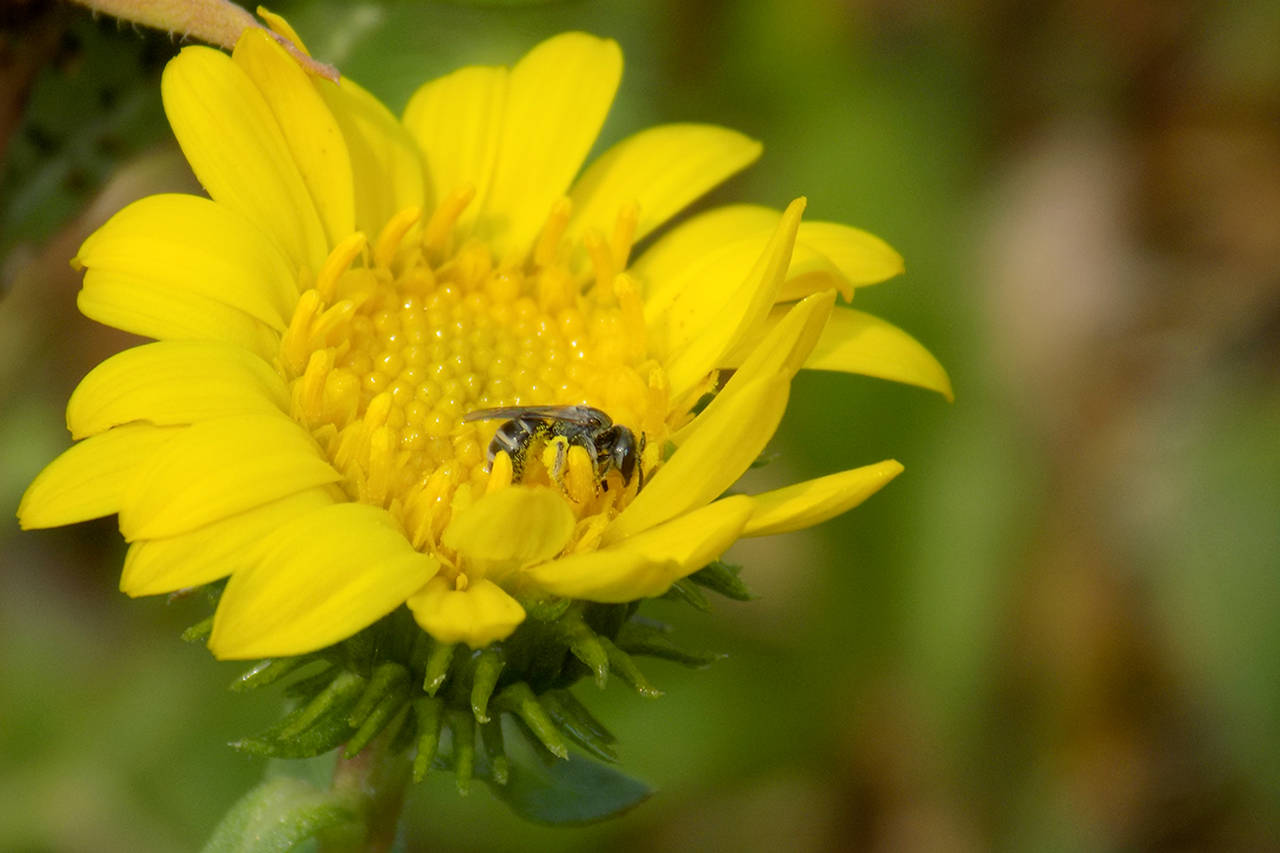
Another milestone in the island’s recovery was documented this summer. On the south end of the island, where a growing patch of Pacific Gumweed blooms yellow in late summer, Barsh found the ground nests of dozens of Lasioglossum, small gregarious native bees that never stray far from a supply of nectar and pollen. Previously, the pollinators seen on Indian Island were mainly bumblebees that can fly long distances and appeared to be “commuting” from Madrona Point and gardens in Eastsound.
This means that there are now enough flowers on Indian Island to support a resident community of wild bees, Barsh explained. “As the island’s meadow continues its recovery, we can expect increasingly spectacular wildflower displays as well as greater resident pollinator diversity.”
Indian Island is among the Monument sites that the BLM is considering for future management in the Resource Management Plan (RMP), a draft of which is expected to be released late this fall. Islanders will have an opportunity to comment on the kind of management they feel is best for the island. Should recreational access be unrestricted, as technically it is now, or should it perhaps be reduced to support the further recovery of Indian Island to a more native state? These are significant decisions that the public can influence. Look for announcements of National Monument Draft RMP Public Meetings where you can share your views on the future of Indian Island as well as Victim, Freeman, Skull, Massacre, Twin, Blind, Oak, Trinka Rock, and other small islands close to Orcas.
Volunteers are still needed to educate visitors and help protect nesting birds and wildflowers on approximately 50 low-tide days each year. Islanders can also help by donating to the Robyn Lowe Fund, established earlier this year by Kwiaht to honor the memory of an exceptional Indian Island volunteer by supporting the training of young islanders as stewards of public lands. Donations can be made on Kwiaht’s website http://www.kwiaht.org.