by Darrell Kirk
Sounder contributor
Four months ago, Ross Newport was having dinner at his Orcas Island home when the conversation turned to political tensions between the United States and Canada. What started as friends “complaining about Trump” transformed into an international flotilla that brought together hundreds of Americans and Canadians in an act of grassroots diplomacy.
“Are we going to be neighbors who build taller walls? Are we going to be neighbors who invade other neighbors? Or are we going to be neighbors who bake cookies and take them to the neighbors?” Newport asked from aboard his vessel, the Island Gypsy, heading to Salt Spring Island. “I think we all want to be the bakers of cookies, not the invaders.”
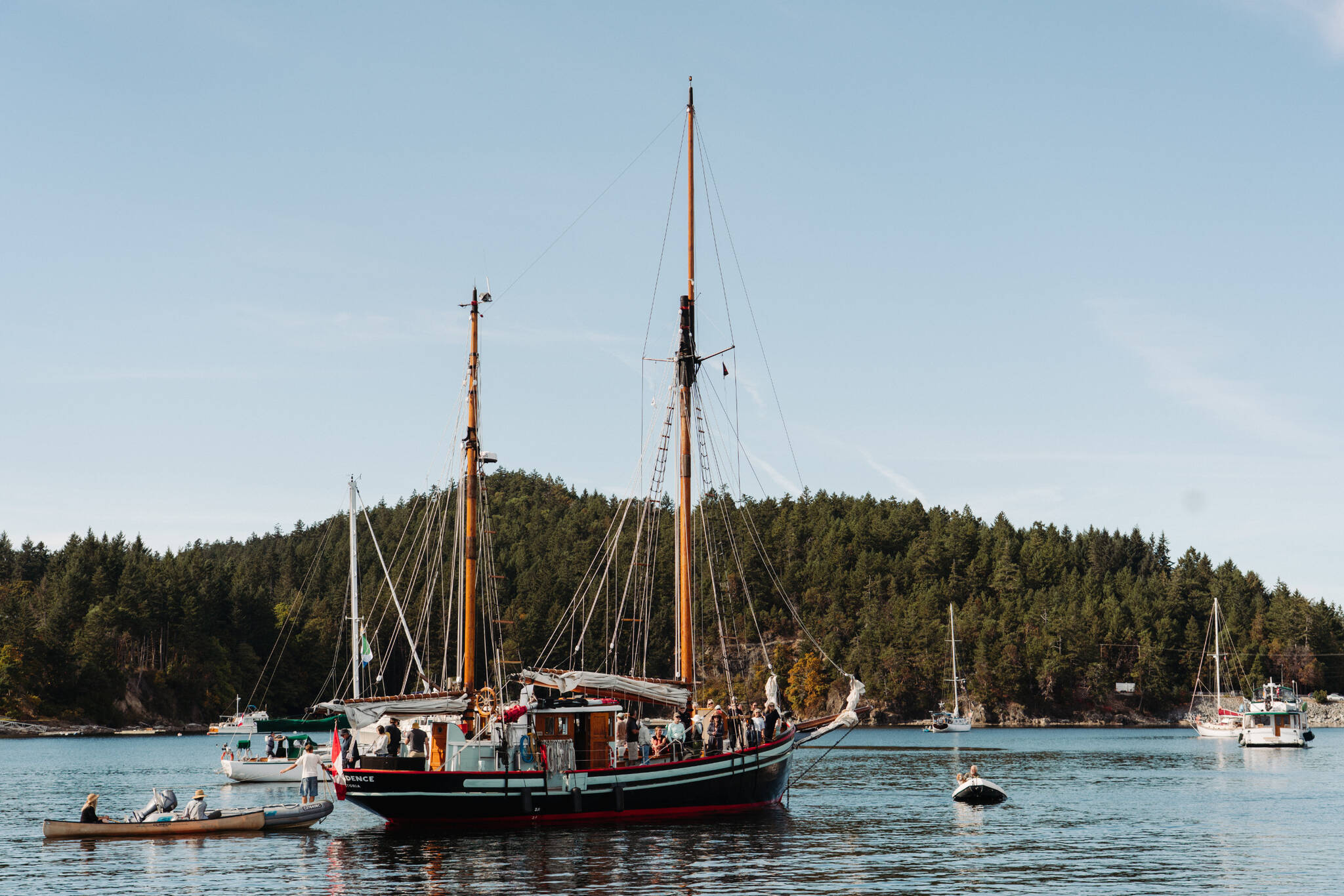
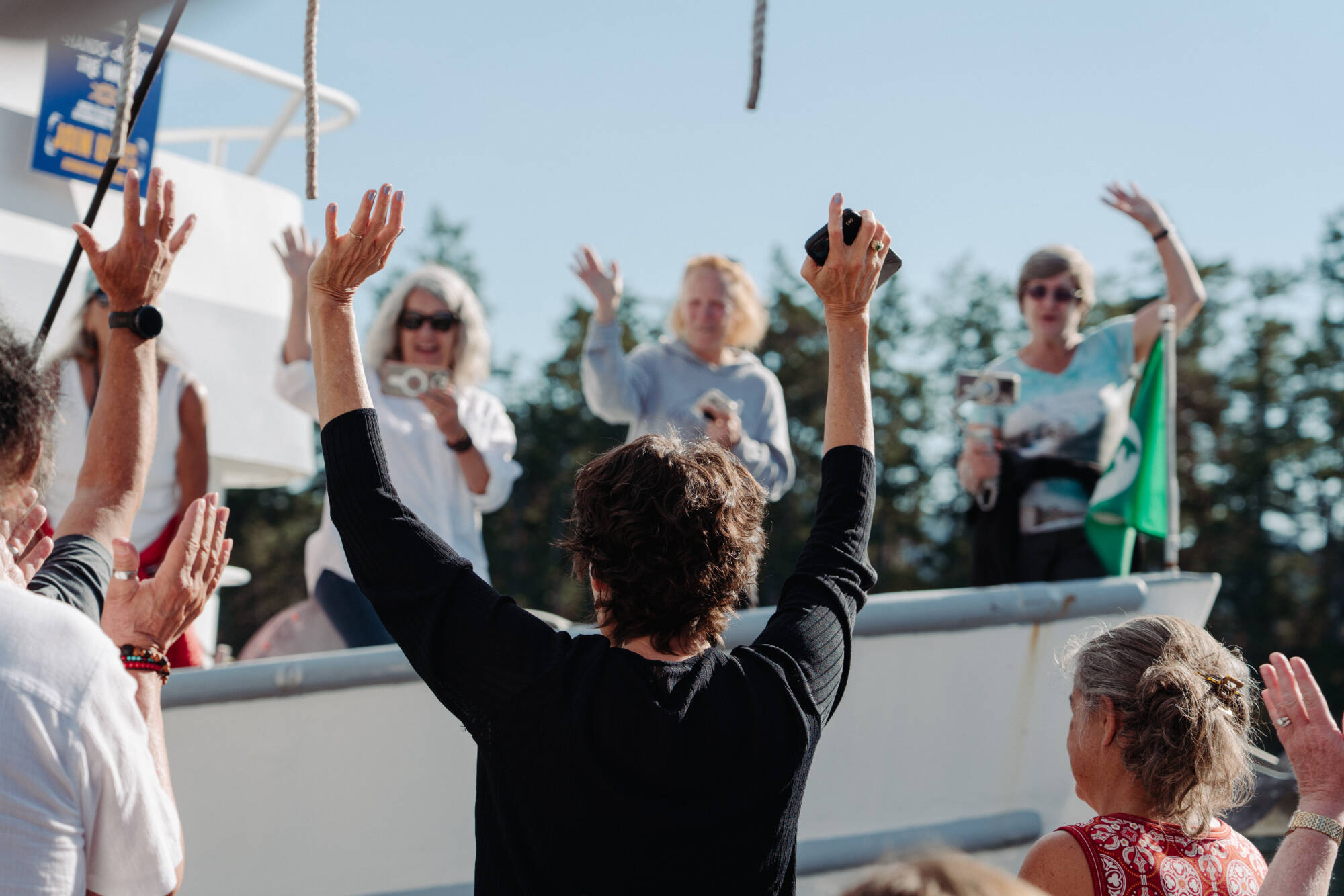
The September event, dubbed “Hands Across the Water,” saw approximately 100 Americans travel by boat from Orcas Island to Salt Spring Island, where they were welcomed by hundreds of Canadian neighbors for three days of panels and cultural exchange.
“I’m so grateful for this event because it’s easy to say that we’re sad about what’s going on [between the United States and Canada],” said organizer Natalie Zohar. “But this is doing something. We don’t get to just sit back and say, I’m sorry this is happening, but we’re doing something.”
For Pacific Northwest islanders, borders represent both barriers and opportunities. Patricia Benton of the Orcas Community Resource Center captured a common sentiment: “A border is simply in someone’s mind. We’re all the same across each border. We all have the same needs, the same highs, the same lows, the joys and sorrows.”
Yet political tensions have created measurable impacts. Jason Roy Allen, president of the Salt Spring Chamber of Commerce, reported American tourism declined by more than 30 percent this summer.
“We’ve seen the cost of goods go up and up and up… tariffs impact us on both sides of the border,” Roy Allen said. “Even our Visitors Information Center has received calls from mostly travelers from Washington State asking if Americans are welcome.”
Steve Martindale, a Canadian barred from entering the United States for life due to a visa overstay, highlighted the complexity of the border.
“Like a lot of Canadians, I have been barred from re-entering the U.S.,” he said, explaining how what was once a porous boundary has become restrictive since 9/11. “We’re more constrained by the ferries because, you know, to get anywhere you have to get on a ferry. The ferry schedule kind of rules our lives.”
Despite formal borders, the islands face similar challenges that formed the basis for three panel discussions. The housing panel revealed parallel crises on both sides of the boundary.
Lisa Byers of OPAL Community Land Trust received a warm welcome at the panel, and in fact, many in the audience and Salt Spring counterparts already knew of OPAL and wanted to know more.
“This form of the community land trust first took shape during the civil rights movement, when Black farmers in southeast Georgia were trying to figure out how to have autonomy over their housing, businesses, and ability to have a life,” Byers said. “They created what became the first community land trust in the country — an 8,000-acre farm that survived for about 10 years until discrimination by our federal government resulted in bankruptcy. The community land trust model is rooted in strong values around finding a way within a capitalist system to decommodify land. It stems from a value system that views access to land as a gift from God — not something for us to profit from, but something for us to figure out how to share.”
Gary Holman, director of the Capital Regional District on Salt Spring, went on to say: “You need to disconnect housing from the market because the market, especially in one of the most desirable areas in the world, will drive prices inexorably upward. The funding that is available requires housing agreements — like covenants on title —that ensure affordability in perpetuity.”
Justin Paulsen, San Juan County Councilman, and construction company owner described the challenges of building affordable housing and emphasized that building codes significantly increase construction costs, particularly citing examples like mandatory heat pump systems that can add $20,000 to a 400-square-foot tiny home when a $200 electric heater would suffice, and upcoming fire prevention requirements that could add 10-15% to construction costs.
He stressed the need to balance building quality with affordability, arguing that while everyone deserves good housing, overly restrictive codes that prioritize “the apex” over basic shelter make it nearly impossible for private builders to deliver affordable housing that keeps their businesses viable.
Young residents expressed similar frustrations. Kya Dalton, a Salt Spring resident who attended the event with her baby in tow, said, “Anyone in my generation understands that the only way we’ll own property is through co-housing and doing it together.”
The marine environment panel highlighted how ecological systems ignore political boundaries. Cindy Elliser, Associate Director of the Salish Sea Institute, emphasized that “this is one giant connected ecosystem that should not be managed separately, and yet it is.”
The indigenous panel provided a poignant perspective on borders. Ken Thomas, on the fisheries and council of the Penelakut nation, explained: “These waterways were our highways pre-contact. We utilized all these areas all the time … we had camps and villages all along Salt Spring … You know, the water didn’t stop us. It was these borders that were drawn up, and the division, you know, is real.”
Josiah French Feld from the Mitchell Bay Nation on San Juan Island spoke on the panel, via cellphone, and he and Jill Harris (Nemetia) from the Penelakut Nation on Salt Spring, immediately connected and learned that they were related. Harris explained how her grandmother would ceremoniously take her father and aunt to shake hands with Josiah French’s grandmother — a ritual whose significance became clear only through years of genealogical research. Her research revealed that her great-great-great-grandfather was born on Guemes Island in the San Juan Islands, demonstrating how families were connected across what would later become international borders.
French Feld continued: “Healing these waters is not just Indigenous work — it’s human work. We have to first recognize that border and what it is. When we remove that border and have a conversation, we get to choose who these Indigenous people from this place are and who has the hereditary knowledge of where it all comes from.”
Ross Newport, who participated in the indigenous panel as an ally, reflected on learning from indigenous perspectives: “That moment in history when the border got drawn was an incredibly devastating moment for indigenous people. People were dying from smallpox. People were being rounded up and sent into reservations. People were being forced to leave here and move across the new border, which included moving to Salt Spring.”
Newport emphasized the importance of changing colonial place names: “On Orcas, I live in a place that for over 100 years has been called Massacre Bay … Dead Man’s Bay on San Juan Island … These names are very hideous and I would like to see many of them change.”
The event produced tangible outcomes. Zohar announced a cross-border radio programming partnership between Orcas Island station KIXP and Salt Spring’s station. In addition, multiple organizations established ongoing collaborations throughout the three day event.
Paulsen delivered an official proclamation recognizing the event: “While we occupy lands divided by a national border, this event is a recognition of our shared values, a celebration of our unique cultures, an acknowledgement of the struggles, past and present, that our communities face together.”
As Canada’s oldest wooden passenger ship, the Providence, led the flotilla through Salish Sea waters, participants demonstrated that community connections can transcend political tensions. In Zohar’s words: “It’s not so much about country to country. I think it’s about community to community.”
Orcas Video photo.
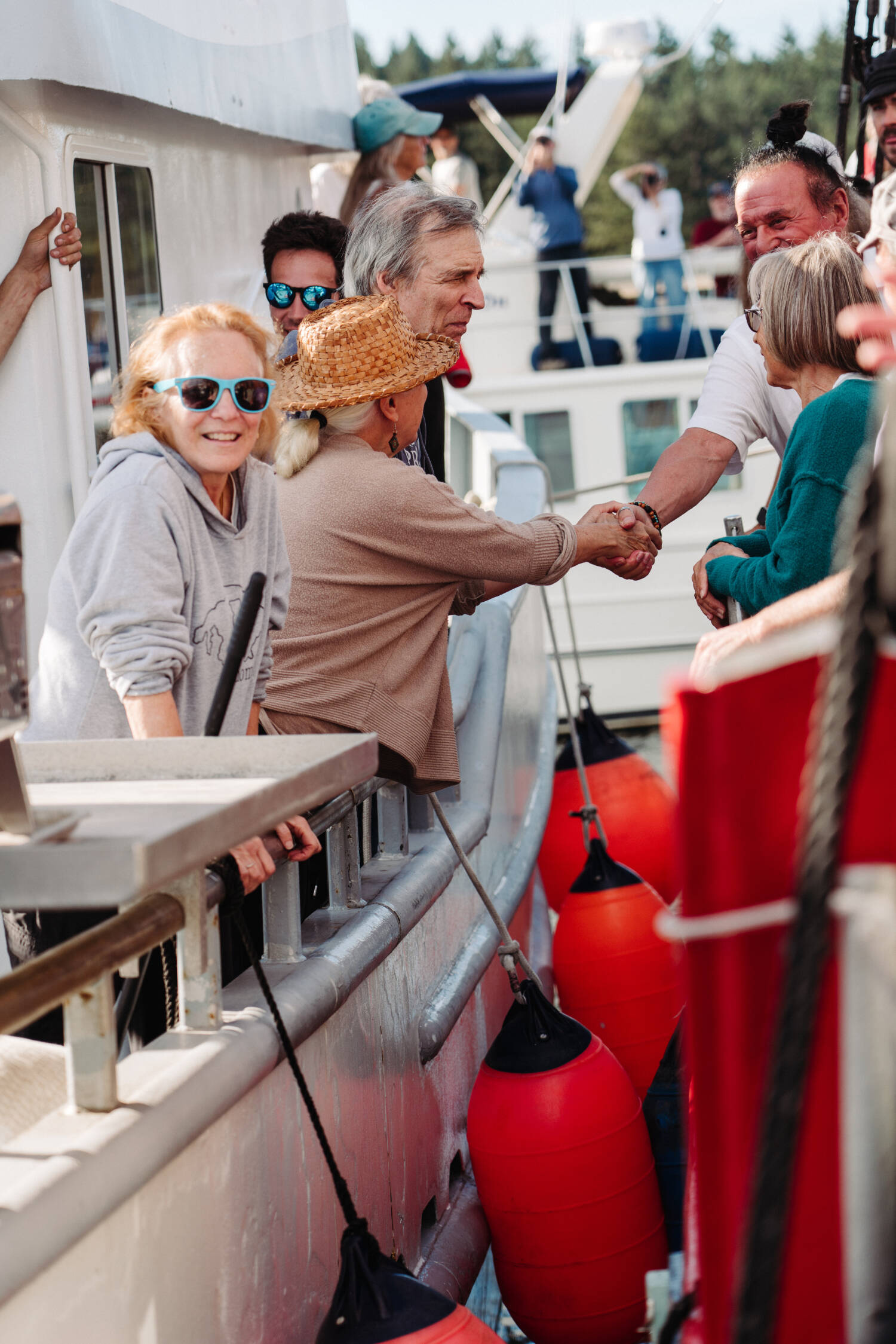
Orcas Video photo. Orcas Islanders (far left) shaking hands with Canadians during the flotilla.