

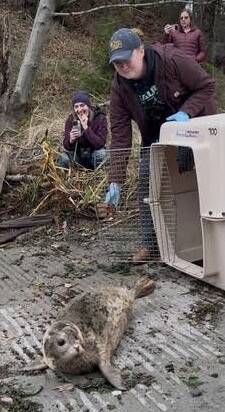
Al Dente’s round face and large watery eyes emerged from his cage, curious about his new surroundings and the small group of humans standing around. In moments, he was free, galumphing down the cement boat ramp at the San Juan County Park, and with barely a splash, back in his native waters of the Salish Sea.
“He came in with a head wound that was pretty severe,” Christine Parker, veterinarian for SeaLife Response, Rehabilitation and Research, known as SR3, said. Al Dente also sustained an eye injury, was malnourished and suffered from pneumonia. It is suspected that the injuries were caused by a dog.
Al Dente was found on Orcas last summer. It is estimated he was likely only a few days old at that time, and weighed only 16 pounds. Responders from the Marine Mammal Stranding Network through the Whale Museum assessed the seal’s situation and contacted SR3. Wolf Hollow was not able to take seals at the time, but hopes to be able to take them again next year.
Realizing the ferry and driving would take too long, other transportation methods were looked into, and a generous person donated a flight to Renton. “As you can imagine, with an animal as injured as he was, getting him into care as quickly as possible was essential,” Casey Mclean, SR3 director, told the Sounder.
The woman who found him stayed with the days-old pup as he waited for his flight.
“He was suckling on the plane’s seat,” Nathan Yoffa, husband of the woman who found him, told the Sounder. His wife had wanted to attend the release on Dec. 13, but was unfortunately not able to. “She sat with him for three hours,” Yoffa said.
Once in Renton, he was brought to the SR3 hospital.
“Everyone got used to handling him differently than the way we handle most seals, because usually we restrain them with their heads, but everywhere we usually restrain them, he had fractures. So we had to learn how to handle him a little differently,” Parker said.
Once he was strong enough, and it became apparent they could not save his eye, SR3 veterinarians and staff performed surgery to remove the eye.
“They actually do quite well without an eye,” Mclean said. Harbor seals dive deep in the dark depths; therefore, they rely heavily on their whiskers. Pop Eye, for example, was a harbor seal with only one eye that frequented the Port of Friday Harbor docks. She survived for years and raised pups.
Surgery, antibiotics and constant check-ups, Al Dente took it all in stride, Parker said. In fact, he thrived. The little pup grew, learned to fish and gained weight until he was a healthy 50-60 pounds by the time he was released, Dec. 13. SR3 had released two other seals in the San Juans earlier, and they had hoped Al Dente would be released along with his friends, but he needed additional recovery time.
“It really was a coordinated effort,” KC Schofield, SR3 response program co-ordinator, said. Besides volunteers and good Samaritans, it took responders from the Whale Museum’s Marine Mammal Stranding Network, treatment by SR3, as well as other agencies that partner with SR3.
“It really does take a village,” Mclean said, explaining that if one finds a marine mammal that has wounds, or its ribs are showing and it looks emaciated, those are signs for concern, and in San Juan County, they should call the Marine Mammal Stranding Network at 360-472-1852 or email hotline@whalemuseum.org.
If the animal appears to be in good physical condition, it may just be resting and need space. To be sure, it could still be monitored from a distance, and a report to the Stranding Network could still be made. Crucially, keep pets on leashes.
“Everyone likes to think their dog wouldn’t attack,” Mclean explained to the small crowd gathered to celebrate Al Dente’s new chapter, “the dog runs up and sniffs curiously, the seal moves so the dog may nip it.” At that age, she continued, the seal doesn’t have a strong immune system, so the tiniest nip can lead to an infection.
For those out on the water, it’s important to keep away from seals resting on the rocks. Mclean pointed out that, being prey animals, seals are extremely skittish. Kayaking or boating close to seal haul-outs causes the seals to scatter, and moms and pups to become separated in the noise and wake of the vessels.
“We have a healthy population of seals, so people often ask why bother rehabbing them,” Mclean said. “But the impacts they are facing are human-caused. We’re giving them the chance they should have had.”
Mclean proceeded to list off a few of the impacts: climate change, pollution, habitat loss, boat danger, noise and dog attacks.
“His injury and the reason we got him were probably preventable by keeping dogs on leashes, away from marine mammals, and respecting their spot on the beach,” Parker said. Al Dente was now swimming far out in the little bay. His head popped up high above the waves. “He is raising up a little higher [in part] to compensate since he doesn’t have that binocular vision anymore. But he’s done great at everything, every stage that he’s moved through. He is just an A-plus student.”
To learn more about SR3, visit https://www.sealifer3.org.