School receives $15k technology grant
Published 5:14 pm Thursday, May 5, 2011
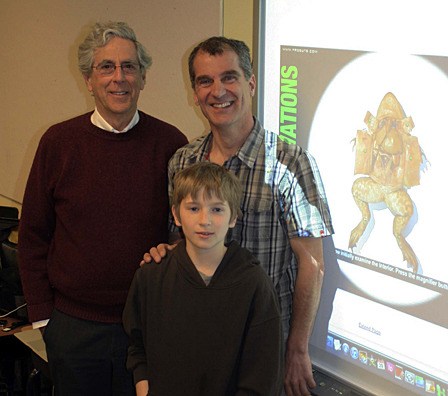
Goodbye smelly formaldehyde, hello frog dissection with the touch of a finger.
The Orcas School District has purchased four interactive whiteboards, overhead projectors, and software with a $15,000 grant from the Frances Bacon Foundation in Pasadena, Calif. The whiteboards work much like an iPhone: teachers can deliver dynamic lessons, write notes in digital ink, and save their work – all by touching a screen.
“Bacon would be overwhelmed at first, but so pleased at the alignment of technology and learning,” said Dr. Richard Fadem, a board member of the foundation. “They are the perfect coordinates.”
Technology teacher Paul Evans worked with Fadem to secure the grant.
“Several years ago we decided that each board member would give around $30,000 apiece to a cause of their choice,” Fadem said.
As a resident of Orcas, he wanted to give back to his community. Fadem gave funds to the Crossroads Lecture series and contacted Evans about technology needs at the school.
“This is changing education,” Evans said. “Interactive white boards are the future.”
SMART Board interactive whiteboards are being used in more than 1.6 million K-12 classrooms and by more than 40 million students globally. Teachers and students can write on the board, erase it with their hand, and perform lessons like dissecting a frog or reading music theory. Orcas elementary principal Kyle Freeman predicts the interactive devices will evolve into 3D.
The school uses a program called Safari Montage in conjunction with the SMART boards. It hosts 4,000 videos on the school server, which means a very fast upload time. In the past, if a video is viewed on Youtube, it takes valuable class minutes to load it.
Evans says Safari Montage has an incredible search engine. Teachers can look for videos, images, audio, interactive documents, web links, e books, quizzes, teachers guides, and even outlines, which can be given to an absent student. Instructors can load and set up a playlist at home. Half of the videos are in Spanish and all offer closed captioning, a feature that Freeman particularly likes. He encourages teachers to keep the sound on simultaneously with closed captioning, as it increases reading levels. Each video is divided by chapters, so if needed, a teacher can show just a portion of the film.
Some classrooms were still using VHS tapes from 1986. Freeman says this brings students up to speed on current teaching technology.
The school also purchased 32 “smart response” remotes. Students can join a class on the screen with their remotes, see questions on the board, and answer using the remote’s key pad. Many students at the University of Washington are required to buy one of the clickers, along with their books, to use for exams.
Two interactive whiteboards are in the middle school, one is in the library, and one is in the elementary. Evans has been leading workshops with the teachers, and they’ve begun to integrate the new tools into their curriculum.
“The goal is to have one in every classroom,” Evans said.