Top stories of 2025: Part 2
Published 1:30 am Monday, December 29, 2025





By Colleen Smith Summers, Heather Spaulding, Kristina Stucki and Darrell Kirk
Staff report
At the end of the year, we take a look at the biggest headlines of the past 12 months. This is part 2. We selected the top stories from our most-read online articles and events that we believe had the most significant impact on our communities.
9. San Juan County confronted historic health care crisis in 2025
San Juan County residents faced an unprecedented health care crisis throughout 2025 as insurance options collapsed and access to care deteriorated.
The year brought a stark reality when LifeWise Health Plan of Washington departed the market, leaving San Juan County as the only one in Washington state with just a single insurance provider. Ambetter Health remained the sole option for self-insured individuals and small business owners.
The crisis deepened when Medicare eliminated telehealth services for most medical appointments, forcing elderly islanders into costly mainland trips for routine care. Ellen Roberts and other residents described spending entire days traveling by ferry just to receive test results.
Premium increases of 25-30% hit hard, with some residents facing monthly costs exceeding $2,800. Network concerns mounted as Ambetter offered no in-network services on Lopez or Orcas islands, and no bronze plans were available for 2026.
Lopez Island faced additional uncertainty when UW Medicine announced it would end its clinic contract in June 2026 without a replacement provider identified.
County officials contacted federal and state legislators throughout the year, with councilman Justin Paulsen warning that the potential elimination of ACA subsidies would magnify the crisis exponentially. The situation left many island families choosing between financial survival and health coverage.
10. SeaDoc’s ‘Salish Sea Wild’ earns Emmy nominations
The SeaDoc Society’s original web series was nominated for two Emmy Awards by the National Academy of Television Arts & Sciences.
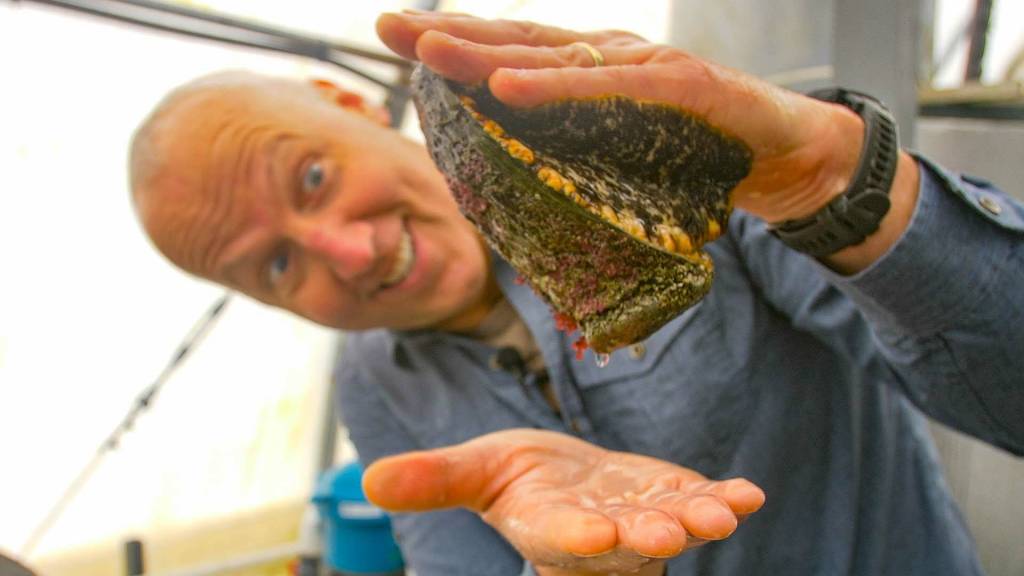
Two “Salish Sea Wild” episodes were nominated in the Northwest Chapter’s Environment/Science — Long Form Content category. The series, which has six seasons, is produced by Bob Friel and hosted by SeaDoc Society Science Director Dr. Joe Gaydos.
The two nominated episodes were “A Shocking Story About Sandpipers” and “Racing to Restore Endangered Abalone.” They can be viewed at https://www.youtube.com/watch?v=0eggmDsgC4c and https://www.youtube.com/watch?v=8P8Gmfr9Pb0.
Friel attended the 62nd annual Emmy Awards ceremony for the Northwest Chapter of the Television Academy of Arts and Sciences on June 7. Going slightly off-fashion in a blue tie to represent the ocean, Friel congratulated PBS for the win.
“We’re thrilled we got the two nominations. It shows that the series we created to further SeaDoc’s primary wildlife health mission can also compete with the big dogs when it comes to offering compelling television,” Friel said.
11. K-pod has first baby since 2022
Southern Resident killer whales welcomed a new addition in December 2025 when an orca calf was spotted in Puget Sound on Dec. 9, marking the first birth in K Pod since 2022.
The calf, designated K47 and seen swimming near likely mother K36 (Yoda), represented a bittersweet moment for researchers. Dr. Deborah Giles of the SeaDoc Society warned there was a high probability the baby would not survive to adulthood, noting K Pod had experienced an 11-year period without births and had the worst reproductive success among the three Southern Resident pods.
The endangered orca population stood at just 75 whales in 2025, down from 88 when they were listed as endangered in 2004-2005. K Pod numbered only 15 members. Scientists attributed the decline to severe food scarcity, particularly Chinook salmon from the Fraser River. Nutritionally deprived mothers frequently lost pregnancies or gave birth to stillborns. The year 2025 saw multiple calf deaths, including heartbreaking instances of mothers carrying their deceased babies.
Researchers emphasized that recovery required increased salmon abundance through fisheries reforms, habitat restoration, and potentially removing the lower four Snake River dams—efforts complicated by political opposition.
12. Leadership changes at Orcas Center
The Orcas Center Board of Trustees announced the appointment of Jake Perrine as the new executive director of Orcas Center in May.
Perrine succeeds Dimitri Stankevich, whose leadership over the past six years guided the organization through a transformative period of artistic growth and community engagement.
A familiar face to the Orcas Island community, Perrine has been deeply involved in the local arts scene as Orcas Center’s artistic and technical director. He brings a wealth of experience and a passionate commitment to supporting local artists and creating accessible, inclusive programming.
13. Originally facing a $6 million shortfall, County Council adopts a balanced 2026 budget
Fully utilized COVID funding, instability of federal and state grants and plateauing revenue sources like sales tax and permits are just a few of the reasons for the shortfall, according to Auditor Natashia Warmenhoven. San Juan County is not alone with these issues. Counties across the nation have used up their COVID assistance funding and are struggling with other federal support, either being dropped altogether or caught up in new requirements or being reviewed.
County governments have not been the only ones suffering as a result of federal upheaval, either. Parks, farmers, nonprofits, schools, health services and libraries have all been impacted.
After months of deliberations and strategic cuts, the deficit was reduced to $1.5 million in December. Council determined that focusing on a one-year budget would allow the organization to maintain some additional personnel and services while allowing more time to address changes for 2027 and beyond.
Following a public hearing on Dec. 9, a 2026 budget was adopted.
The County’s budget process, past documents (including past budget books), quarterly reports and more can be viewed on the auditor’s webpages at https://www.sanjuancountywa.gov/2030/San-Juan-County-Budget.
With 2027 looking more dire than 2026, the Council intends to get to work right away on the 2027. “The budget is all we are going to be talking about for a very long time,” Council Chair Kari McVeigh said, prior to approving the 2026 budget, noting that the things that were on the table to be cut remain on the table for cuts in 2027.
14. Teen center Peach Pit opens
Orcas Island teens welcomed a brand-new space to call their own this summer.
The Peach Pit is a place for sixth graders through those aged 20 to gather, eat and play. Co-founders Maia Vechey and Meagan Gable were inspired to create a spot that was teen-oriented and provided a safe hangout for young adults to be with friends, study and access resources tailored to their needs.
Gable pitched the idea of the Peach Pit to The Funhouse Commons board of directors. The board unanimously approved taking it on under a comprehensive fiscal sponsorship model.
It is staffed almost entirely by teens who have been trained and supported to shape the culture and inner workings of the Peach Pit, which The Funhouse Commons fiscally sponsors.
“Our Youth Staffing Program gives teens real responsibility,” Gable said. “They’re not just helping out — they’re running the show. From interior design to leadership development, the skills they gain here are real and lasting.”
The young adults feel the Peach Pit provides the resources they need to develop real-world skills that support their future aspirations. The staff have the opportunity to choose their job based on interests like event planning, management, inventory and more.
The center is named after the diner on the television show “Beverly Hills, 90210,” which was a primary hangout spot for the characters. It is located above Con’s Pit Stop, where Portofino’s Pizza operated for many years.
15. Multiple unverified cougar sightings
Multiple unverified cougar sightings on San Juan Island in early August 2025 prompted local and state agencies to issue safety warnings to residents and hikers.
The first reported encounter occurred on Aug. 4 when Seattle visitor Leslie DeGasparis spotted what she believed was a mountain lion while running on White Point Road near Roche Harbor. DeGasparis described seeing a large animal with a face that approached within 10 feet before she backed away and fled to safety at a nearby home.
A second sighting was reported the same day in the same area by a local woman familiar with mountain lions from her time in Colorado. She encountered the animal at 20 yards while walking her dogs.
A third sighting near Snug Harbor was reported on Aug. 7. Because no photographs or videos were captured and the sightings weren’t witnessed by law enforcement or wildlife professionals, they remained unverified. The Sheriff’s office planned to install trail cameras in the area.
The Washington Department of Fish and Wildlife noted that while cougars are native to the state, their presence alone didn’t warrant management action. Wolf Hollow’s wildlife expert suggested any cougar would likely pass through the island quickly. Warning signs were posted on trails by Roche Harbor Resort and San Juan Island National Historical Park.
16. Friday Harbor Mayor found not guilty of animal abuse
Mayor Raymont Jackson, 59, was found not guilty of animal cruelty on Oct. 24 in San Juan County District Court after three months of legal and public scrutiny over his treatment of 12-year-old terrier mix Sasha.
Jackson, whose singular term as mayor of Friday Harbor ends in January, was charged with one count of animal cruelty in the second degree after his dog was found with a neck wound from an electronic collar by concerned neighbors in August. He pleaded not guilty.
The state’s criminal case centered on witnesses and evidence from the first few days after Sasha was found. Details of the neck wound as well as an intense foul odor from the wound, were presented. The collar was said to be extremely tight with a one-inch metal prong on the inside. The collar’s odor was so offensive that the deputy put it in the trunk of his patrol vehicle rather than the cab. A vet who responded to the call testified that the wound was likely long-standing and had developed over time. The prosecution argued that the situation could have been prevented and asked the jury to use common sense and experience to interpret the evidence around whether Jackson knew about and ignored the dog’s suffering.
Witnesses for the defense described the Jacksons’ relationship with Sasha as loving, and longtime neighbors and health care providers stated they’d never felt concerned about abuse or mistreatment, asserting that she was known for wandering off and rolling in things. The veterinary expert for the defense, based on viewing photos of Sasha’s wound, disagreed with the assessment that the wound was long-standing and stated she had seen lesions like this appear overnight in the past. The defense argued that the State hadn’t met its burden of proof because it wasn’t clear exactly what happened to Sasha or who was involved.
After a two-day trial, Jackson was found not guilty. However, because the bond was forfeited, the dog was not returned to the family.
17. Spring Street School remains open
Spring Street International School raised enough money to open in fall 2025 after a summer of fundraising. In June, the school released a statement sharing its “dire” financial situation— which was attributed to low enrollment and financial mismanagement — and the need for $2 million in pledges to stay open.
A student-organized event raised over $83,000, enabling the school to reach the $1.6 million needed to keep its doors open.
“The kids did an amazing job,” Angela Maguire, interim Head of School for SSIS, said of the student event. “It was completely student-organized: logistics, publicity, designing the program, organizing all the student speakers, and even the food.”
Spring Street had a tumultuous 2025, replacing both the Head of School and Chair of the Board after a third-party investigation revealed a change of culture and operations was necessary. Shortly after the change, Maguire became aware of the school’s financial mismanagement and dove in to fix the problem. The school has since raised sufficient funds, hired new staff, laid off others, and had a successful first semester, including its first experiential trip since the switch.