SNAP Benefits’ limbo impacts islanders
Published 10:30 am Tuesday, November 11, 2025



By Kristina Stucki
Sounder contributor
Supplemental Nutrition Assistance Program benefits nationwide have been impacted by the government shutdown, now the longest in U.S. history. A significant portion of San Juan County’s population (11%) has food insecurity, which means they lack consistent access to enough food to meet their nutritional needs. The withholding of SNAP dollars is driving local organizations into emergency meetings around the islands; plans and resources are being assembled to help the community bridge the gap.
Federal background
“Bottom line, the well has run dry,” announced the USDA website in late October, blaming Senate Democrats for holding out “for healthcare for illegal aliens and gender mutilation procedures” before they’d “reopen the government so mothers, babies, and the most vulnerable among us can receive critical nutrition assistance.” Some are accusing the Trump administration of violating the Hatch Act due to its messaging on government websites.
Washington joined 23 other states in a joint lawsuit against the USDA for not funding SNAP benefits, with the argument that there are contingency funds that should be used to avoid the “irreparable harm that increases every day that SNAP benefits are delayed.”
Judge Indira Talwani, the federal judge hearing the case in Boston, appeared to be frustrated with the Trump administration’s arguments that they’re legally unable to use those contingency funds on SNAP.
“Congress put money in an emergency fund, and it is hard for me to understand how this is not an emergency,” she said. “We’re not going to make everyone drop dead because it’s a political game someplace else.”
Talwani ruled on Oct. 31 that SNAP benefits must be paid out of the contingency funds almost simultaneously as a different federal judge, John J. McConnell Jr., ruled similarly in a Rhode Island case.
The Trump administration appealed the decision and committed to funding 50% of SNAP benefits with the contingency funds. Food and Nutrition Services announced in a memorandum on Nov. 4 that benefits would be decreased by 50%. They released a second memorandum on Nov. 5 saying it would actually be only 35%.
On Nov. 6, McConnell ruled that SNAP must be paid in full by Friday, Nov. 7. The Trump administration appealed to the Supreme Court for an emergency stay, which was granted. A Nov. 8 memo from the USDA says that all states need to reverse their SNAP payments if paid in full or be faced with federal action, “including cancellation of the Federal share of State administrative costs and holding States liable.”
In the meantime, 42 million Americans’ access to enough food is in limbo.
Impacts of SNAP
Basic Food, as the SNAP program is known in Washington state, helps nearly one million people in Washington each month, representing more than 11% of the state’s population, according to the Washington Department of Social and Health Services. Children make up 33% of SNAP beneficiaries, and another 33% are elderly or disabled. Approximately 30,000 veterans receive food assistance in Washington.
In San Juan County, there are more than 2,000 people who are food insecure, which is 11% of the population. While only 938 people in the county receive SNAP benefits, the actual number of income-eligible islanders is 3,529, with 40-65% of students qualifying for discounted or free meals.
Since SNAP benefits are actual funds loaded onto Electronic Benefits Transfer, or EBT, cards that are then used in grocery stores, there is an additional economic impact as well. If this month’s funds aren’t distributed, according to San Juan County Communications Program Coordinator Kyra Jahanfar, communities throughout the state will lose more than $265 million in economic activity in November, with the most profound impacts in rural Washington.
Local action
Gov. Bob Ferguson committed to sending $2 million per week to Washington food banks and is actively participating in federal lawsuits to force payment of benefits.
The San Juan County Health and Community Services department is serving as a central hub for the numerous local organizations that have mobilized to ensure islanders are fed during this time of uncertainty. They’ve published a “Food Access” website, which is a compilation of resources and information that islanders need, whether they need food or want to help support those who do.
“We know there’s real fear and pain right now for families who depend on these benefits to feed their loved ones,” Kristen Rezabek, Health & Nutrition program coordinator for San Juan County Health & Community Services, told the Sounder. “What gives me hope is how compassionate and responsive our community is in times of need. Time and again, we’ve seen people come together with a shared commitment to make sure every family has the chance to thrive and have their needs met.”
Rezabek is no stranger to dealing with cuts in services by the Trump administration. She’s in her last month of managing the SNAP-Ed program, which was cut earlier this year. SNAP-Ed, according to the USDA website, includes “nutrition education classes, social marketing campaigns, and efforts to improve policies, systems, and the environment of communities.”
“It’s definitely a loss, because that program has been basically eliminated,” said Rezabek, who’s been working on SNAP-Ed since 2016. “Almost a decade of work that I’ve been doing and developed, now gone. There’s going to be a huge gap.”
San Juan Island
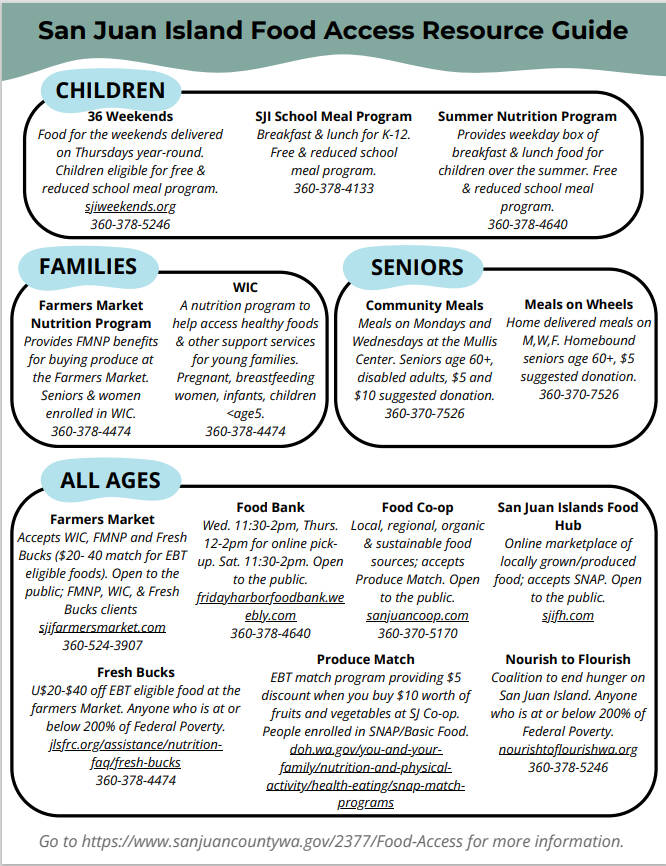
San Juan Island has a food access guide, available on the county’s food access webpage and on the Journal’s website, which outlines the available food programs. It includes the Rotary’s 36 Weekend program (weekend food for children, currently serving 45 families with the ability to scale up to 90), the Farmers Market nutrition program (offers credits for buying produce), weekly community meals for seniors and disabled adults at the Mullis Center, the Fresh Bucks program, and the Nourish to Flourish program. The document clearly lays out all programs, including contact information and resources for each.
Other opportunities for meals in Friday Harbor include the community Thanksgiving dinner, which is currently seeking volunteers and donations, as well as the bi-weekly “Everything but the Kitchen Sink” dinners at the Grange, organized and prepared by Cynthia Burke, who is also looking for helpers and potentially someone to take over. Burke selects produce and items that are still good but may be unsuitable for sale, and creates casseroles and dinners to distribute to anyone who shows up at the Grange on the first and third Mondays of every month, from 4:30-6 p.m., with no questions asked.
“It’s absurd that we have hungry people here,” Burke, who’s been offering this service to the community for nearly 10 years, told the Sounder. “There’s a massive amount of food waste, and it’s got to change. If somebody else wants to take on the work with me, we’d be able to go all year. For now, it’s just October through March.”
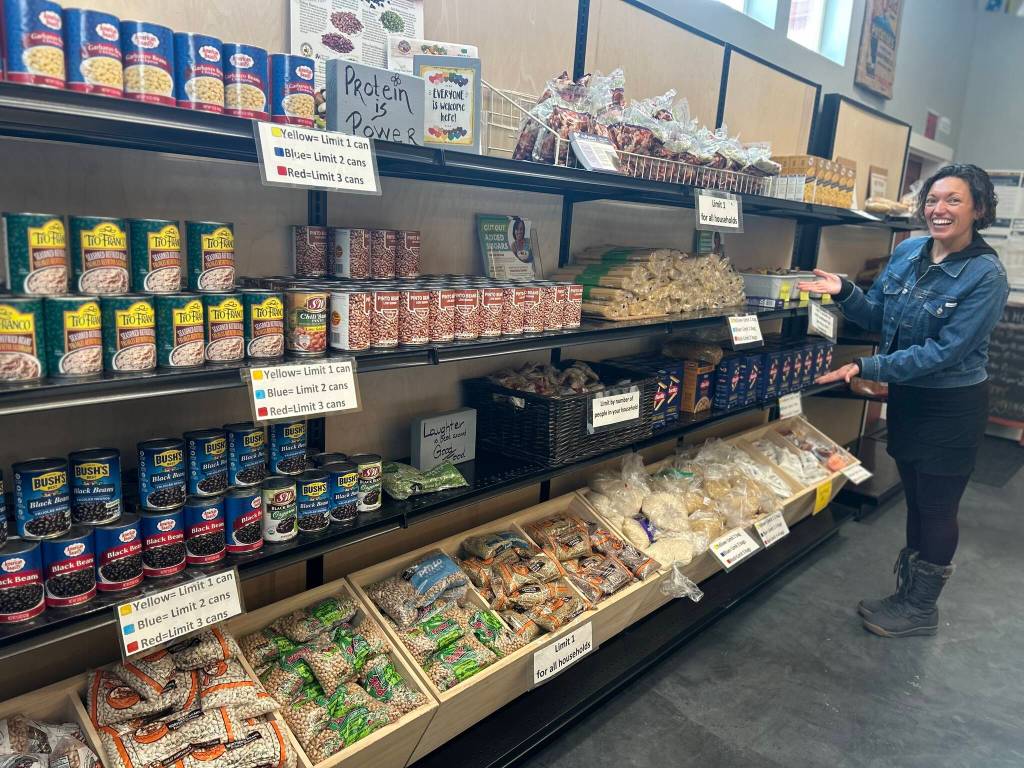
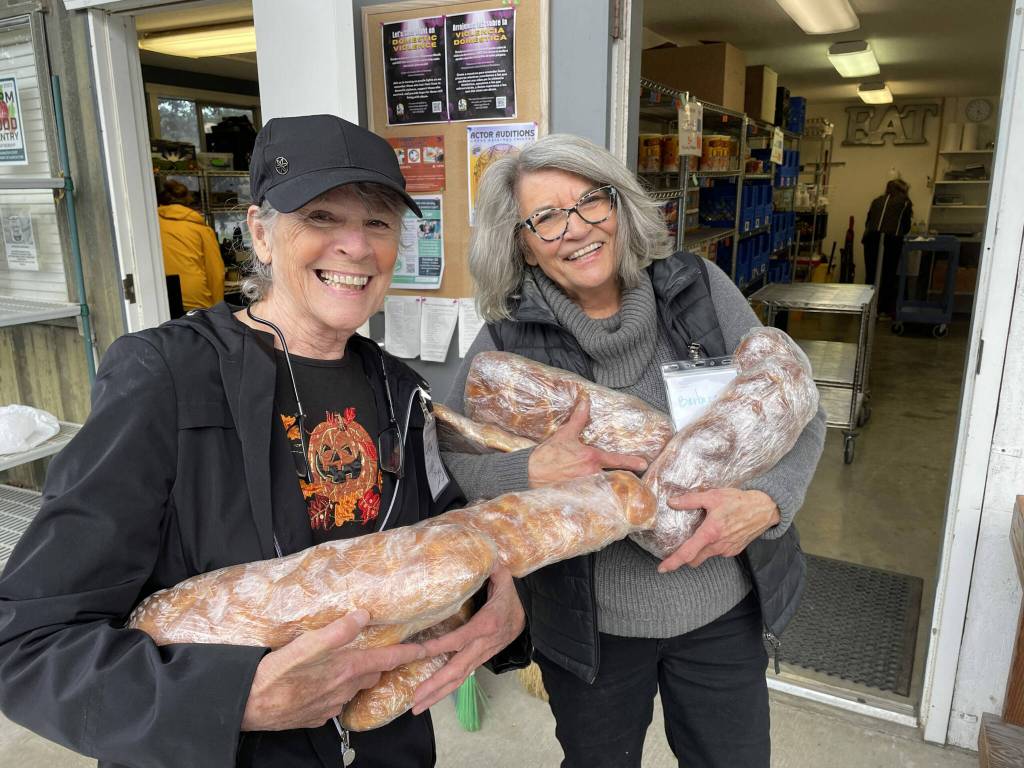
The Friday Harbor Food Bank can also use donations and volunteers. It offers its services no questions asked (except for the size of the household). Rachelle Radonski, manager of the food bank, asks that people either check the website to determine what they need or make monetary donations.
“Everyone wants to help! The food donations are coming in, but our garbage bill has gone up in amazing amounts as well,” Radonski said in an interview, mentioning that the community’s eagerness to jump in sometimes results in duplicate programs or unforeseen difficulties. “I take my clients’ safety so seriously. I know everyone comes from such a great place, but I’m urging people to be really thoughtful about their donations and ideas. They want to help right now, but take a breath, be conscious of the bigger picture, and help us do our job.”
The San Juan Island Community Foundation is hosting a panel of local nonprofit leaders at their learning session on Nov. 13 from noon to 1:30 p.m. at the Grange, with a focus on how local organizations and the community can help meet Island needs. Leaders from the Joyce L. Sobel Family Resource Center, Mullis Community Senior Center, SAFE San Juans, San Juan Community Home Trust, Compass Health, SJI Healthcare Foundation and the Friday Harbor Food Bank will all come together in a public forum to discuss local solutions.
“The disruption in SNAP benefits and rising costs of food, housing, and healthcare premiums are stretching island families thinner than ever,” said Amy Saxe-Eyler, CEO of SJICF. “Our nonprofits are seeing that when one basic need becomes harder to meet, it ripples through every part of a person’s wellbeing. Community collaboration has never been more important.”
Orcas Island
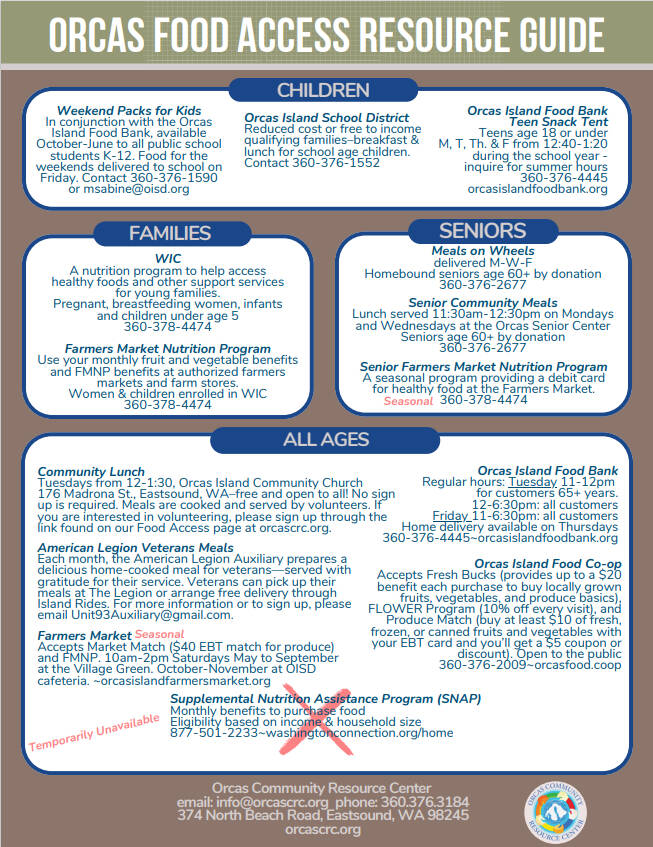
The Orcas Food Access resource guide outlines similar benefits as the San Juan Island guide, including weekend packs for kids and the teen snack tent, both from the Orcas Island Food Bank, Farmer’s Market Nutrition program, Senior Community Meals on Mondays and Wednesdays at the Orcas Senior Center, and Community Lunches for all at Orcas Island Community Church on Tuesdays. The complete guide can be found on the county’s food access webpage and on the Journal’s website at https://www.sanjuancountywa.gov/DocumentCenter/View/33730/Orcas-Food-Access-Resource-Guide.
The Orcas Island Community Foundation’s Board of Directors allocated funds from their Community Emergency Response Fund to grant funding to the Orcas Family Resource Center to distribute grocery gift cards to individuals and families whose SNAP benefits have been impacted.
“Starting Monday, Nov. 3, Orcas residents who do not receive their SNAP benefits are encouraged to visit OCRC to receive a grocery gift card,” said Lindsey Jennings, executive director of the foundation, in an update on their website. “The Orcas Island Food Bank continues to play a critical role in providing access to fresh and nutritious food and is prepared to welcome all community members who need support.”
Those who wish to help are encouraged to donate to the CERF, allowing the foundation to continue providing this funding.
Lopez Island
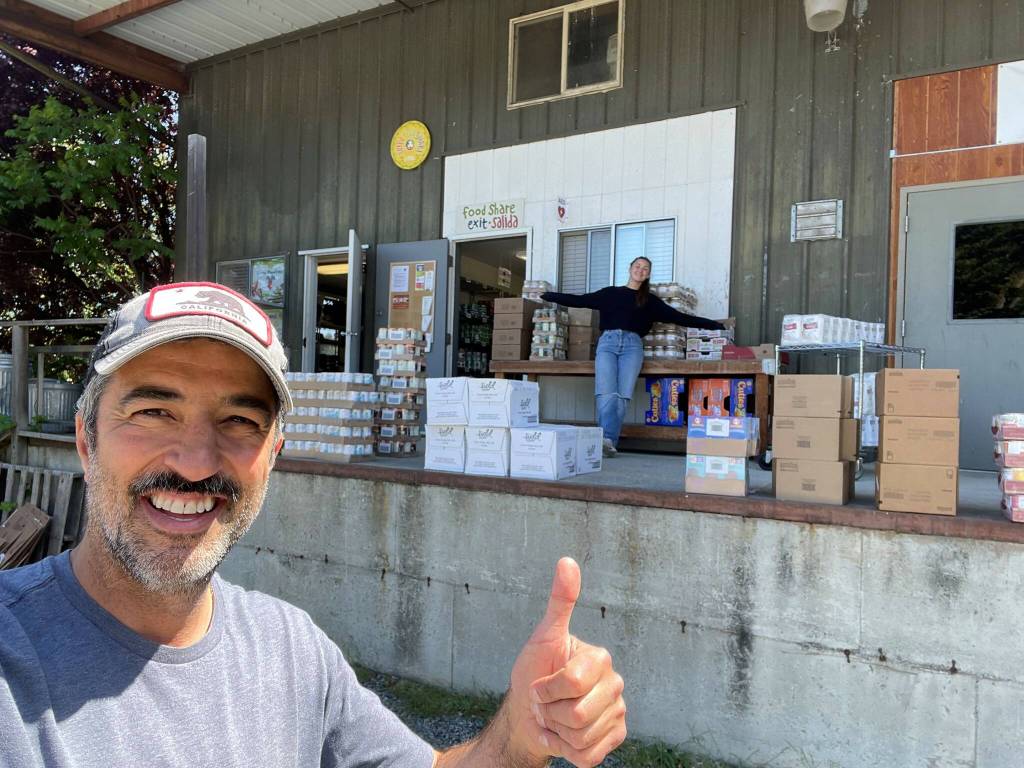
The Lopez Food Access Resource Guide is currently being developed. However, the Lopez Island Family Resource Center and Food Share Pantry are the primary resources for the 96 households on the island that rely on SNAP benefits.
“LIFRC is resolute in our efforts to make sure people have the food they need today and in the future,” the Family Resource Center said in a statement. “Every day, new challenges and new solutions unfold. We will do our best to keep the community informed. Please check our website and social media for updates.”
The best way to help on Lopez is to donate to the LIFRC’s Year-End Appeal campaign, where they’re hoping to raise the remaining $320,000 needed to meet the needs of families on the island. Donations can be made on the LIFRC website. Another program they’re asking for help with is the Donate a Pie program for Thanksgiving. Pies will be accepted on Tuesday, Nov. 25, from 10 a.m. to 2 p.m. at the family resource center.
Check on your neighbor
Multiple community leaders mentioned that the first thing to do, really, is check on your friends and neighbors.
“Even before the things I listed, islanders can check on their friends and neighbors and other families they know to make sure they’re ok,” Saxe-Eyler of SJICF mentioned.
Radonski of the Friday Harbor Food Bank shared a similar sentiment.
“Honestly, the best thing you can do is check on your neighbors and friends,” she said. “Many of the folks out front aren’t getting the food for themselves – they’re helping someone else. Sometimes the best place to help is right in your own neighborhood.”