OIFR seeks $18.5M bond for aging fleet and fire stations in need of repair | Town hall reveals critical equipment failures, insurance rating concerns and volunteer shortage
Published 1:30 am Tuesday, October 14, 2025



By Darrell Kirk
Sounder contributor
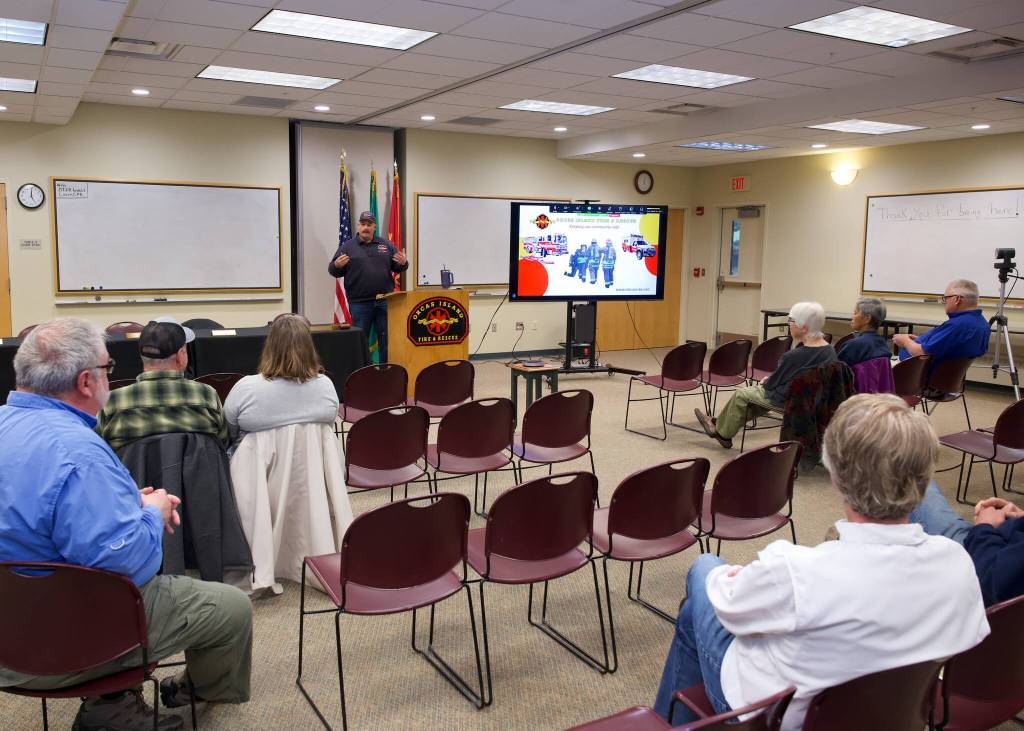
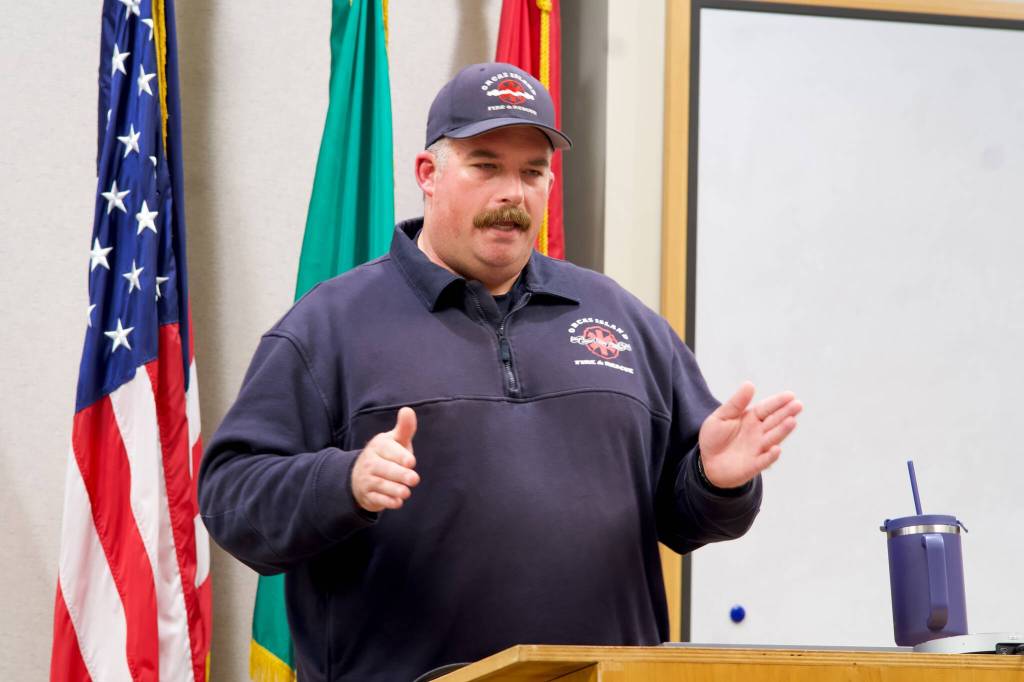
Orcas Island Fire and Rescue officials presented an $18.5 million bond measure at a town hall meeting held on Sept. 29, describing aging fire engines that have broken down during emergencies, leaking roofs and facilities so deteriorated that volunteers work in soot-covered stations without proper ventilation.
The bond proposal, known as Proposition 1, will appear on the Nov. 5 ballot and would be repaid over 20 years at approximately 27 cents per $1,000 of assessed property value — about $267 annually for a home valued at $1 million.
Fire Chief Chad Kimple told the gathering at Station 21 that the department faces a “catch-up phase” after years of deferred maintenance. The proposal comes with significant financial trade-offs and a controversial history of failed levy attempts.
Why bonds over levies
Fire commissioners chose the bond structure after extensive community input and committee work spanning several months.
“We’re in a catch-up phase,” Kimple explained. “If we kick this can down the road much longer, the price tag is going to keep going up.”
The bond allows immediate access to funds rather than waiting for levy revenue to accumulate gradually. The current 77-cent operations levy, which passed in early 2024 after two failed attempts, provides baseline operational funding but cannot cover capital expenses.
“Replacing a fire engine today costs over a million dollars, and this levy doesn’t offer the bandwidth to capture those funds,” Kimple noted.
The fire department’s volunteers and staff insisted that capital funding be legally separated from operational expenses. “Our volunteers and crew staff said we don’t want the money to go back into the operations fund and commingle with salaries or day-to-day operations,” Kimple explained. “It needs to be a siloed fund. That’s what the bond offers.”
Perhaps the most immediate concern for property owners is the fire department’s declining protection class rating, which directly affects insurance availability, and possibly rates.
According to the Washington Survey and Ratings Bureau Protection Classification Report dated Oct. 1, 2024, Orcas Fire Department’s overall rating dropped from Class 6 to Class 7. The report reveals the department achieved only 32% of possible credit for water supply, 29% for fire department capabilities, 58% for emergency communications and 52% for fire safety control.
The most severe deficiencies include department staffing (11% credit), company training (17% credit), age of apparatus (26% credit) and zero credit for training center training, pre-fire planning and multiple alarm response. Kimple expressed confidence about rating recovery.
“People are our first priority — recruitment and volunteers, getting more structural firefighters,” he said. “That’s what the rating is based on.” The department has a tentative re-audit scheduled for fall 2026.
The rating decline stems primarily from insufficient volunteer firefighters. The WSRB requires a minimum of six volunteer firefighters per station. Orcas Landing needs three additional firefighters, West Sound needs two and Deer Harbor needs two more.
“People here often work two or three jobs and struggle to find housing,” Kimple explained. “That’s the biggest reason we run into a lack of volunteer sign-ups.”
A fire academy is scheduled to begin Jan. 3, requiring weekend attendance for approximately three months. After initial training, ongoing commitment drops to just two evenings per month.
The department operates seven fire stations across Orcas Island, but only the main station in Eastsound is staffed 24/7. The fleet includes fire engines ranging from 20 to 28 years old — well beyond the industry standard of 20-25 years.
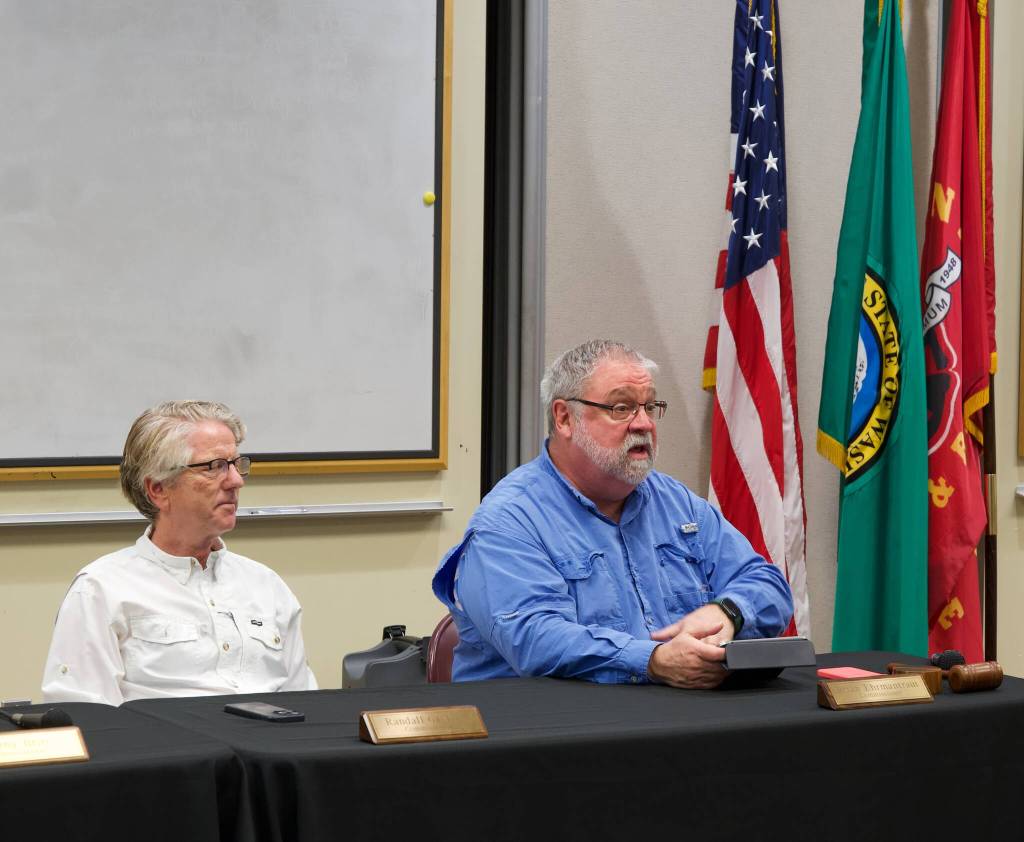
In a follow-up statement to the Islands’ Sounder after the town hall, Commissioner Brian Ehrmantraut clarified that the National Fire Protection Association standards specify 15 years for front-line fire engine service and an additional 10 years for reserve or spare status. Since all of the department’s engines serve as front-line apparatus at their respective stations, many are operating beyond the recommended standards.
Ehrmantraut explained that the “catch-up situation” requires refurbishing or replacing several fire engines near the beginning of the bond’s 20-year project timeline to bring the fleet within industry standards and, critically, to stagger the fleet’s age distribution so the department won’t face the current problem again — having to replace multiple engines simultaneously in the future.
“We’ve had fire trucks break down during fires as recently as early this year — a pump failure and an electronics failure,” Kimple reported. “Some of our trucks have electronic issues because parts aren’t being manufactured anymore.”
The aging fleet includes a 1999 main pumper, a 1997 Rosario engine, two 2005 fire engines, four 2008 fire engines purchased simultaneously, two 18-year-old water tenders, a 26-year-old Doe Bay ambulance and an 18-year-old Deer Harbor ambulance on its third motor and second transmission.
The apparatus bay at Station 21 has fought roof leaks for three years.
“We do repairs, and another one pops up,” Kimple noted. “We’ve got issues with our Rosario Station — the main beam has mold and ventilation problems.”
Kimple warned that Western Washington is experiencing a fundamental shift in wildfire risk.
“We’re not in a fire season anymore. We’re in a fire year,” Kimple stated. “The trend in Western Washington is getting drier every year. We’re going to have more dead fuel in the future.”
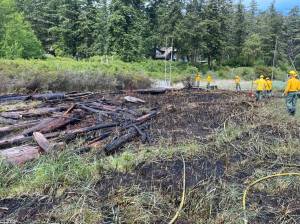
The island now experiences two wildfire seasons — April through October, and during January-February freezes. “We’ve fought wildfires in frozen temperatures on the island,” Kimple said.
The department recently responded to a significant wildfire requiring mutual aid from San Juan Island, Lopez Island and the Department of Natural Resources with helicopter support.
“We had one resident who refused to evacuate and was in imminent threat,” Kimple recalled. “We deployed the sheriff’s deputy to request a mandatory evacuation. That’s the first time in my career we’ve done mandatory evacuation.”
Orcas Island resident Robert Dashiell challenged the bond proposal at the town hall, arguing that a single-year permanent levy would be financially superior to the $18.5 million bond. Dashiell calculated that if the full bond amount were acquired at once, interest costs would reach approximately $11 million over 20 years, and by his calculations, a permanent levy would generate about $9.6 million more revenue for the department beyond the interest savings — potentially solving capital needs for the next hundred years.
He asserted that this alternative was never adequately discussed by commissioners. Ehrmantraut countered that while the board did consider a permanent levy, timing was critical given the department’s urgent capital needs, and the community had decisively rejected two permanent levy attempts in 2023, making commissioners reluctant to pursue that path again. Kimple acknowledged the permanent levy as a valid option but emphasized the department faces immediate needs and is “in a pickle” requiring faster access to capital funding.
Despite his objections to the bond’s financing structure, Dashiell praised the commissioners for emerging from “a rather dark hole of problems,” commending their transparency and the positive reforms under current leadership, though he maintained his belief that a better financing alternative exists.
The bond allows for phased spending through three sell-offs to reduce total interest costs.
“We are not forced to spend all $18.5 million,” Kimple noted. “We’re looking at cost-saving ways to reduce that number down.”
Two community committees spent months evaluating needs. The Facilities Committee included Greg Sawyer, Bruce Brackett, Caleb Weichart, Clark Cundy, George Schermerhorn and Toni Knudson. The Apparatus Replacement Committee comprised Brian Ehrmantraut, Penny Buttke, Kevin McCoy, Jack Delisle, Dimitri Stankevich and Poke Haffner.
In a statement to the Islands’ Sounder, San Juan County Councilman Justin Paulsen expressed support.
“In these tumultuous economic times, local control of local dollars and services provides a steadying force,” Paulsen stated. “The leaders of Orcas Island Fire and Rescue have taken logical and thoughtful steps that build trust within the community while acknowledging the need for transparent financial accountability.”
The bond requires a 60% supermajority to pass — a higher threshold than the simple majority required for most ballot measures. All registered voters in the Orcas Island Fire and Rescue service area are eligible to vote. Ballots will be mailed in mid-October. For more information, visit www.orcasfire.org.