Wildland fire: A testament to island community cooperation | Rapid response from multiple agencies and private partners contained blaze that threatened six homes
Published 1:30 am Tuesday, July 15, 2025



by Darrell Kirk
Sounder contributor
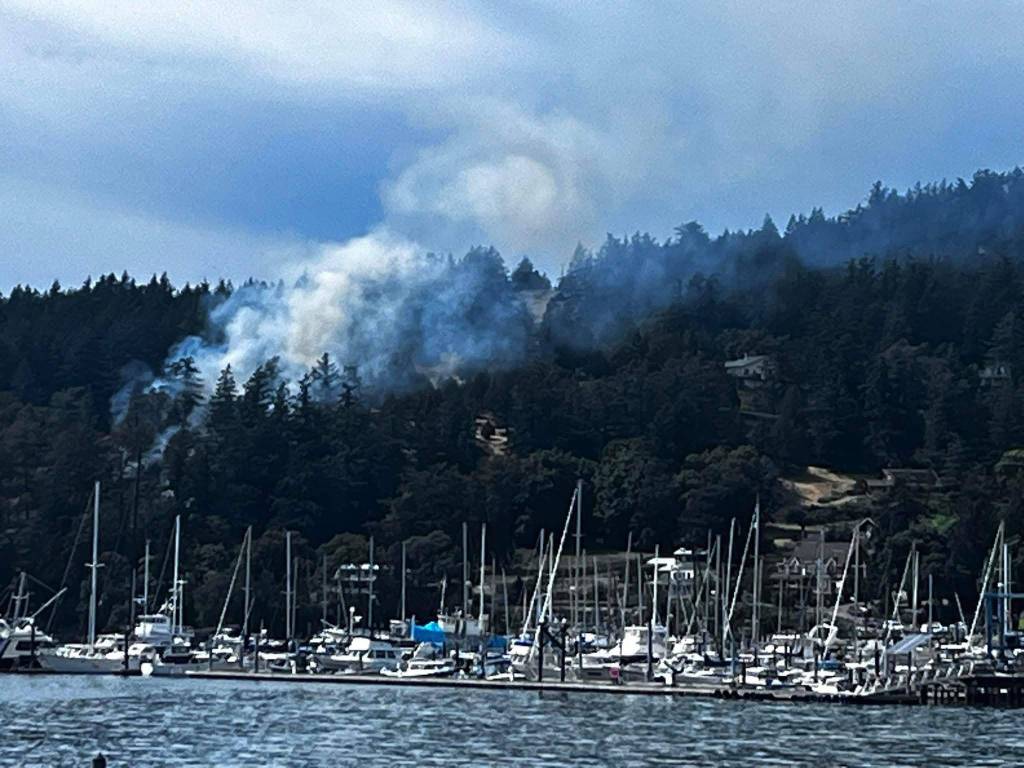
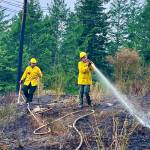
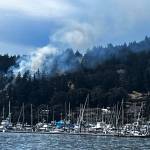
What began as a 40-foot brush fire on Orcas Island on Tuesday, July 8, quickly escalated to a 7-acre wildland blaze that threatened six homes before being contained through an extraordinary display of interagency cooperation and community response.
The wildland fire, reported at 3:43 p.m., demonstrated how effective preparation, mutual aid agreements and private sector partnerships can mean the difference between a manageable incident and a potential catastrophe.
But as Fire Chief Chad Kimple of Orcas Island Fire and Rescue emphasized, this was a best-case scenario that may not be repeatable as the fire season intensifies.
“When we get into the month of August and month of September, when things are really dry, you know, there’s no guarantee we’re going to have two helicopters or mutual aid assistance if there’s fires on other islands,” Kimple warned. “We were very fortunate the stars aligned where everybody was available to come to our emergency here on Orcas, but that’s not a guaranteed response.”
Minutes matter in fire response
The fire’s rapid growth highlighted the volatile conditions that can turn a small incident into a major emergency. According to Ben Luna, public information officer for Orcas Island Fire and Rescue, the transformation was dramatic. “It toned out as a 40-foot fire,” Luna said. “Within minutes it was a two acre fire. And then very quickly after that it expanded to between five and seven acres.”
The location itself was particularly concerning to firefighters. “I believe this is the third fire in that area in the last 10 years,” Luna noted. “That place, because of the brush and the grass and that uphill slope, it is very easy for a small fire to become large rapidly.”
Six homes faced an immediate threat, with fire engines positioned in front of each one.
“In some cases it was really just feet away from those homes,” Luna explained.
Added Kimple: “We had engines parked at almost every structure.”
A network of mutual support
The successful containment showcased what emergency officials call mutual aid at its finest. Ryan Rodruck, public information officer for the Washington State Department of Natural Resources, emphasized the collaborative nature of the response. “Our forces, you know, our helicopters and our engines, that’s something that we cannot be effective with without our local partners on the ground,” Roderick said. “Those first responders there on the island … they really deserve all the credit for how fast we were able to knock this fire down.”
The response began with Kimple activating mutual aid resources even before reaching the scene. “Thankfully, I was in contact with DNR before I even arrived because they were already aware of the smoke,” Kimple explained. “And so we were in phone contact right away and their supervisor was prepping their crews. And then the moment I got on scene, I activated one helicopter and a couple of engines coming from the mainland.”
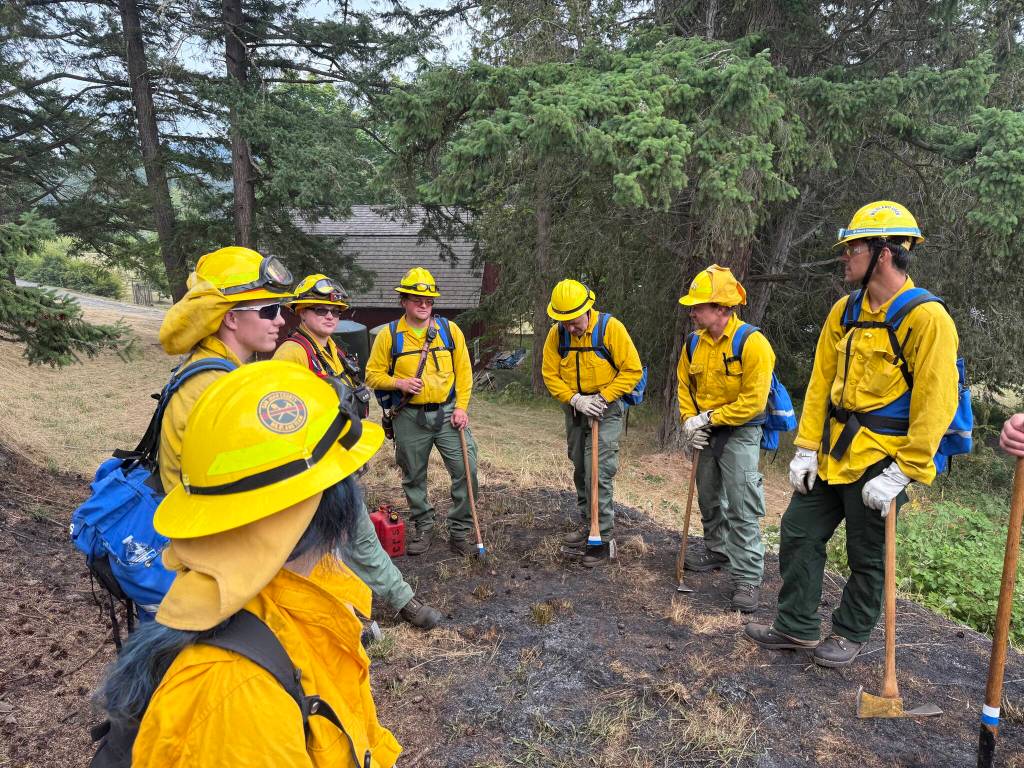
This rapid coordination brought firefighting crews from Lopez and San Juan islands through the San Juan County Interagency Wildland Team. “Then during suppression, and after speaking with the DNR, I got a hold of dispatch and requested mutual aid within the county,” Kimple said. “And then through Jordan Pollack’s leadership, who is now a division chief on San Juan Island Fire and Rescue we had assets from the interagency wildland team.”
Caleb Pal, captain with Lopez Island Fire and EMS, described the swift response.
“I contacted the Sheriff’s Office. They got a deputy to captain the boat over here on Lopez and run us over to Orcas,” he said. “We got our crew paged out, spun up at the fire station here on Lopez, went down to the boat, boated over, and we were on scene with the incident commander in less than an hour from when they initially requested us.”
Air support
DNR’s response included both air and ground resources.
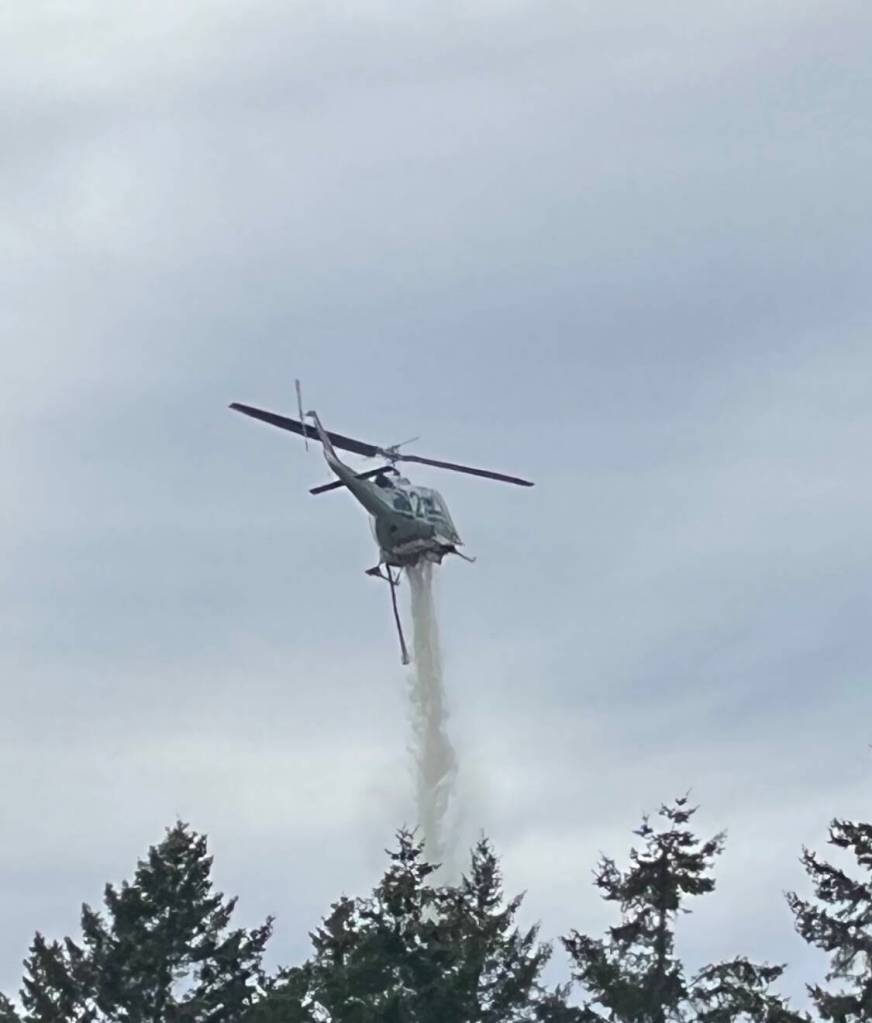
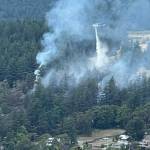
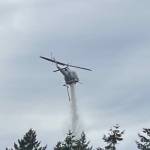
“We did dispatch a helicopter right away, just right after it was reported,” Rodruck said. “And that helicopter was on scene just within a few minutes.” The initial helicopter proved crucial in stopping the fire’s advance. “The helicopter out of Big Lake, the first helicopter was able to dampen down the fire at the head, just below Melba Lane,” Kimple explained. “And we were able to save that house. A second DNR-contracted Chinook helicopter soon joined the effort, carrying between 1,800 and 3,000 gallons of water. We were lucky enough that DNR had access to a second helicopter through a contract. So we had two helicopters working the fire,” Kimple said.
The integration of private sector resources proved equally crucial.
Justin Paulsen, San Juan County Council member, observed: “Chad made a call to Island Excavating and was able to get a dozer to the location to begin doing what is really the type of wildland forest work that you see, you only see on a much larger response. Integrating local business resources into a response like this is a sign of how our community works.”
Luna praised the relationship between the fire department and local companies.
“Many people in the department have worked for and are quite close with not just Island Excavators, but with other excavating companies as well,” he said. “We know what their equipment is, we know what their capability is, and in almost every situation, when we call them, they will stop what they’re doing, they will get a trailer, and then in the case on Tuesday, they brought a dozer, and they were there, I believe, within an hour.”
Community and infrastructure response
The fire required coordination with utility providers. When power lines became involved, OPALCO quickly responded.
“The moment we got confirmation that fire was involved for power lines, we had OPALCO remotely shut down that site, which is the main feeder for Orcas West. So we put all of Gear Harbor out,” Kimple explained.
The broader community rallied to support the response.
“We had the neighbors in the West Sound community that were getting their garden hoses out and getting ready,” Kimple noted. The fire department established a staging area at West Sound Cafe to coordinate the complex operation.
Sheriff Eric Peter emphasized that effective emergency response transcends traditional boundaries and stereotypes.
“I don’t like the stereotype of us and the law, like we’re separate,” he said. “Law enforcement, the fire, the EMS, we are all community members. We’re all … somebody’s husbands, wives, brothers, sisters, fathers, daughters.”
Peter’s perspective reflects a deeper understanding of what makes island emergency response work. He stressed that the human connections underlying professional cooperation are what enable the swift, coordinated responses islanders witnessed during the West Sound fire. The sheriff also addressed the emotional toll that emergency responders face, noting the importance of vulnerability and mutual support.
“All of us have to find ways to deal with the traumatic things that we see in our line of work, whether it’s law enforcement … fire department, EMS,” Peter said. He emphasized that traditional attitudes about toughness in emergency services are changing: “I was brought up in law enforcement. You should just suck it up and keep going. If you show vulnerability or feelings, then you’re weak. And that’s just not true. It takes courage to have vulnerability.”
Kimple emphasized the volunteer nature of the response: “Our department is comprised mostly of volunteers and we only have two career firefighter paramedics on duty every day and everybody else who is showing up to your emergency is a volunteer. So for this fire, it really depended on our neighbors, our volunteers and local resources coming together.”
Despite the successful response, officials emphasized that favorable circumstances played a significant role.
“We got darn lucky,” Paulsen noted. “If the winds had been 10 miles an hour higher, if there hadn’t been folks working in the neighborhood doing yard work who noticed the smoke and called right away, or had waited another twenty minutes to call, there would have been a totally different outcome.”
Rodruck stressed that Western Washington can no longer consider wildfire solely an Eastern Washington problem.
“We are in a place where … we used to think of wildfire as being a uniquely Eastern Washington problem. That is simply not the case anymore,” he said. “It is very much a Western Washington problem, and it is very much an island problem at this point.”
The importance of early detection cannot be overstated. Kimple was clear about citizen responsibilities: “If you see smoke during wildfire season, call 911 immediately and try to give the best landmark and directions you can. I know sometimes when you see smoke from afar, it can be difficult to pinpoint, but try to find landmarks and describe it to the dispatcher.”
Protecting your home: Critical preparation
Both DNR and local fire officials emphasize that homeowner preparation can significantly impact firefighting effectiveness. Kimple highlighted the state’s Wildfire Ready Neighbors program, noting that homes typically catch fire from ember showers rather than direct flame contact.
Rodruck echoed this message: “I would strongly encourage everyone to look at the DNR’s Wildfire Ready Neighbors program. That provides resources, both technical resources and financial resources, to get your home prepared.”
The recommendations focus on simple but crucial actions.
For more information about the program, go to https://www.sanjuanislandscd.org/wildfire-preparedness.
Conservation district leadership
While the Wildland fire response demonstrated exceptional emergency coordination, prevention work happening throughout the year may prove equally crucial as fire season intensifies. Paul Andersson of the San Juan Islands Conservation District emphasized the critical role of proactive fire prevention through the Wildfire Ready Neighbors program and forest restoration work.
“Best management practices of that sort are what we’re prescribing to landowners, homeowners, when we come out of these assessments and we give every homeowner a report card and some follow-up steps that they can do,” Andersson explained. “And we’re conducting these with hundreds of homeowners in the county, on outer islands as well. We’ve been to Stewart, we’ve been to Blakely, Decatur, and Obstruction.”
The Conservation District provides both technical assistance and financial support for fire prevention measures. “We go out and we provide free technical assistance and we consult, and then we determine what the needs are of that homeowner and landowner,” Andersson said. “And we can come up with plans to help secure funding, usually in a cost share model, where we will fund 75% of a prescribed practice and the landowner or homeowner will fund the other 25%.”
Andersson said his organization’s forest thinning work on Turtleback Preserve, directly adjacent to where the Wildland fire burned, exemplifies the type of fuel reduction needed throughout the islands.
“I noted that it probably came right up to an edge of the Turtleback Preserve where our conservation corps crews have been doing a lot of forestry work and thinning work to get some of these fuels out of the forest so that if something catches fire, it doesn’t take down all of Turtle Back,” he said.
Restoring traditional fire practices with tribal partners
Perhaps most significantly, the Conservation District has begun working with tribal nations to restore traditional prescribed burning practices that maintained healthy forests for millennia.
“Before settlers came to the islands, this area was burned consistently. It’s a fire-adapted landscape that hasn’t seen fire for 150 years now. So we’re completely overstocked,” Andersson explained. “There used to be about 30 to 50 trees per acre. And now we’re seeing 300 to 500 trees per acre. So, if you imagine what an old-growth forest looks like, there’s no space in these forests for trees to get that big. And all the trees are competing for the same nutrients. They’re all the same species, the same size and the same age … We have the equivalent of tinderbox forests throughout the islands because there has been no fire.”
He says the solution involves returning to traditional practices: “Inviting tribes to come and participate in a prescribed fire event where we can return some degree of fire to the landscape to burn through underlying layers and put some charcoal back in the soil.”
The Conservation District has conducted some of the first prescribed burns in over a decade in partnership with tribal members, including recent work on Mount Grant with the Samish Indian Nation.
“We’re involving the tribes in these because that’s what they had done for millennia,” Andersson said.
The collaboration extends beyond fire management to cultural education. Andersson described a recent retreat where Conservation Corps members learned traditional cedar weaving from tribal elders.
“This crew of Conservation Corps members has been working out in the forests here and they’re seeing these culturally modified trees. They’re seeing the stripped cedar bark from trees in areas that they are thinning and burning and protecting, but they’ve never had the chance to sort of tie the other end together and learn how to weave this traditional cedar bark into something of value.”
Despite the clear need for expanded prevention work, Andersson warned that state budget cuts severely threaten these programs.
Looking forward
Kimple was candid about future challenges. The success depended on optimal conditions that may not align again as fire season progresses and resources become stretched across multiple incidents throughout the state.
“I think in a potential wildland fire that has a catastrophic outcome, which I think we were able to prevent … it does take all hands,” Kimple reflected on the response that mobilized volunteers, career firefighters, multiple agencies and private sector partners.
While the response demonstrated the effectiveness of interagency cooperation and community preparedness, it also highlighted the growing wildfire risk facing island communities and the reality that such comprehensive responses may not always be available.
“This response was really an indication that it works when all spokes of the wheel are working together,” Paulsen reflected, “as we see the fire danger rise in the next month or two, all spokes of the wheel may not be available.”
For island residents, the message is clear: preparation at the individual level remains crucial to community safety. As Rodruck concluded, “The more prepared you are and the better your plan, the quicker you’ll be able to get out and the quicker those firefighters will be able to get in and do protection on that property.”