A block watch for San Juan County beaches
Published 9:40 am Wednesday, September 22, 2010
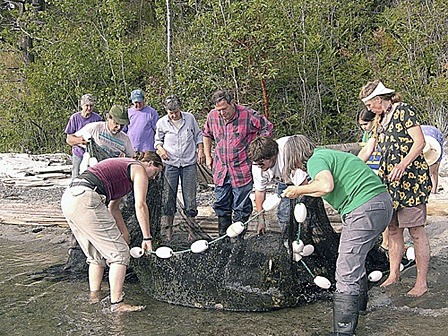
When little Ozzie the oystercatcher hatched on Indian Island this summer, his home was a busy patch of rock. Enthusiastic low tide visitors wanted to scale the island’s peak, or brought curious dogs with them, and didn’t necessarily know there was a fragile baby nestled on the isle.
Volunteers from the Indian Island Marine Health Observatory stepped in, manning watches to guard the path along the tombolo from the beach with friendly smiles and information about Ozzie and his family. Visitors and community responded positively, said Marcia Spees, a WSU Beach Watcher.
“Everyone voluntarily stayed off of the green part of the island,” she said. “Most of them were excited to learn about the oystercatchers.”
The Indian Island Marine Health Observatory is an Orcas Island group made up of graduates of the WSU Beach Watchers program, along with people from Kwiaht – The Center for Historical Ecology of the Salish Sea, more than 180 kids from Orcas schools, the Bureau of Land Management, the Land Bank and the San Juan Nature Institute.
The group began in the summer of 2009, working to identify species that could serve as valid indicators of marine ecosystem health.
The Orcas group is just one of five community monitoring groups in the San Juan Islands (on Waldron, Orcas, San Juan, and two on Lopez) that collect field data from local docks and beaches.
Representatives from the five groups gathered in Eastsound on September 15 to meet one another, share their work and dialogue with members of the San Juan County Marine Resources Committee.
Volunteers want to understand how human activities affect local marine life and share that knowledge with islanders, visitors and other researchers.
They also want to involve local kids in the discovery process; many at the meeting noted that today’s bright-eyed students of the tide-pools will be tomorrow’s marine stewardship policy-makers.
One key concept for the groups is “this idea that ordinary people in a community can be involved in actual legitimate scientific field work that has the opportunity to actually influence governmental policy,” Spees told the Sounder. “You have a whole county full of people who know a lot about the environment they live in. It’s grassroots politics.”
Lead speakers included WSU Beach Watchers coordinator Shann Weston and Russell Barsh of Kwiaht, but many volunteers also shared their experiences and ideas for the future.
Barsh said the marine monitoring network has nearly 100 volunteers, with a core of 65 very active people who conduct field and lab work each month.
“Total volunteer effort county-wide is at least 4500 hours per year,” he said. “Orcas alone is 16 core volunteers and about 1000 hours per year.”

Many of the community monitoring volunteers have attended the WSU Beach Watchers program, which offers non-scientists professional-level environmental education in exchange for volunteer hours.
Weston said she will soon be adjusting the format for Beach Watchers classes to make them more accessible.
The organizations welcome volunteers, and if marine monitoring sounds dull to you, think again; word is Barsh does a fabulous impression of an Orange Peel Nudibranch.
“It’s open to anyone who wants to volunteer,” said Spees. “Some people are just passionate about the environment and the sea.”
“Everyone involved is motivated by different things, but they’re all working towards this goal; they still work together well,” added Jeff Hanson, Outreach Coordinator for the San Juan County Marine Resources Committee.
To get involved
The website www.indianisland.info includes tide pool etiquette tips an Oh My! Biology section of color photos so visitors can get to know some of Indian Island’s inhabitants, like grunt sculpins, sea lemons, sunflower stars, decorator crabs and more. There’s even an underwater video of a sea star hunting down fleeing prey.
The San Juan County Marine Resources Committee Web site is www.sjmrc.org