Documentary filmmaker seeking islanders’ orca whale stories
Published 3:45 pm Tuesday, August 24, 2010
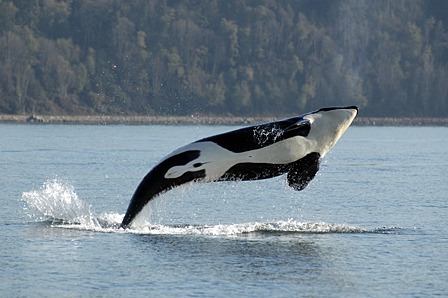
As dominant predators of the aquatic world, orca whales rule the Puget Sound with strength and benevolence.
“I think orcas are a more highly evolved life form,” said Dr. Randy Eaton, an author, filmmaker, and professor who has been studying orcas for more than 30 years. “They have an absolutely matriarchal society, which is extremely rare among mammals. Males spend their entire lives helping their mothers raise their young. The orcas consistently break all the rules we are expected to live by.”
Eaton says their relationships to coastal cultures “goes off the scale.”
“Natives in the upper British Columbia region had a treaty in ancient times between the humans and the orcas: the humans will caretake life on the land, and the orcas will take care of life in the sea,” he said.
Eaton has been in the San Juans since mid-July, working on his third documentary about a species he says has the most stable society among mammals. Entitled “Orca Spell,” the film will explore the history of orcas’ interaction with coastal peoples and modern society. Eaton recently returned from British Columbia, where he spoke to tribe members. Next on his interview list are locals Tom Averna, Denise and Dan Wilk, and Kelly Balcomb-Bartok. He invites anyone who has “stories that reveal orca intelligence and awareness” to contact him about appearing in the film. He will be on Orcas until the end of September.

Eaton began examining orcas while teaching at the University of Washington in the 1970s.
“For 10 years I had been studying large carnivores and their behavior,” he said. “I began comparing the behaviors of dominant predators of planet earth with an eye to understanding why humans were having such a hard time getting along with one another. I thought maybe other creatures who held dominant rank in their domain would provide insight.”
Eaton contrasted lions, wolves, orcas, and humans, and found something illuminating about the whales: they maintain a peaceful hierarchy.
“I couldn’t find any evidence of orcas making war upon one another, which lions, wolves, and humans all do,” Eaton said.
His new film will delve into orcas’ relationship with mankind.
“From the Makah Whalers to the Inuit, the story is the same: ‘they never attacked us, until we attacked them,’” he said. “And they only retaliated against the exact person who attacked them. (The tribes) say, ‘we’ve had peace ever since.’ To this day, among those peoples, the highest possible respect, admiration, and reverence is given to the orca whale. The Makah say the orca is one step above god.”
For 20 years, from 1976 to 1996, Eaton studied orcas in the Pacific Northwest. As president of the Orca Society, University of Washington, Eaton edited the science magazine, “Orca: Marine Mammals and Humans.” His writing has appeared everywhere from “Science and Evolution” to “Sports Illustrated” and “Magical Blend.” He has been interviewed in “Sports Illustrated,” “Saturday Review,” “Omni,” “the Los Angeles Times” and the “Washington Post.” Eaton gave a speech on ecological problems in the U.S. that was broadcast by CBS TV National News, and PBS “Nova” interviewed him about endangered species.
Eaton has held faculty positions in zoology, psychology, wildlife and humanities at the University of Washington, the University of Georgia, and Florida Atlantic University. He is winner of two national book awards as well as numerous writing and film awards. He lectures widely, and is currently based out of Cincinnati. One of Eaton’s previous documentaries, “Killer Whales and the Orca Project,” also featured Orcas Island. It aired on PBS.
“If there is a model species for humanity today, it is the orca whale,” Eaton said. “(They demonstrate) how to rule the world in peace and show immense respect for humanity, who has the potential of doing the same.”
Be a part of the film
Contact Randy Eaton at 513-300-4168 or reaton@eoni.com.