by MANDI JOHNSON
Sounder reporter
Whether he’s on Orcas or in Bali, Aleph Geddis will be working on his art.
“I have two workshops, one on Orcas and one in Bali,” said Geddis, expressing that there are many benefits to having two studios. “The two environments each inspire me in different ways and shifting places allows me to shift perspective.”
It’s no coincidence that Geddis has a workshop on both Orcas and Bali. “I’ve always been drawn to the islands,” Geddis said. “But the two environments are very different.”
On Bali, Geddis shares a studio with close friends and other artists, saying that he feels very inspired there.
“Bali is a lot busier… Orcas is more of a quiet, calming place for recharging,” he said.
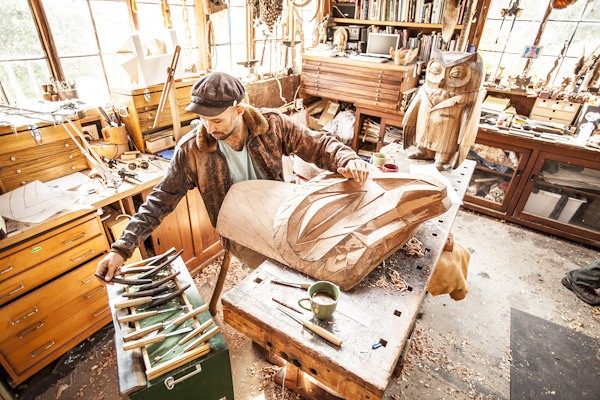
Geddis is an Orcas Island native, avid traveler and dedicated sculptor of wood. He spent many hours in his youth with his stepfather, Walter, who is also a wood sculptor. For the past 35 years, they’ve shared a carving shed on the island.
“It’s a really special place for me and having grown up here, it’s a big part of who I am as an artist,” said Geddis.
His passion for sculpting started at Waldorf School, where teachers would read as students sculpted with beeswax. He began his woodworking journey as an apprentice to his stepfather at age 20. Together they carved birds, plants and animals. This inspired Geddis to learn about the Native American arts and he began to carve masks.
With work greatly inspired by Native American tribal art of the Pacific Northwest, as well as art styles from Japan, Geddis’ works have been focused on bestiary, geometry and spoons.
As his mask carving skills evolved, the sculptures began to display Geddis’ growing interest in geometry.
“I was into math and geometry at a young age, and it has always been an influence in my work,” said Geddis. “When I was 19, I got really into sacred geometry and studying and sculpting the platonic solids.”
Masks and geometrical shapes are both relatively understandable artistic themes; but spoons?
“My spoon project stems from my desire to bring art into all aspects of my life,” Geddis said.
Spoons aren’t the only utensil he has created to unify his appreciation for the intersection of art and function. Geddis has created some of his own Native American-inspired bent knives to use in his carvings. Along with his custom-made knives, he uses a variety of gauges, chisels, knives and Japanese tools.
Geddis very rarely uses power tools in his work.
“Power tools are noisy, cause dust, and I don’t like the surface they leave on wood,” he said. “Carving is so much more intimate with hand tools; there’s nothing better than the feeling of a chip coming off with a sharp blade.”
The type of wood is important to Geddis as well. He prefers yellow cedar, big leaf maple and walnut trees for their creamy quality and ability to hold detail. He also enjoys working with wood that has irregular features, especially for his geometric pieces.
“A crack contrasts nicely against the organized structure of geometry,” Geddis said.
“In my work there’s always an interaction between hard and soft, between tension and fluidity,” he added. “Modern clean lines are mixed with something handmade, textural and timeless.”
Geddis was one of a handful of 28 young artists on display at the Bellevue Arts Museum during its “The New Frontier: Young Designer-Makers in the Pacific Northwest” exhibit, which ran from April until August last year.
When Filson, a Seattle-based clothing retailer, re-opened its newly remodeled flagship store in November 2015, included in the décor was a 18.5 foot tall totem pole designed by Geddis. He had some help carving the large commissioned piece. In the end it took a team of five carvers to complete it.
Geddis described the job as a dream project, expressing much pleasure at having gotten to work with Filson to create this unique piece.
“I feel like our styles and aesthetic really align,” he said. “So it [was] a dream project for me.”
Geddis has found success in pursuing his passion and following his dreams.
“If you’re passionate about a craft, don’t be afraid of putting in the time to master it,” he said. “These days people are so impatient with their dreams. Wood carving is something that requires ultimate patience, dedication and love of process.”