OPALCO schedules special vote on Decatur solar expansion as community members urge delay
Published 1:30 am Tuesday, April 21, 2026

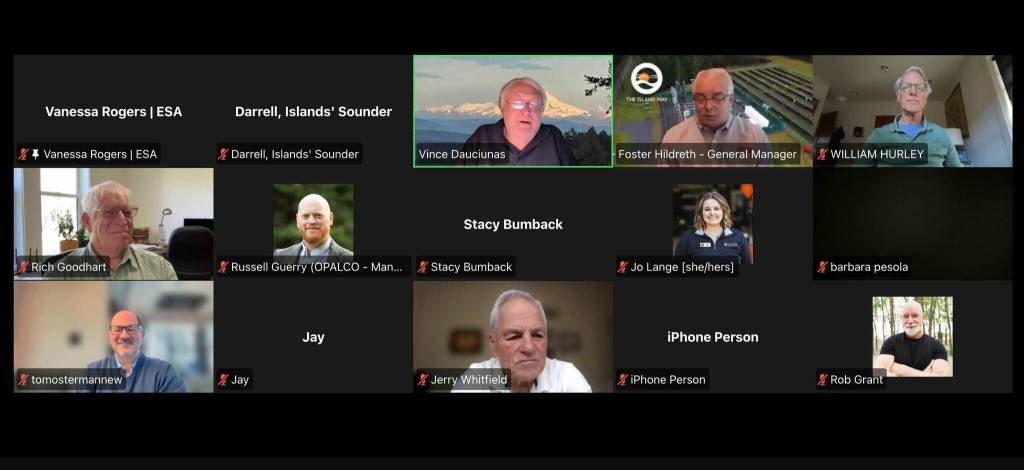


With more than 30 Decatur Island community members demanding they stop, and a board election still open until May 4, OPALCO directors met via Zoom on Thursday, April 16, and scheduled a special vote for April 21 on a $5,534,000 solar expansion project — one that community members argued was contingent, legally unsettled and still awaiting a Conditional Use Permit.
The project, a proposed expansion of OPALCO’s existing Community Solar site on Decatur Island, would add up to 4,450 panels producing an estimated 2,883,091 kWh annually. Staff presented five build options and recommended the largest, contingent on revision of a Native Growth Area covenant recorded on the property. The special meeting on April 21, from 10-11 a.m., is open to the public but reserved for board members to discuss and vote on the project. There will be no member comment period at that meeting.
Community members push back
The member comment period drew sustained opposition from Decatur Island residents. More than 30 community members and OPALCO member-owners signed a letter asking the board to defer the vote. The threshold question, they wrote, is “whether directors of a member-owned nonprofit cooperative should allow a vote to proceed on April 21 on a project that staff’s own packet presents as contingent, incomplete, legally unsettled, and still dependent on future alteration of recorded site constraints, during an election that remains open until May 4, with results announced at the May 7 annual meeting.”
Residents cited OPALCO’s own survey showing only 13% support for siting solar on forested lands, and argued the project “does not cleanly fit the Decatur site as it exists today.”
Community member Alan Mizuta told the board that “1.1 million dollars in public and member money was spent before the underlying land use and environmental restrictions were even identified.” He asked the board to “delay the April 21st special meeting until late May — let the new board be seated, let the hearing examiner rule, let the appeals landscape become clear.”
Decatur residents Bill Hurley and Dawni Cunnington co-presented a formal slide presentation to the board, delivering some of the sharpest criticism of the day. “We are not opposed to solar,” Cunnington told the board. “We are opposed to spending co-op money to clear-cut environmentally protected land in order to install solar panels that will be shaded on four sides by tall trees and second growth forest.” She charged that “management raced to spend co-op funds on a parcel without even a normal feasibility period to determine if the site was suitable for this use,” adding that two recorded environmental deed restrictions “were evident on the title report prior to purchase — who doesn’t read their title report? That’s exceedingly sloppy.” Hurley pressed the financial case, arguing that energy production is “overstated by 23 percent” due to shading from adjacent trees, that the project “adds only one percent to the county demand — hence does not improve reliability,” and that without battery storage, “it does not provide the resilience that is important to solar energy installations.” He told the board flatly: “The actual payback will be more like 30 years. The grants are not in hand. There’s no guarantee that the grants will be coming.”
Other Decatur Island residents and OPALCO members added their voices to the opposition. Charlie Conway, who filed a SEPA appeal and said he was “able to demonstrate in sworn testimony that neither wildfire nor stormwater control issues were fully addressed by appropriate subject matter experts,” told the board that OPALCO management “had no intention of implementing any of the community’s substantive recommendations” and that the completed design “maxes out the available space right up to the wetland setbacks and right up to the property lines, where solar panels will be installed at the base of 70-foot trees.” Joanne Pierson, an OPALCO member since the mid-1960s, said management’s meetings felt like “you’re just supposed to accept what we say and we don’t have to explain what we’re doing.” Kendra Lamb warned the board to “consider the million dollars versus the trust that’s being eroded in OPALCO,” noting that “at least 87 percent of the people don’t want it.” Debbie Warren said, “No business — no private business, no corporate business — would make such fundamental decisions without all the information.” Rob Grant, a solar investor and full-time Decatur resident who described himself as pro-solar, said “today’s situation with the board feels like a rush job,” and that one word came to mind listening to OPALCO’s consultants: “disingenuous.” Karen Pearson called the proceedings “a complete abuse of power — the change in narrative, the redefinition of laws, and the submittal for the laws to bend in favor of the project rather than reassessing the project to fit the procedures all culminate in an abuse of power.” Dennis Jenkins, who lives directly across from the existing solar panels, told the board: “For these past eight years I have walked by the forest OPALCO proposes to cut down. This is my neighborhood where I live. This is my home and OPALCO wants to destroy it.” And Shawn Campbell, a San Juan County Public Works equipment operator, raised a stormwater concern the consultants had not addressed: “A large portion — maybe half of that solar project’s area — flows directly into an HOA of Decatur Shores, and I don’t believe Decatur Shores has had any requests from OPALCO to do any improvements to handle the increased amount of water flow.”
Outside land use counsel Clara Park, an OPALCO consultant who attended the meeting, told the board that OPALCO originally applied for a provisional use permit, but the County determined the project required a Conditional Use Permit, triggering a public hearing held over two days on Feb. 25 and March 6. Two SEPA appeals were filed by Decatur Island residents Charles Conway and Alan Mizuta, though Park noted that the majority of public comments submitted for the hearing were in support of the project and that the County asked the hearing examiner to deny the appeals. On the Native Growth Area covenant, Park said neither OPALCO nor the County were aware of the recorded documents until early February — just before the hearing — and that County staff has since confirmed both the native growth area and the simple land division can be modified, with OPALCO proposing to expand the NGA from 3.82 to 4.07 acres while keeping all solar panels in place.
OPALCO consultant and environmental planner Vanessa Rogers of Environmental Science Associates told the board that wetland scientists delineated nine wetlands on the site, and the project was designed to fully avoid all wetlands and their regulatory buffers, with the County determining the project will not have a probable significant adverse impact on the environment. Rogers added that fire risk on the site is very low, incorporating class A fire-rated materials and automated thermal cameras, and that all stormwater impacts will be effectively managed on site with no adverse effects to adjoining properties.
OPALCO consultant Stacy Bumback of ESA, also a co-op member who lives part-time on Crane Island, told the board that a cultural resources and tribal resources assessment was conducted per the requirements of Section 106 of the National Historic Preservation Act, with six tribes consulted and the Suquamish tribe most engaged, ultimately confirming a finding of no historic properties affected. “I personally was on site looking at the glacial deposits and the previous disturbance and ultimately we concluded with that the project had a very limited potential for significant resources to be present,” Bumback said. “Everything, you know, combined what we decided and we worked closely with DAP and the tribes on this is that we would prepare an inadvertent discovery plan during construction, because there’s always a chance that something could get found during construction.”
Board President Vince Dauciunas, noting it was his last full board meeting before retirement, framed the broader stakes: “The state wants the outcomes, counties control the map, utilities carry the risk, and the public often rejects the footprint. Until those four pieces are aligned, Washington will keep producing plans, studies, and promises faster than it produces actual power and transmission.”
The special OPALCO Board Meeting will be held via Zoom on April 21 at 10 a.m.
Dauciunas bids farewell at County Council, issues energy warning
Four days later, on Monday, April 20, outgoing OPALCO Board President Vince Dauciunas appeared before the San Juan County Council — using the occasion of his retirement recognition to deliver a sweeping warning about the future of energy in the San Juan Islands.
Dauciunas, 15 years on the OPALCO board and board president for the last 10, opened with: “I spent last night studying the retirement speeches of various presidents. Eisenhower and Nixon came to mind — one was warning about the military industrial complex, and then when Nixon didn’t make it for governor, he said you won’t have a Dick [Nixon] to kick around anymore. So I’m not sure what to take away from those, but I got it. So I prepared some remarks.”
He then paid tribute to General Manager Foster Hildreth. “I’d like to recognize and thank Foster Hildreth, who I worked with closely for nearly all of these 15 years,” he said. “We’ve added more than a few gray hairs together.”
He then warned the Council that “the information I’m going to present this morning is not available to you by reading the local times or the local social media. It’s buried deep in obscure reports and websites and requires persistent digging to get to the nuggets. To wit, I’ve accumulated over 2,000 documents and 10 gigabytes of stuff since 2018 related to the subject.”
The numbers he laid out were stark. Commerce’s 2024 report to the Legislature shows raw electric load doubling by 2050, requiring “something like 10,000 to 12,000 megawatts of combined wind and solar nameplate” — land equivalent to “up to 650,000 acres or 1,000 square miles — approximately 12 times the size of metropolitan Seattle or seven times the size of Portland.” Meanwhile, actual data from the Energy Information Agency shows net generating capacity in Washington state from 2019 through 2025 is “astonishing — negative several hundred megawatts.” He told the Council flatly that “the state has not created a credible pathway to permit and build what the law requires.”
“If Washington badly misses these build-out goals,” he said, “the result is not just an embarrassment in policy. It means the state likely gets the worst of all worlds — higher greenhouse gas emissions than promised, higher electric rates, and greater adequacy risk.”
Then he turned to what troubles him most. “What troubles me most is not just the policy gap, it’s the awareness gap. I do not believe the state government, county governments or the public yet have more than the vaguest notion of the scale of the problem now bearing down on us. We passed laws, adopted plans, written climate elements, repeated ambitious goals, but that’s not the same thing as securing actual electric supply transmission and infrastructure. To borrow from the musical, ‘The Music Man,’ we’ve got trouble right here in River City. And far too many people think the band can tune up later.”
His request to the Council was direct: “Recognize electric power as essential infrastructure. Work with Opalco as a planning partner. Modify the code and policy barriers that block local generation, storage and grid facilities. Require honest infrastructure analysis in the action plans supporting the comprehensive plan and climate element. And advocate at the state and federal level for the permitting, transmission and, most importantly, the funding necessary to keep the county reliable. Don’t treat energy adequacy as somebody else’s problem.”
He closed with confidence: “I believe San Juan County can face the hard truths, make sound decisions and do what responsible communities do — prepare, build, adapt and endure.” He noted that “this county is small enough, practical enough and close enough to the consequences of its own decisions to do better than much of the rest of the state. San Juan County has smart people, capable institutions and a community that knows how to pull together when something truly matters. Opalco has talented people, dedicated crews and a long tradition of solving hard problems and difficult conditions.” Then, borrowing from another musical: “Goodbye, farewell, Auf Wiedersehen to you.”
Council members respond
Council member Kari McVeigh was direct. “This was billed as a recognition of retirement for Vince, not a professor or a lecture,” she said. “So that’s a little surprising to me to hear that. I’m not sure that this is the right forum — which is not to say I don’t think conversations need to happen. I absolutely do think they need to happen.” She added that “Opalco needs to be open to a really strong and strenuous public engagement around these — not just telling them what to do, but actually listening to the fears and figuring out how we can mitigate against those.”
Council member Jane Fuller embraced Dauciunas’ message while urging a change in approach. “I’ve deeply appreciated the intellect that you bring to conversation about our future challenges,” she said. “I’ve seen the dissension just grow and grow and grow. We have to lean into meaningful collaborative dialogue in a way we haven’t before — finding solutions to diverging viewpoints and a pathway forward to achieve some meaningful goals.” She said she would “welcome the opportunity to have a conversation with the board once those two new people are brought on board,” adding: “I think it’s really important that we take stock of how we work differently together in the future, listening to our community.”
Council Chair Justin Paulsen closed with the lesson he drew from Dauciunas’ tenure. “We have realized just how fragile our energy world is when something halfway around the world can interrupt the global energy supply so radically,” he said, embracing Dauciunas’ core warning: “Goals without policy is just hope, or some version of that. And we can’t continue to base our resiliency on hope.” He ended with a call to the state: “We have a county that is ready and willing and wants to build resiliency. We need the state to give us the ability to do that. We can’t do it on the backs of just the residents here. We need cooperation from the state.”