Ferry reservation modernization project sinks after contract cancellation
Published 1:30 am Friday, April 17, 2026
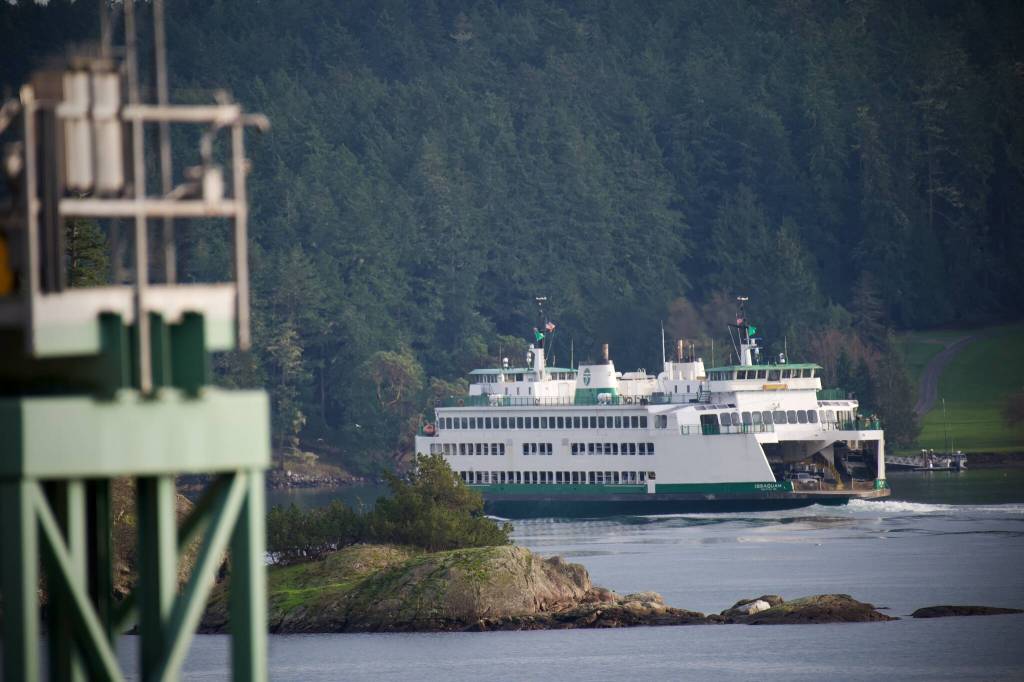
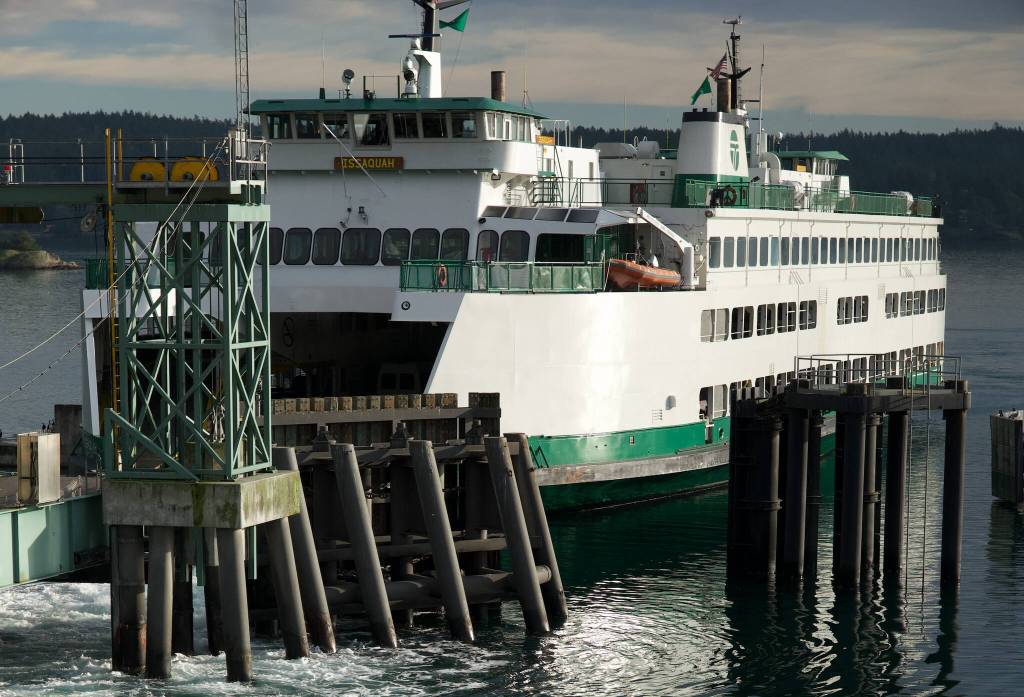


Washington State Ferries has terminated its contract with Anchor Operating System, the vendor hired in January 2025 to modernize the agency’s ticketing and reservations platform — a costly and contentious end to a project already more than a year behind schedule, and one that raises serious questions about transparency, user testing and how a multimillion-dollar public technology project went so wrong so quietly.
The Sounder began investigating in December, after San Juan Island resident and User Experience & Computer Consultant David Robison contacted the paper. Robison had been monitoring the project’s risk rating on the Washington State Information Technology Project Dashboard and had already written to Gov. Ferguson on Oct. 29, warning that it had shifted from medium to high in June and never recovered. The contract termination followed in March 2026.
The Sounder contacted Dana L. Warr, deputy director of external relations for WSF, about a phone call between John Vezina, the assistant secretary of Washington State Ferries, and Anchor Systems co-founder and CEO Nasi Peretz. Warr replied by email, confirming the call and providing financial details of the project.
Washington State Ferries, Warr wrote, was “no longer confident Anchor could provide a reliable system with sufficient operational support across our 20 terminals.” Anchor had been required to deploy a proof-of-concept on the Port Townsend/Coupeville route by May 2025, with further deployments that fall. Neither deadline was met.
The contract was formally terminated on March 20. Warr disclosed that the full project is funded at approximately $22 million — significantly higher than the $8.7 million previously cited publicly.
Warr added that WSF spent $773,000 on the Anchor contract, of which $432,000 is considered reusable. But Robison, who attended the Ferry Advisory Committee meeting on April 8 and pressed for a fuller accounting, says those figures tell only part of the story.
Additional costs included Stellar Associates, an external quality assurance firm, plus staff time from project manager Jeff Masumoto and other WSF and Washington State Department of Transportation personnel. Robison, who has been monitoring the project on the Washington State Information Technology Project Dashboard, noted that the overall cost figures he observed ranged from $1.5 million to $3 million over the course of the project.
As of April 10, the dashboard lists an “Actual Spend” of $3,195,547 — more than four times the $773,000 WSF has cited publicly as the cost of the Anchor contract. The full tally remains unclear.
Anchor’s rebuttal
Anchor pushed back sharply. In interviews and written statements to The Sounder, co-founder and CEO Nasi Peretz called points five and six of the termination letter “an outright dishonest statement,” writing that reliability concerns “were never and continue to not be brought as a concern.”
WSF had purchased Anchor’s equipment and hardware at its own request, Peretz noted. A third-party quality assurance company found no high or critical bugs in the platform. Peretz disputed the claim that Anchor never conducted user testing, saying the mobile app underwent three independent rounds selected by the state, earning top satisfaction scores. He said his team would have welcomed community involvement all along: “The mobile application in its test flight mode is available for anyone to test. I can add ten people from the [Ferry Advisory] committee so that they can test in our playground, in our sandbox.”
Anchor Head of Sales Dustin Mantell added that feedback from WSF throughout the engagement had been consistently positive, pointing to former Project Manager Dwayne Moats: “From his vantage point, there was clear satisfaction with the progress and outcomes delivered by Anchor.”
Moats, whose own contract was abruptly terminated by Masumoto on Nov. 26, 2025, offered a strikingly different account of the project’s collapse.
Anchor, he said, had been a committed partner from the start — engaging before the contract was signed, working essentially for free with payment tied to a successful launch, and purchasing all hardware at cost with no profit. The problems stemmed from Masumoto, who repeatedly expanded scope, delayed a critical contract amendment that froze key deliverables and — after a steering committee voted to stay with Anchor — assembled a list of technical “showstoppers” with a two-week deadline to satisfy them. Total resource spend across contractors and WSF staff was approaching $2 million when he left — far exceeding the $773,000 WSF has cited publicly.
“I believe the best path forward would have been to let Anchor finish,” he said. “They had worked for free. They had accommodated the multi-system and other emerging needs not covered in the Request for Proposal (RFP). They were nearly done.”
What the independent review found
The full extent of the project’s management failures has now been laid bare by an independent quality assurance review by Stellar Associates.
In its Lessons Learned Report dated March 18, 2026, prepared for Washington State Ferries’ Ticketing and Reservation Modernization Project, Stellar Associates — the same external QA firm whose costs Robison noted were absent from WSF’s public accounting — drew on interviews with 14 project participants to deliver a detailed assessment. The report describes a project undermined from the start by rushed procurement that prioritized low cost over vendor capability, a project charter approved only after a vendor was already selected and an unrealistic schedule driven by wishful thinking rather than data. Basic project management tools, such as a RACI chart and a completed Project Management Plan, were never put in place.
Key roles — including a test manager, technical architect and scrum master — were either never filled or brought on too late to be effective. The Agile framework, widely regarded as essential for complex software projects, was not introduced until late 2025, well into the project’s lifecycle. The vendor, meanwhile, frequently failed to deliver working software during sprints, repeatedly reintroduced defects into the codebase and at times effectively directed the project’s priorities rather than WSF leadership.
With the vendor contract now terminated and a $450,000 termination payment issued, WSF must restart its modernization efforts — having spent roughly $2.8 million of its $8.8 million budget with nothing yet implemented.
A community left in the dark
The termination hit hardest in the San Juan Islands, where residents and elected officials had spent more than a year asking for a seat at the table and had received almost nothing. San Juan County Council member Justin Paulsen, who serves on the Ferry Advisory Committee, said the silence was total from the outset.
“The ferry advisory committees in both San Juan County and in Jefferson County have been asking for and offering to be user evaluators, user testers, from day one,” he said.
Kari McVeigh, the San Juan County Council liaison to the FAC, said the FAC received only a canned, pre-recorded demonstration in February — weeks before the termination.
At the Ferry Advisory Committee meeting on April 8, McVeigh pressed WSF liaison Tali Teal directly on what had gone wrong and what assurances the community had that the same mistakes would not be repeated in the next procurement.
Teal’s response offered little comfort: “I don’t have a good answer for you other than what we’ve already been able to share.”
Robison said the failure was rooted in how the project was conceived. Early-stage wireframe testing would have surfaced problems cheaply — and avoided what he called “perception of completeness bias,” the unconscious reluctance of users to criticize a finished-looking product.
Traditional “Waterfall” development delivers a project as one large package, leaving stakeholders in the dark until the end. Agile frameworks break work into small continuous deliverables, each tested before the next begins — keeping failures small and correctable rather than catastrophic.
Carson Scheidel, founder of SmartStubs and a competing RFP bidder on the project, said this project is a textbook case of what happens when that [Agile product development] process is bypassed.
“That iterative cycle has to include user feedback, because otherwise, who are you talking to?” said Scheidel. “We always go for the minimum viable product (MVP) — something that hits all the buttons but isn’t necessarily fancy.”
Notably, Peretz himself said Anchor operates on this model: “We don’t use Waterfall (traditional project management). We’ve been agile in methodology.”
The gap between Anchor’s account and the community’s experience points to a breakdown that WSF has yet to fully explain. McVeigh was blunt: “It’s now going to be pushed out till as early as 2028. Not to be transparent about what went wrong … we have to make sure we don’t do it again.”